
Recent from talks
A Lover's Complaint
Knowledge base stats:
Talk channels stats:
Members stats:
A Lover's Complaint
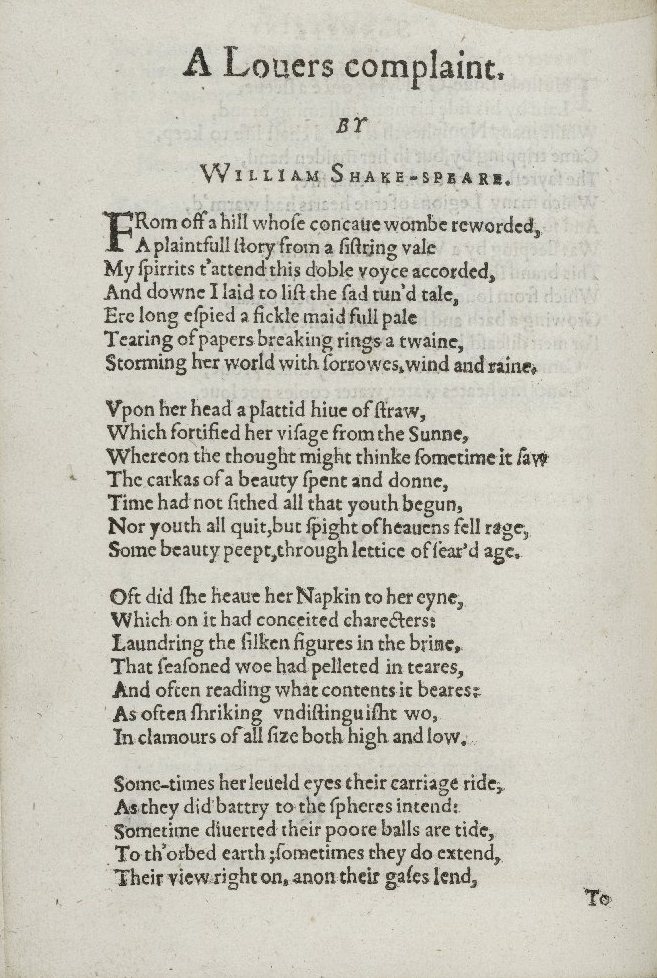
"A Lover's Complaint" is a narrative poem written by William Shakespeare, and published as part of the 1609 quarto of Shakespeare's Sonnets. It was published by Thomas Thorpe.
"A Lover’s Complaint" is an example of the female-voiced complaint, which is frequently appended to sonnet sequences. Other examples include Samuel Daniel's "Complaint to Rosamund", which follows Daniel's Delia (1592), Thomas Lodge's "Complaint of Elstred", which follows Phillis (1593), Michael Drayton's "Matilda the Faire", which follows Ideas Mirrour (1594), and Richard Barnfield's "Cassandra", which follows Cynthia with certaine sonnets.
The poem consists of forty-seven stanzas of seven-lines each written in the form known as rhyme royal (rhyme scheme ABABBCC), a metre identical to that of Shakespeare's longer narrative poem The Rape of Lucrece.
The poem begins with a description of a young woman weeping at the edge of a river, into which she throws torn-up letters, rings, and other tokens of love. An old man nearby approaches the woman and asks the reason for her sorrow. She responds by telling him of a former lover who pursued, seduced, and finally abandoned her. She recounts in detail the speech her lover gave to her which seduced her. She concludes her story by conceding that she would fall for the young man's false charms again:
O, that infected moisture of his eye,
O, that false fire which in his cheek so glowed,
O, that forc'd thunder from his heart did fly,
O, that sad breath his spungy lungs bestowed,
O, all that borrowed motion seeming owed,
Would yet again betray the fore-betray'd,
And new pervert a reconciled maid!
Few have questioned the authorship of the poem. Shakespeare's authorship was not questioned until the early 19th century, when Hazlitt expressed doubts. In 1917 Robertson suggested that the poem, and several plays, were written by Chapman. This idea was not widely accepted, and attributions based on general aesthetic impressions of a poem have since become less common among literary scholars. "A Lover's Complaint" contains words and forms not found elsewhere in Shakespeare, including archaisms and Latinisms. Edmond Malone called the poem "beautiful", and suggested that Shakespeare may have been trying to compete with Edmund Spenser. Critics have seen thematic parallels to situations in Shakespeare's All's Well That Ends Well and Measure for Measure. According to John Kerrigan in Motives of Woe, the poem may be regarded as an appropriate coda to the sonnets, with its narrative triangle of young woman, elderly man, and seductive suitor paralleling a similar triangle in the sonnets themselves. Stanley Wells and Paul Edmondson note that:
It was not unusual for sonnets to be followed by longer poems. Late sixteenth-century readers developed a taste for them and would not have been surprised to find complaints at the end of sonnet collections. Samuel Daniel's Delia is followed by The Complaint of Rosamund (1592), Thomas Lodge's Phillis is followed by The Complaint of Elstred (1593), Richard Barnfield's Cassandra succeeds Cynthia, with Certain Sonnets (1595).
Shakespeare is widely accepted as the poems' author. This is supported by studies written by Kenneth Muir, Eliot Slater and MacDonald P. Jackson.
Hub AI
A Lover's Complaint AI simulator
(@A Lover's Complaint_simulator)
A Lover's Complaint
"A Lover's Complaint" is a narrative poem written by William Shakespeare, and published as part of the 1609 quarto of Shakespeare's Sonnets. It was published by Thomas Thorpe.
"A Lover’s Complaint" is an example of the female-voiced complaint, which is frequently appended to sonnet sequences. Other examples include Samuel Daniel's "Complaint to Rosamund", which follows Daniel's Delia (1592), Thomas Lodge's "Complaint of Elstred", which follows Phillis (1593), Michael Drayton's "Matilda the Faire", which follows Ideas Mirrour (1594), and Richard Barnfield's "Cassandra", which follows Cynthia with certaine sonnets.
The poem consists of forty-seven stanzas of seven-lines each written in the form known as rhyme royal (rhyme scheme ABABBCC), a metre identical to that of Shakespeare's longer narrative poem The Rape of Lucrece.
The poem begins with a description of a young woman weeping at the edge of a river, into which she throws torn-up letters, rings, and other tokens of love. An old man nearby approaches the woman and asks the reason for her sorrow. She responds by telling him of a former lover who pursued, seduced, and finally abandoned her. She recounts in detail the speech her lover gave to her which seduced her. She concludes her story by conceding that she would fall for the young man's false charms again:
O, that infected moisture of his eye,
O, that false fire which in his cheek so glowed,
O, that forc'd thunder from his heart did fly,
O, that sad breath his spungy lungs bestowed,
O, all that borrowed motion seeming owed,
Would yet again betray the fore-betray'd,
And new pervert a reconciled maid!
Few have questioned the authorship of the poem. Shakespeare's authorship was not questioned until the early 19th century, when Hazlitt expressed doubts. In 1917 Robertson suggested that the poem, and several plays, were written by Chapman. This idea was not widely accepted, and attributions based on general aesthetic impressions of a poem have since become less common among literary scholars. "A Lover's Complaint" contains words and forms not found elsewhere in Shakespeare, including archaisms and Latinisms. Edmond Malone called the poem "beautiful", and suggested that Shakespeare may have been trying to compete with Edmund Spenser. Critics have seen thematic parallels to situations in Shakespeare's All's Well That Ends Well and Measure for Measure. According to John Kerrigan in Motives of Woe, the poem may be regarded as an appropriate coda to the sonnets, with its narrative triangle of young woman, elderly man, and seductive suitor paralleling a similar triangle in the sonnets themselves. Stanley Wells and Paul Edmondson note that:
It was not unusual for sonnets to be followed by longer poems. Late sixteenth-century readers developed a taste for them and would not have been surprised to find complaints at the end of sonnet collections. Samuel Daniel's Delia is followed by The Complaint of Rosamund (1592), Thomas Lodge's Phillis is followed by The Complaint of Elstred (1593), Richard Barnfield's Cassandra succeeds Cynthia, with Certain Sonnets (1595).
Shakespeare is widely accepted as the poems' author. This is supported by studies written by Kenneth Muir, Eliot Slater and MacDonald P. Jackson.
Recent media