



Community hub
Recent from talks
Contribute something to knowledge base
Content stats: 0 posts, 0 articles, 1 media, 0 notes
Members stats: 0 subscribers, 0 contributors, 0 moderators, 0 supporters
Subscribers
Supporters
Contributors
Moderators
Hub AI
Adherens junction AI simulator
(@Adherens junction_simulator)
Hub AI
Adherens junction AI simulator
(@Adherens junction_simulator)
Adherens junction
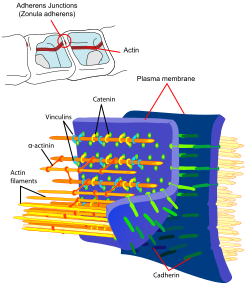
In cell biology, adherens junctions (or zonula adherens, intermediate junction, or "belt desmosome") are protein complexes that occur at cell–cell junctions and cell–matrix junctions in epithelial and endothelial tissues, usually more basal than tight junctions. An adherens junction is defined as a cell junction whose cytoplasmic face is linked to the actin cytoskeleton. They can appear as bands encircling the cell (zonula adherens) or as spots of attachment to the extracellular matrix (focal adhesion).
Adherens junctions uniquely disassemble in uterine epithelial cells to allow the blastocyst to penetrate between epithelial cells.
A similar cell junction in non-epithelial, non-endothelial cells is the fascia adherens. It is structurally the same, but appears in ribbonlike patterns that do not completely encircle the cells. One example is in cardiomyocytes.
Adherens junctions are composed of the following proteins:
Adherens junctions were, for many years, thought to share the characteristic of anchor cells through their cytoplasmic actin filaments.[citation needed]
Adherens junctions may serve as a regulatory module to maintain the actin contractile ring with which it is associated in microscopic studies.[citation needed]
Adherens junction
In cell biology, adherens junctions (or zonula adherens, intermediate junction, or "belt desmosome") are protein complexes that occur at cell–cell junctions and cell–matrix junctions in epithelial and endothelial tissues, usually more basal than tight junctions. An adherens junction is defined as a cell junction whose cytoplasmic face is linked to the actin cytoskeleton. They can appear as bands encircling the cell (zonula adherens) or as spots of attachment to the extracellular matrix (focal adhesion).
Adherens junctions uniquely disassemble in uterine epithelial cells to allow the blastocyst to penetrate between epithelial cells.
A similar cell junction in non-epithelial, non-endothelial cells is the fascia adherens. It is structurally the same, but appears in ribbonlike patterns that do not completely encircle the cells. One example is in cardiomyocytes.
Adherens junctions are composed of the following proteins:
Adherens junctions were, for many years, thought to share the characteristic of anchor cells through their cytoplasmic actin filaments.[citation needed]
Adherens junctions may serve as a regulatory module to maintain the actin contractile ring with which it is associated in microscopic studies.[citation needed]
Recent media
Recent media