
Recent from talks
Album-equivalent unit
Knowledge base stats:
Talk channels stats:
Members stats:
Album-equivalent unit
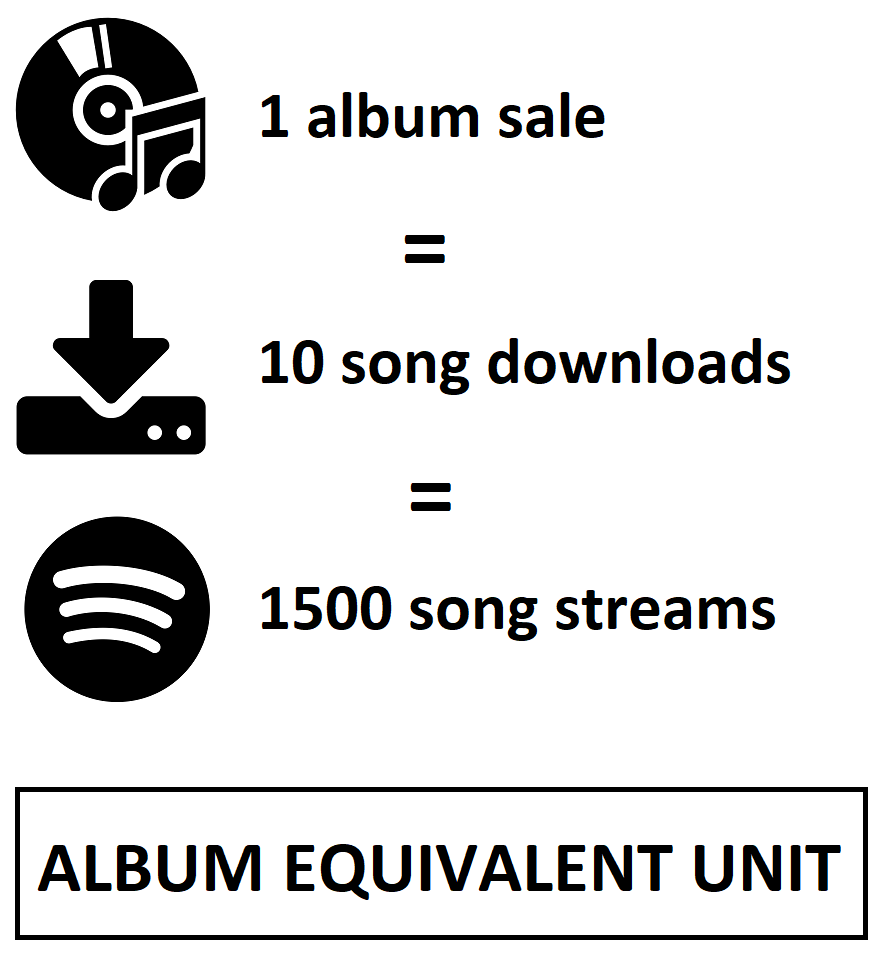
The album-equivalent unit, or album equivalent, often shortened to just unit, is a sales metric in the music industry that defines the number of songs streamed and songs downloaded equal to one album sale. The album-equivalent unit was introduced in the mid-2010s as an answer to the drop of album sales in the 21st century. Album sales more than halved from 1999 to 2009, declining from a $14.6 to $6.3 billion industry, partly due to cheap digitally downloaded singles. For instance, the only albums that went platinum in the United States in 2014 were the Frozen soundtrack and Taylor Swift's 1989, whereas several albums had gone platinum in 2013.
The use of album-equivalent units transformed the music charts from a ranking of best-selling albums into a ranking of most popular albums. The International Federation of the Phonographic Industry (IFPI) have used album-equivalent unit to measure their Global Recording Artist of the Year since 2013.
The term album-equivalent unit had been used by the International Federation of the Phonographic Industry (IFPI) long before the streaming era began. Between 1994 and 2005, the IFPI counted three physical singles as an equivalent of one album unit in their annual Recording Industry in Numbers (RIN) report. The term was reintroduced by the IFPI in 2013 to measure their Global Recording Artist of the Year. By this point, the album-equivalent units had already included music downloads and streams. An alternative term of album equivalent unit is sales plus streaming (SPS) unit, which was introduced by Hits magazine.
Beginning with the December 13, 2014 issue, the Billboard 200 albums chart revised its ranking methodology with album-equivalent unit instead of pure album sales. With this overhaul, the Billboard 200 includes on-demand streaming and digital track sales (as measured by Nielsen SoundScan) by way of a new algorithm, using data from all of the major on-demand audio subscription services including Spotify, Apple Music, Google Play, YouTube and formerly Xbox Music. Known as TEA (track equivalent album) and SEA (streaming equivalent album) when originally implemented, 10 song sales or 1,500 song streams from an album were treated as equivalent to one purchase of the album. Billboard continues to publish a pure album sales chart, called Top Album Sales, that maintains the traditional Billboard 200 methodology, based exclusively on Nielsen SoundScan's sales data. Taylor Swift's 1989 was the first album to top the chart with this methodology, generating 339,000 album-equivalent units (281,000 units came from pure album sales). In Billboard's February 8, 2015, issue, Now That's What I Call Music! 53 became the first album in history to miss the top position of the Billboard 200 despite being the best-selling album of the week.
Similarly the Recording Industry Association of America, which had previously certified albums based on units sold to retail stores, began factoring streaming for their certifications in February 2016.
RIAA summary by format, in million copies per year.
In July 2018, Billboard and Nielsen revised the ratios used for streaming equivalent album units to account for the relative value of streams on paid music services like Apple Music or Amazon Music Unlimited versus ad-supported music and video platforms such as Spotify's free tier and YouTube. Under the updated album equivalent ratios, 1,250 premium audio streams, 3,750 ad-supported streams, or 3,750 video streams are equal to one album unit.
In the United Kingdom, the Official Charts Company has included streaming into the UK Albums Chart since March 2015. The change was decided after the massive growth of streaming; the number of tracks streamed in the UK in a year doubled from 7.5 billion in 2013 to just under 15 billion in 2014. Under the new methodology, Official Charts Company takes the 12 most-streamed tracks from an album, with the top two songs being given lesser weight so that the figure will reflect the popularity of the album as a whole rather than of one or two successful singles. The adjusted total is divided by 1000 and added to the album sales figure. Sam Smith's In the Lonely Hour was the first album to top the chart with this rule. Out of its 41,000 album-equivalent units, 2,900 units came from streaming and the rest were pure sales. By 2017, streaming had accounted more than half of album-equivalent units in the UK, according to British Phonographic Industry (BPI).
Hub AI
Album-equivalent unit AI simulator
(@Album-equivalent unit_simulator)
Album-equivalent unit
The album-equivalent unit, or album equivalent, often shortened to just unit, is a sales metric in the music industry that defines the number of songs streamed and songs downloaded equal to one album sale. The album-equivalent unit was introduced in the mid-2010s as an answer to the drop of album sales in the 21st century. Album sales more than halved from 1999 to 2009, declining from a $14.6 to $6.3 billion industry, partly due to cheap digitally downloaded singles. For instance, the only albums that went platinum in the United States in 2014 were the Frozen soundtrack and Taylor Swift's 1989, whereas several albums had gone platinum in 2013.
The use of album-equivalent units transformed the music charts from a ranking of best-selling albums into a ranking of most popular albums. The International Federation of the Phonographic Industry (IFPI) have used album-equivalent unit to measure their Global Recording Artist of the Year since 2013.
The term album-equivalent unit had been used by the International Federation of the Phonographic Industry (IFPI) long before the streaming era began. Between 1994 and 2005, the IFPI counted three physical singles as an equivalent of one album unit in their annual Recording Industry in Numbers (RIN) report. The term was reintroduced by the IFPI in 2013 to measure their Global Recording Artist of the Year. By this point, the album-equivalent units had already included music downloads and streams. An alternative term of album equivalent unit is sales plus streaming (SPS) unit, which was introduced by Hits magazine.
Beginning with the December 13, 2014 issue, the Billboard 200 albums chart revised its ranking methodology with album-equivalent unit instead of pure album sales. With this overhaul, the Billboard 200 includes on-demand streaming and digital track sales (as measured by Nielsen SoundScan) by way of a new algorithm, using data from all of the major on-demand audio subscription services including Spotify, Apple Music, Google Play, YouTube and formerly Xbox Music. Known as TEA (track equivalent album) and SEA (streaming equivalent album) when originally implemented, 10 song sales or 1,500 song streams from an album were treated as equivalent to one purchase of the album. Billboard continues to publish a pure album sales chart, called Top Album Sales, that maintains the traditional Billboard 200 methodology, based exclusively on Nielsen SoundScan's sales data. Taylor Swift's 1989 was the first album to top the chart with this methodology, generating 339,000 album-equivalent units (281,000 units came from pure album sales). In Billboard's February 8, 2015, issue, Now That's What I Call Music! 53 became the first album in history to miss the top position of the Billboard 200 despite being the best-selling album of the week.
Similarly the Recording Industry Association of America, which had previously certified albums based on units sold to retail stores, began factoring streaming for their certifications in February 2016.
RIAA summary by format, in million copies per year.
In July 2018, Billboard and Nielsen revised the ratios used for streaming equivalent album units to account for the relative value of streams on paid music services like Apple Music or Amazon Music Unlimited versus ad-supported music and video platforms such as Spotify's free tier and YouTube. Under the updated album equivalent ratios, 1,250 premium audio streams, 3,750 ad-supported streams, or 3,750 video streams are equal to one album unit.
In the United Kingdom, the Official Charts Company has included streaming into the UK Albums Chart since March 2015. The change was decided after the massive growth of streaming; the number of tracks streamed in the UK in a year doubled from 7.5 billion in 2013 to just under 15 billion in 2014. Under the new methodology, Official Charts Company takes the 12 most-streamed tracks from an album, with the top two songs being given lesser weight so that the figure will reflect the popularity of the album as a whole rather than of one or two successful singles. The adjusted total is divided by 1000 and added to the album sales figure. Sam Smith's In the Lonely Hour was the first album to top the chart with this rule. Out of its 41,000 album-equivalent units, 2,900 units came from streaming and the rest were pure sales. By 2017, streaming had accounted more than half of album-equivalent units in the UK, according to British Phonographic Industry (BPI).
Recent media