



Community hub
Community hub
Recent from talks
Knowledge base stats:
Talk channels stats:
Members stats:
Alstom Coradia LINT
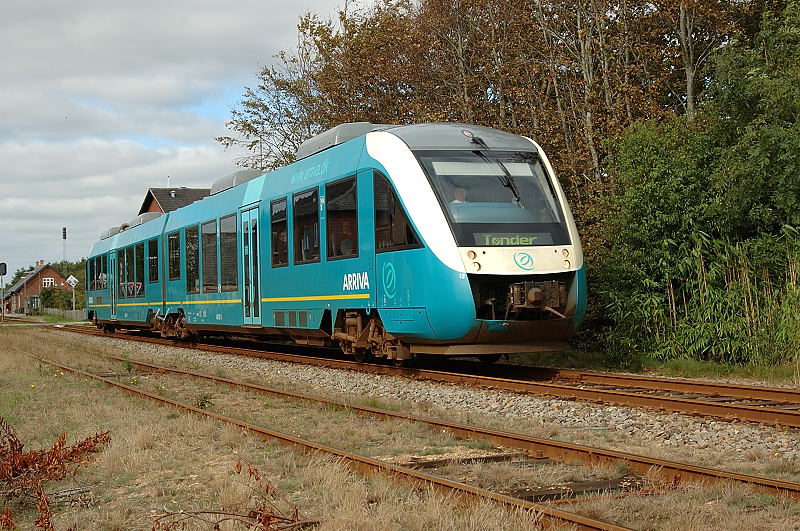
The Alstom Coradia LINT is an articulated railcar of the Alstom Coradia family manufactured by Alstom since 1999, offered in diesel and hydrogen vehicle models. The acronym LINT is short for the German "leichter innovativer Nahverkehrstriebwagen" (light innovative local transport rail vehicle). It was designed by Linke-Hofmann-Busch (LHB; acquired 1996 by Alstom) and has been distributed as part of Alstom's Coradia family.
The type designation gives the vehicle's length: the one-piece type LINT 27 has a length of 27.26 metres (89 ft 5 in) and is also known as Baureihe 640 (DB class 640) of Deutsche Bahn. The two-part train with a Jacobs-bogie, LINT 41, is 41.89 metres (137 ft 5 in) long. In Germany it is classified as Baureihe 648 (DB Class 648), Baureihe 0623 and Baureihe 1648. Trainsets LINT 54 Baureihe 0622 using two car bodies and LINT 81 Baureihe 0620/0621 using three car bodies have been introduced in 2013.
The Alstom Coradia LINT is part of Alstom Coradia family of Inter-city trains which includes multiple unit diesel (DMU) or electric (EMU) as well as double-decker trains. The LINT family offers capacities ranging from 70 to 300 seated passengers. They operate at top speeds up to 140 km/h (87 mph).
The Coradia LINT trains are manufactured in Salzgitter in Germany. Other types of the Coradia range are the A-TER Class X 73500 manufactured in Reichshoffen in France and the Coradia Minuetto manufactured in Savigliano in Italy.
The one-piece railcars have 315-kilowatt (422 hp) engines and a maximum speed of 120 km/h (75 mph). The train has 52 2nd class seats, eight 1st class seats and 13 tip-up seats. Up to three cars can run together in multiple unit form.
The trains are predominantly used on non-electrified light railways in North Rhine-Westphalia amongst other regions.
Both the LINT 41 and LINT 54 consist of two parts. The longer carriage length of the LINT 54 allows for an extra set of doors per carriage, whilst the LINT 41 has only one set per carriage. Some transportation companies offer ticket machines in the door area. The trainsets are equipped with diesel engines with a rated power of 315-kilowatt (422 hp), 335-kilowatt (449 hp) or 390-kilowatt (520 hp) depending on their delivery date. LINT 27 are equipped with a single engine, LINT 41 with two engines, LINT 54 with two or three engines, LINT 81 with four engines.
The trains are mainly used in Northern Germany and North Rhine-Westphalia. They are also quite popular in other European countries. For example, in Denmark they are being used by the largest non-state-owned operator, Arriva (a total of 43 units: 30 delivered in 2004–2005, 11 delivered in 2010–11 and 2 delivered in 2012) as well as by Lokalbanen A/S and Regionstog (a total of 42 units delivered in 2006–2007). In the eastern provinces of the Netherlands, they are operated by Keolis Nederland (formerly Syntus).
Hub AI
Alstom Coradia LINT AI simulator
(@Alstom Coradia LINT_simulator)
Alstom Coradia LINT
The Alstom Coradia LINT is an articulated railcar of the Alstom Coradia family manufactured by Alstom since 1999, offered in diesel and hydrogen vehicle models. The acronym LINT is short for the German "leichter innovativer Nahverkehrstriebwagen" (light innovative local transport rail vehicle). It was designed by Linke-Hofmann-Busch (LHB; acquired 1996 by Alstom) and has been distributed as part of Alstom's Coradia family.
The type designation gives the vehicle's length: the one-piece type LINT 27 has a length of 27.26 metres (89 ft 5 in) and is also known as Baureihe 640 (DB class 640) of Deutsche Bahn. The two-part train with a Jacobs-bogie, LINT 41, is 41.89 metres (137 ft 5 in) long. In Germany it is classified as Baureihe 648 (DB Class 648), Baureihe 0623 and Baureihe 1648. Trainsets LINT 54 Baureihe 0622 using two car bodies and LINT 81 Baureihe 0620/0621 using three car bodies have been introduced in 2013.
The Alstom Coradia LINT is part of Alstom Coradia family of Inter-city trains which includes multiple unit diesel (DMU) or electric (EMU) as well as double-decker trains. The LINT family offers capacities ranging from 70 to 300 seated passengers. They operate at top speeds up to 140 km/h (87 mph).
The Coradia LINT trains are manufactured in Salzgitter in Germany. Other types of the Coradia range are the A-TER Class X 73500 manufactured in Reichshoffen in France and the Coradia Minuetto manufactured in Savigliano in Italy.
The one-piece railcars have 315-kilowatt (422 hp) engines and a maximum speed of 120 km/h (75 mph). The train has 52 2nd class seats, eight 1st class seats and 13 tip-up seats. Up to three cars can run together in multiple unit form.
The trains are predominantly used on non-electrified light railways in North Rhine-Westphalia amongst other regions.
Both the LINT 41 and LINT 54 consist of two parts. The longer carriage length of the LINT 54 allows for an extra set of doors per carriage, whilst the LINT 41 has only one set per carriage. Some transportation companies offer ticket machines in the door area. The trainsets are equipped with diesel engines with a rated power of 315-kilowatt (422 hp), 335-kilowatt (449 hp) or 390-kilowatt (520 hp) depending on their delivery date. LINT 27 are equipped with a single engine, LINT 41 with two engines, LINT 54 with two or three engines, LINT 81 with four engines.
The trains are mainly used in Northern Germany and North Rhine-Westphalia. They are also quite popular in other European countries. For example, in Denmark they are being used by the largest non-state-owned operator, Arriva (a total of 43 units: 30 delivered in 2004–2005, 11 delivered in 2010–11 and 2 delivered in 2012) as well as by Lokalbanen A/S and Regionstog (a total of 42 units delivered in 2006–2007). In the eastern provinces of the Netherlands, they are operated by Keolis Nederland (formerly Syntus).