




Community hub
Recent from talks
Contribute something to knowledge base
Content stats: 0 posts, 0 articles, 1 media, 0 notes
Members stats: 0 subscribers, 0 contributors, 0 moderators, 0 supporters
Subscribers
Supporters
Contributors
Moderators
Alternating current
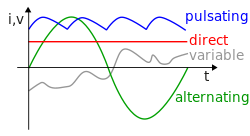
Alternating current (AC) is an electric current that periodically reverses direction and changes its magnitude continuously with time, in contrast to direct current (DC), which flows only in one direction. Alternating current is the form in which electric power is delivered to businesses and residences, and it is the form of electrical energy that consumers typically use when they plug kitchen appliances, televisions, fans and electric lamps into a wall socket. The abbreviations AC and DC are often used to mean simply alternating and direct, respectively, as when they modify current or voltage.
The usual waveform of alternating current in most electric power circuits is a sine wave, whose positive half-period corresponds with positive direction of the current and vice versa (the full period is called a cycle). "Alternating current" most commonly refers to power distribution, but a wide range of other applications are technically alternating current although it is less common to describe them by that term. In many applications, like guitar amplifiers, different waveforms are used, such as triangular waves or square waves. Audio and radio signals carried on electrical wires are also examples of alternating current. These types of alternating current carry information such as sound (audio) or images (video) sometimes carried by modulation of an AC carrier signal. These currents typically alternate at higher frequencies than those used in power transmission.
Electrical energy is distributed as alternating current because AC voltage may be increased or decreased with a transformer. This allows the power to be transmitted through power lines efficiently at high voltage, which reduces the energy lost as heat due to resistance of the wire, and transformed to a lower, safer voltage for use. Use of a higher voltage leads to significantly more efficient transmission of power. The power losses () in the wire are a product of the square of the current ( I ) and the resistance (R) of the wire, described by the formula:

This means that when transmitting a fixed power on a given wire, if the current is halved (by doubling the voltage), the power loss due to the wire's resistance will be reduced by a factor of four.
The power transmitted is equal to the product of the current and the voltage (assuming no phase difference); that is,
Consequently, power transmitted at a higher voltage requires less loss-producing current than for the same power at a lower voltage. Power is often transmitted at hundreds of kilovolts on pylons, and transformed down to tens of kilovolts to be transmitted on lower level lines, and finally transformed down to 100 V – 240 V for domestic use.
High voltages have disadvantages, such as the increased insulation required, and generally increased difficulty in their safe handling. In a power plant, energy is generated at a convenient voltage for the design of a generator, and then stepped up to a high voltage for transmission. Near the loads, the transmission voltage is stepped down to the voltages used by equipment. Consumer voltages vary somewhat depending on the country and size of load, but generally motors and lighting are built to use up to a few hundred volts between phases. The voltage delivered to equipment such as lighting and motor loads is standardized, with an allowable range of voltage over which equipment is expected to operate. Standard power utilization voltages and percentage tolerance vary in the different mains power systems found in the world.
High-voltage direct-current (HVDC) electric power transmission systems have become more viable as technology has provided efficient means of changing the voltage of DC power. Transmission with high voltage direct current was not feasible in the early days of electric power transmission, as there was then no economically viable way to step the voltage of DC down for end user applications such as lighting incandescent bulbs.
Alternating current
Alternating current (AC) is an electric current that periodically reverses direction and changes its magnitude continuously with time, in contrast to direct current (DC), which flows only in one direction. Alternating current is the form in which electric power is delivered to businesses and residences, and it is the form of electrical energy that consumers typically use when they plug kitchen appliances, televisions, fans and electric lamps into a wall socket. The abbreviations AC and DC are often used to mean simply alternating and direct, respectively, as when they modify current or voltage.
The usual waveform of alternating current in most electric power circuits is a sine wave, whose positive half-period corresponds with positive direction of the current and vice versa (the full period is called a cycle). "Alternating current" most commonly refers to power distribution, but a wide range of other applications are technically alternating current although it is less common to describe them by that term. In many applications, like guitar amplifiers, different waveforms are used, such as triangular waves or square waves. Audio and radio signals carried on electrical wires are also examples of alternating current. These types of alternating current carry information such as sound (audio) or images (video) sometimes carried by modulation of an AC carrier signal. These currents typically alternate at higher frequencies than those used in power transmission.
Electrical energy is distributed as alternating current because AC voltage may be increased or decreased with a transformer. This allows the power to be transmitted through power lines efficiently at high voltage, which reduces the energy lost as heat due to resistance of the wire, and transformed to a lower, safer voltage for use. Use of a higher voltage leads to significantly more efficient transmission of power. The power losses () in the wire are a product of the square of the current ( I ) and the resistance (R) of the wire, described by the formula:
This means that when transmitting a fixed power on a given wire, if the current is halved (by doubling the voltage), the power loss due to the wire's resistance will be reduced by a factor of four.
The power transmitted is equal to the product of the current and the voltage (assuming no phase difference); that is,
Consequently, power transmitted at a higher voltage requires less loss-producing current than for the same power at a lower voltage. Power is often transmitted at hundreds of kilovolts on pylons, and transformed down to tens of kilovolts to be transmitted on lower level lines, and finally transformed down to 100 V – 240 V for domestic use.
High voltages have disadvantages, such as the increased insulation required, and generally increased difficulty in their safe handling. In a power plant, energy is generated at a convenient voltage for the design of a generator, and then stepped up to a high voltage for transmission. Near the loads, the transmission voltage is stepped down to the voltages used by equipment. Consumer voltages vary somewhat depending on the country and size of load, but generally motors and lighting are built to use up to a few hundred volts between phases. The voltage delivered to equipment such as lighting and motor loads is standardized, with an allowable range of voltage over which equipment is expected to operate. Standard power utilization voltages and percentage tolerance vary in the different mains power systems found in the world.
High-voltage direct-current (HVDC) electric power transmission systems have become more viable as technology has provided efficient means of changing the voltage of DC power. Transmission with high voltage direct current was not feasible in the early days of electric power transmission, as there was then no economically viable way to step the voltage of DC down for end user applications such as lighting incandescent bulbs.
Recent media
Recent media