
Recent from talks
Rick Husband Amarillo International Airport
Knowledge base stats:
Talk channels stats:
Members stats:
Rick Husband Amarillo International Airport
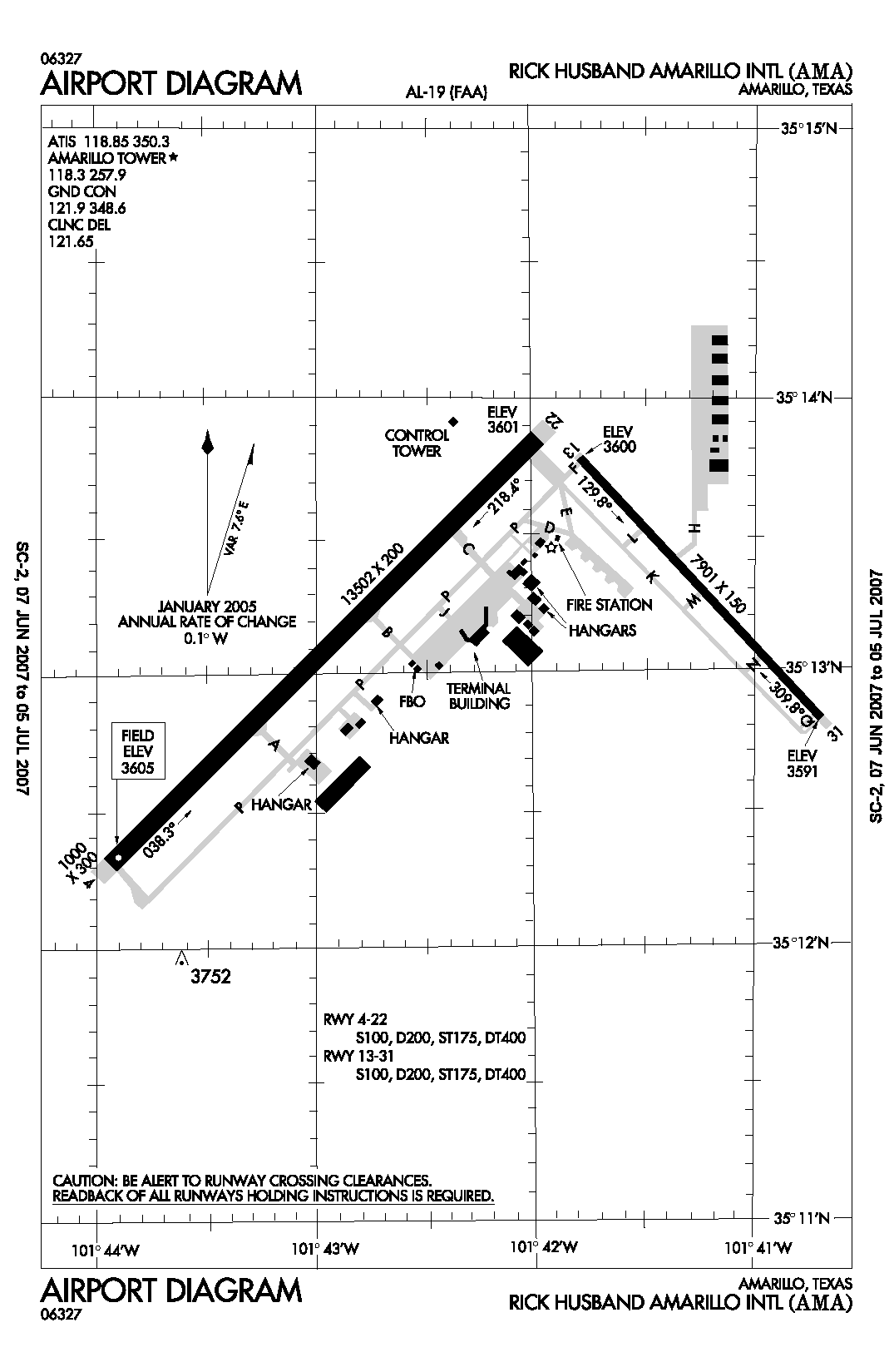
Rick Husband Amarillo International Airport (IATA: AMA, ICAO: KAMA, FAA LID: AMA) is a public airport six miles (10 km) east of downtown Amarillo, in Potter County, Texas, United States. The airport was renamed in 2003 after NASA astronaut and Amarillo native Rick Husband, who died in the Space Shuttle Columbia disaster in February of that year.
The first recorded landing of aircraft in Amarillo occurred on 27 April 1918, when two Army Signal Corps planes, commanded by a Lt. R. Gray, landed in a pasture located in the 500 block of N. Polk. They refueled at the corner of NE 4th and N. Polk, before taking off again. In 1919, pilot-mechanics Fred W. Hinds and Jack Hiller, stationed at Call Field, flew W.K. Whipple to the same pasture. Whipple met with Porter Whaley, the head of Amarillo's Board of City Development, about starting an aviation company. The result was the Panhandle Air Service and Transportation Co.
Panhandle Aerial Service and Transportation Co. was based at Amarillo's first aerodrome, Bivins Field, which started operation on 1 January 1920. Located in the Bivins Addition of southwest Amarillo, the two runways now form North and South Julian Boulevard. The company was financed by H.E. Fuqua and Lee Bivins, which included building a $30,000 six-plane hangar located near 15th and Crockett. The operation eventually moved to the north of Amarillo, west of the current Ross Rogers Municipal Golf Course. In 1928, the field was renamed Bivins-English Field, when Harold English took over management.
The City of Amarillo opened a municipal airport, referred to as "Old Muny" or "Old Municipal Airport", on 29 May 1929, located 4 miles west of the current Amarillo International Airport. Western Air Express air service was inaugurated here on 1 June 1929. Charles Lindbergh and wife were in attendance. Old Muny closed in 1951.
Also in 1929, Bivins-English Field was relocated further 7 miles east of Amarillo on Highway 60, and renamed English Field. Amarillo Airport Corporation, formed by Harold English and Thornton Oxnard, had bought out Lee Bivins' interest. Western Air Express had merged to become TWA and moved operations from Old Muny to English Field in 1930. Southern Air Transport soon followed. By 1935, Braniff Airways was also operating from English Field. In the winter of 1937 a fire destroyed the hangar, administration building, and cafe. Operations continued though, and English Field was rebuilt between in 1939–43, which included paved runways and taxiways when the city took over in 1941.
Western Air Express began passenger airline service to Amarillo on June 1, 1929 with an eastbound flight to Wichita and Kansas City and a westbound flight to Albuquerque and Los Angeles. In mid 1930, these routes for Western Air Express were merged with Transcontinental Air Transport to become Transcontinental and Western Air (TWA) and Amarillo became a stop on a coast-to-coast service between Los Angeles and New York City using Ford Trimotor aircraft. The airline's timetable stated this transcontinental flight could be accomplished in 36 hours with an "overnight hotel stop" being made in each direction on a routing of Los Angeles – Kingman, Ariz. – Winslow, Ariz. – Albuquerque – Amarillo – Wichita – Kansas City – St. Louis – Indianapolis – Columbus, Ohio – Pittsburgh – Philadelphia – New York City (via Newark Airport). In 1934 TWA upgraded its service using Douglas DC-2 aircraft which were then upgraded to Douglas DC-3s in 1937. Transcontinental & Western Air changed its name to Trans World Airlines (still keeping the TWA letters) in 1946 and, by 1950, began using much larger four-engine Lockheed Constellation aircraft at Amarillo. In 1955 TWA partnered with Braniff International to operate an interchange flight between San Francisco and Houston stopping in Los Angeles, Las Vegas, Amarillo, and Dallas, Amarillo being the junction point for the interchange. In 1964 TWA began operating the first jet aircraft through Amarillo which included the Boeing 707, Boeing 727, and the Convair 880. Most eastbound flights first stopped at Wichita and continued onto Kansas City, St. Louis, Chicago, and New York. Westbound flights first stopped at Albuquerque then continued to Los Angeles. Nonstop service to Phoenix was added in 1970. After airline deregulation was passed in late 1978, TWA added nonstop flights to Kansas City, St. Louis, and Las Vegas while dropping service to Albuquerque. All TWA service to Amarillo was discontinued on December 15, 1982.
Southern Air Transport (1929) initiated service on an Amarillo – Wichita Falls – Dallas route in 1929. The company was one of many airlines merged to become American Airways in 1930. American continued the route to Dallas until late 1933. The American Airways name was later changed to American Airlines and service returned to Amarillo in 1981
Western Air Express briefly returned to Amarillo in 1933 operating a route to Dallas as well as a route to Pueblo, Colorado Springs, and Denver, Colorado.
Hub AI
Rick Husband Amarillo International Airport AI simulator
(@Rick Husband Amarillo International Airport_simulator)
Rick Husband Amarillo International Airport
Rick Husband Amarillo International Airport (IATA: AMA, ICAO: KAMA, FAA LID: AMA) is a public airport six miles (10 km) east of downtown Amarillo, in Potter County, Texas, United States. The airport was renamed in 2003 after NASA astronaut and Amarillo native Rick Husband, who died in the Space Shuttle Columbia disaster in February of that year.
The first recorded landing of aircraft in Amarillo occurred on 27 April 1918, when two Army Signal Corps planes, commanded by a Lt. R. Gray, landed in a pasture located in the 500 block of N. Polk. They refueled at the corner of NE 4th and N. Polk, before taking off again. In 1919, pilot-mechanics Fred W. Hinds and Jack Hiller, stationed at Call Field, flew W.K. Whipple to the same pasture. Whipple met with Porter Whaley, the head of Amarillo's Board of City Development, about starting an aviation company. The result was the Panhandle Air Service and Transportation Co.
Panhandle Aerial Service and Transportation Co. was based at Amarillo's first aerodrome, Bivins Field, which started operation on 1 January 1920. Located in the Bivins Addition of southwest Amarillo, the two runways now form North and South Julian Boulevard. The company was financed by H.E. Fuqua and Lee Bivins, which included building a $30,000 six-plane hangar located near 15th and Crockett. The operation eventually moved to the north of Amarillo, west of the current Ross Rogers Municipal Golf Course. In 1928, the field was renamed Bivins-English Field, when Harold English took over management.
The City of Amarillo opened a municipal airport, referred to as "Old Muny" or "Old Municipal Airport", on 29 May 1929, located 4 miles west of the current Amarillo International Airport. Western Air Express air service was inaugurated here on 1 June 1929. Charles Lindbergh and wife were in attendance. Old Muny closed in 1951.
Also in 1929, Bivins-English Field was relocated further 7 miles east of Amarillo on Highway 60, and renamed English Field. Amarillo Airport Corporation, formed by Harold English and Thornton Oxnard, had bought out Lee Bivins' interest. Western Air Express had merged to become TWA and moved operations from Old Muny to English Field in 1930. Southern Air Transport soon followed. By 1935, Braniff Airways was also operating from English Field. In the winter of 1937 a fire destroyed the hangar, administration building, and cafe. Operations continued though, and English Field was rebuilt between in 1939–43, which included paved runways and taxiways when the city took over in 1941.
Western Air Express began passenger airline service to Amarillo on June 1, 1929 with an eastbound flight to Wichita and Kansas City and a westbound flight to Albuquerque and Los Angeles. In mid 1930, these routes for Western Air Express were merged with Transcontinental Air Transport to become Transcontinental and Western Air (TWA) and Amarillo became a stop on a coast-to-coast service between Los Angeles and New York City using Ford Trimotor aircraft. The airline's timetable stated this transcontinental flight could be accomplished in 36 hours with an "overnight hotel stop" being made in each direction on a routing of Los Angeles – Kingman, Ariz. – Winslow, Ariz. – Albuquerque – Amarillo – Wichita – Kansas City – St. Louis – Indianapolis – Columbus, Ohio – Pittsburgh – Philadelphia – New York City (via Newark Airport). In 1934 TWA upgraded its service using Douglas DC-2 aircraft which were then upgraded to Douglas DC-3s in 1937. Transcontinental & Western Air changed its name to Trans World Airlines (still keeping the TWA letters) in 1946 and, by 1950, began using much larger four-engine Lockheed Constellation aircraft at Amarillo. In 1955 TWA partnered with Braniff International to operate an interchange flight between San Francisco and Houston stopping in Los Angeles, Las Vegas, Amarillo, and Dallas, Amarillo being the junction point for the interchange. In 1964 TWA began operating the first jet aircraft through Amarillo which included the Boeing 707, Boeing 727, and the Convair 880. Most eastbound flights first stopped at Wichita and continued onto Kansas City, St. Louis, Chicago, and New York. Westbound flights first stopped at Albuquerque then continued to Los Angeles. Nonstop service to Phoenix was added in 1970. After airline deregulation was passed in late 1978, TWA added nonstop flights to Kansas City, St. Louis, and Las Vegas while dropping service to Albuquerque. All TWA service to Amarillo was discontinued on December 15, 1982.
Southern Air Transport (1929) initiated service on an Amarillo – Wichita Falls – Dallas route in 1929. The company was one of many airlines merged to become American Airways in 1930. American continued the route to Dallas until late 1933. The American Airways name was later changed to American Airlines and service returned to Amarillo in 1981
Western Air Express briefly returned to Amarillo in 1933 operating a route to Dallas as well as a route to Pueblo, Colorado Springs, and Denver, Colorado.
Recent media