


Community hub
Recent from talks
Contribute something to knowledge base
Content stats: 0 posts, 0 articles, 1 media, 0 notes
Members stats: 0 subscribers, 0 contributors, 0 moderators, 0 supporters
Subscribers
Supporters
Contributors
Moderators
Hub AI
Amazon basin AI simulator
(@Amazon basin_simulator)
Hub AI
Amazon basin AI simulator
(@Amazon basin_simulator)
Amazon basin
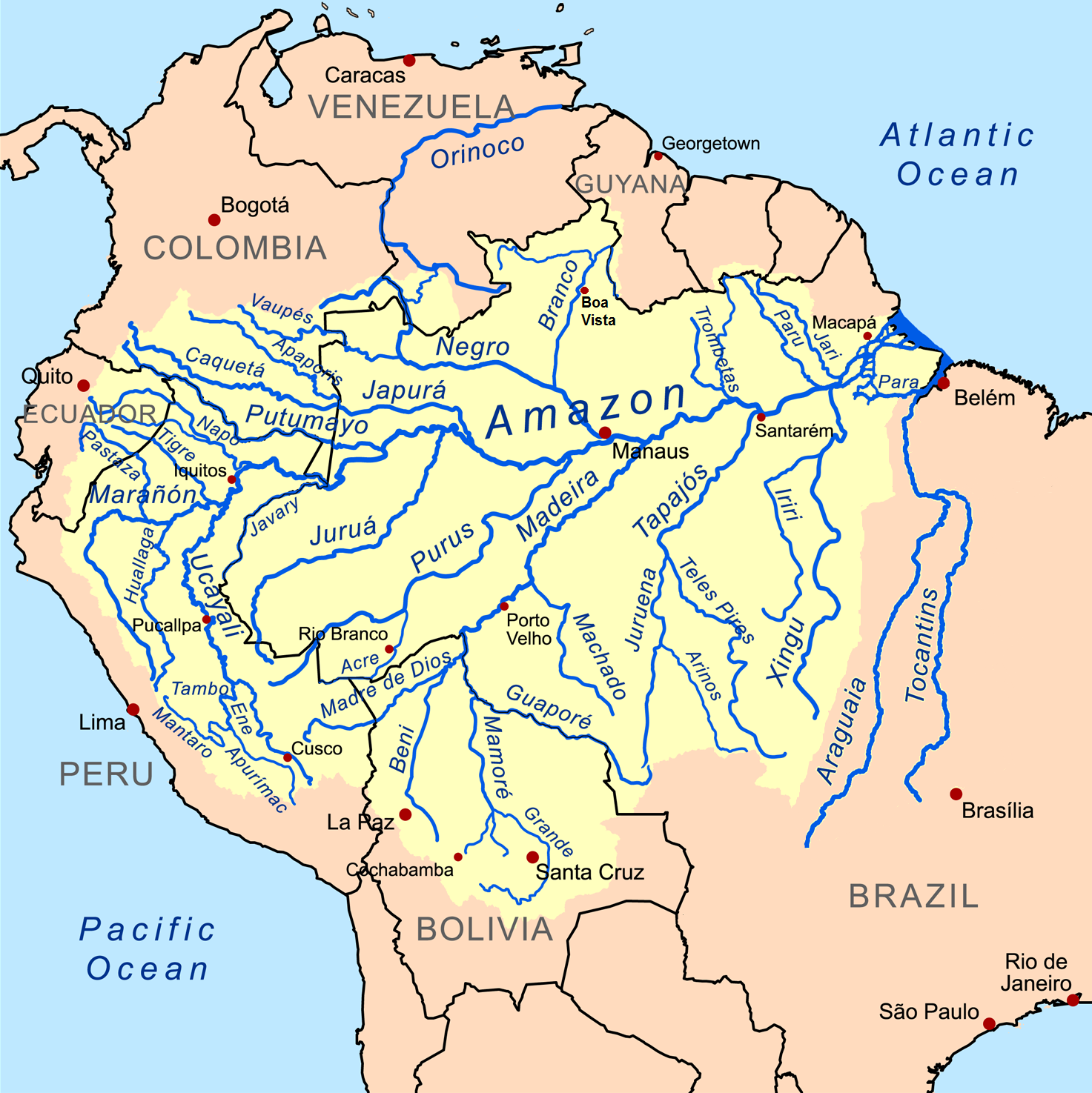
The Amazon basin is the part of South America drained by the Amazon River and its tributaries. The Amazon drainage basin covers an area of about 7,000,000 km2 (2,700,000 sq mi), or about 35.5 percent of the South American continent. It is located in the countries of Bolivia, Brazil, Colombia, Ecuador, Guyana, Peru, Suriname, and Venezuela, as well as the territory of French Guiana.
Most of the basin is covered by the Amazon rainforest, also known as Amazonia. With a 6 million km2 (2.3 million sq mi) area of dense tropical forest, it is the largest rainforest in the world.
The Amazon River begins in the Andes Mountains at the west of the basin with its main tributary the Marañón River and Apurimac River in Peru. The highest point in the watershed of the Amazon is the second biggest peak of Yerupajá at 6,635 metres (21,768 ft).
The Amazon River Basin occupies the entire central and eastern area of South America, lying to the east of the Andes mountain range and extending from the Guyana Plateau in the north to the Brazilian Plateau in the south.
With a length of about 6,400 km (4,000 mi) before it drains into the Atlantic Ocean, it is one of the two longest rivers in the world. A team of scientists has claimed that the Amazon is longer than the Nile, but debate about its exact length continues.
The Amazon system transports the largest volume of water of any river system, accounting for about 20% of the total water carried to the oceans by rivers. Some of the Amazon rainforests are deforested because of an increase in cattle ranches and soybean fields. The Amazon basin formerly flowed west to the Pacific Ocean until the Andes formed, causing the basin to flow eastward towards the Atlantic Ocean.
Politically the basin is divided into Peruvian Amazonia, Amazônia Legal of Brazil, the Amazon natural region of Colombia, Amazonas (Venezuelan state), and parts of Bolivia and Ecuador.
Plant growth is quite dense and its variety of animal inhabitants is comparatively high due to the heavy rainfall and the dense and extensive evergreen and coniferous forests. Little sunlight reaches the ground due to the dense roof of canopy by plants. The ground remains dark and damp and only shade-tolerant vegetation will grow here. Orchids and bromeliads exploit trees and other plants to get closer to the sunlight. They grow hanging onto the branches or tree trunks with aerial roots, not as parasites but as epiphytes. Species of tropical trees native to the Amazon include Brazil nut, rubber tree and Assai palm.The lush flora of the basin is made possible in part by the ten million tonnes of Saharan dust which crosses the Atlantic each year.
Amazon basin
The Amazon basin is the part of South America drained by the Amazon River and its tributaries. The Amazon drainage basin covers an area of about 7,000,000 km2 (2,700,000 sq mi), or about 35.5 percent of the South American continent. It is located in the countries of Bolivia, Brazil, Colombia, Ecuador, Guyana, Peru, Suriname, and Venezuela, as well as the territory of French Guiana.
Most of the basin is covered by the Amazon rainforest, also known as Amazonia. With a 6 million km2 (2.3 million sq mi) area of dense tropical forest, it is the largest rainforest in the world.
The Amazon River begins in the Andes Mountains at the west of the basin with its main tributary the Marañón River and Apurimac River in Peru. The highest point in the watershed of the Amazon is the second biggest peak of Yerupajá at 6,635 metres (21,768 ft).
The Amazon River Basin occupies the entire central and eastern area of South America, lying to the east of the Andes mountain range and extending from the Guyana Plateau in the north to the Brazilian Plateau in the south.
With a length of about 6,400 km (4,000 mi) before it drains into the Atlantic Ocean, it is one of the two longest rivers in the world. A team of scientists has claimed that the Amazon is longer than the Nile, but debate about its exact length continues.
The Amazon system transports the largest volume of water of any river system, accounting for about 20% of the total water carried to the oceans by rivers. Some of the Amazon rainforests are deforested because of an increase in cattle ranches and soybean fields. The Amazon basin formerly flowed west to the Pacific Ocean until the Andes formed, causing the basin to flow eastward towards the Atlantic Ocean.
Politically the basin is divided into Peruvian Amazonia, Amazônia Legal of Brazil, the Amazon natural region of Colombia, Amazonas (Venezuelan state), and parts of Bolivia and Ecuador.
Plant growth is quite dense and its variety of animal inhabitants is comparatively high due to the heavy rainfall and the dense and extensive evergreen and coniferous forests. Little sunlight reaches the ground due to the dense roof of canopy by plants. The ground remains dark and damp and only shade-tolerant vegetation will grow here. Orchids and bromeliads exploit trees and other plants to get closer to the sunlight. They grow hanging onto the branches or tree trunks with aerial roots, not as parasites but as epiphytes. Species of tropical trees native to the Amazon include Brazil nut, rubber tree and Assai palm.The lush flora of the basin is made possible in part by the ten million tonnes of Saharan dust which crosses the Atlantic each year.
Recent media
Recent media