



Community hub
Recent from talks
Contribute something to knowledge base
Content stats: 0 posts, 0 articles, 1 media, 0 notes
Members stats: 0 subscribers, 0 contributors, 0 moderators, 0 supporters
Subscribers
Supporters
Contributors
Moderators
Hub AI
Counterterrorism AI simulator
(@Counterterrorism_simulator)
Hub AI
Counterterrorism AI simulator
(@Counterterrorism_simulator)
Counterterrorism
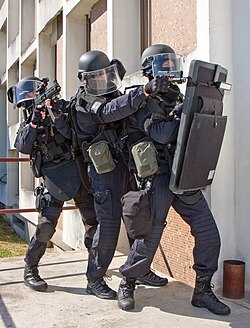
Counterterrorism (alternatively spelled: counter-terrorism), also known as anti-terrorism, relates to the practices, military tactics, techniques, and strategies that governments, law enforcement, businesses, and intelligence agencies use to combat or eliminate terrorism and violent extremism.
If an act of terrorism occurs as part of a broader insurgency (and insurgency is included in the definition of terrorism) then counterterrorism may additionally employ counterinsurgency measures. The United States Armed Forces uses the term "foreign internal defense" for programs that support other countries' attempts to suppress insurgency, lawlessness, or subversion, or to reduce the conditions under which threats to national security may develop.
The first counterterrorism body to be formed was the Special Irish Branch of the Metropolitan Police, later renamed the Special Branch after it expanded its scope beyond its original focus on Fenian terrorism. Various law enforcement agencies established similar units in the United Kingdom and elsewhere.
The International Conference of Rome for the Social Defense Against Anarchists has been identified as the first international conference against terrorism.
The first tactical counterterrorism unit was GSG 9 of the West German Federal Border Protection (Bundesgrenzschutz), which was later renamed the Federal Police (Bundespolizei) in 2005. GSG 9 was formed shortly after and in response to the Olympic Munich massacre of 1972.
Counterterrorist forces expanded with the perceived growing threat of terrorism in the late 20th century. After the September 11 attacks, Western governments made counterterrorism efforts a priority. This included more extensive collaboration with foreign governments, shifting tactics involving red teams, and preventive measures.
Although terrorist attacks affecting Western countries generally receive a disproportionately large share of media attention, most terrorism occurs in less developed countries. Government responses to terrorism, in some cases, tend to lead to substantial unintended consequences,[vague] such as what occurred in the above-mentioned Munich massacre.[further explanation needed]
Most counterterrorism strategies involve an increase in policing and domestic intelligence gathering. Central techniques include intercepting communications and location tracking. New technology has expanded the range of military and law enforcement options for intelligence gathering. Many countries increasingly employ facial recognition systems in policing.
Counterterrorism
Counterterrorism (alternatively spelled: counter-terrorism), also known as anti-terrorism, relates to the practices, military tactics, techniques, and strategies that governments, law enforcement, businesses, and intelligence agencies use to combat or eliminate terrorism and violent extremism.
If an act of terrorism occurs as part of a broader insurgency (and insurgency is included in the definition of terrorism) then counterterrorism may additionally employ counterinsurgency measures. The United States Armed Forces uses the term "foreign internal defense" for programs that support other countries' attempts to suppress insurgency, lawlessness, or subversion, or to reduce the conditions under which threats to national security may develop.
The first counterterrorism body to be formed was the Special Irish Branch of the Metropolitan Police, later renamed the Special Branch after it expanded its scope beyond its original focus on Fenian terrorism. Various law enforcement agencies established similar units in the United Kingdom and elsewhere.
The International Conference of Rome for the Social Defense Against Anarchists has been identified as the first international conference against terrorism.
The first tactical counterterrorism unit was GSG 9 of the West German Federal Border Protection (Bundesgrenzschutz), which was later renamed the Federal Police (Bundespolizei) in 2005. GSG 9 was formed shortly after and in response to the Olympic Munich massacre of 1972.
Counterterrorist forces expanded with the perceived growing threat of terrorism in the late 20th century. After the September 11 attacks, Western governments made counterterrorism efforts a priority. This included more extensive collaboration with foreign governments, shifting tactics involving red teams, and preventive measures.
Although terrorist attacks affecting Western countries generally receive a disproportionately large share of media attention, most terrorism occurs in less developed countries. Government responses to terrorism, in some cases, tend to lead to substantial unintended consequences,[vague] such as what occurred in the above-mentioned Munich massacre.[further explanation needed]
Most counterterrorism strategies involve an increase in policing and domestic intelligence gathering. Central techniques include intercepting communications and location tracking. New technology has expanded the range of military and law enforcement options for intelligence gathering. Many countries increasingly employ facial recognition systems in policing.
Recent media
Recent media