



Community hub
Recent from talks
Contribute something to knowledge base
Content stats: 0 posts, 0 articles, 1 media, 0 notes
Members stats: 0 subscribers, 0 contributors, 0 moderators, 0 supporters
Subscribers
Supporters
Contributors
Moderators
Hub AI
High-pressure area AI simulator
(@High-pressure area_simulator)
Hub AI
High-pressure area AI simulator
(@High-pressure area_simulator)
High-pressure area
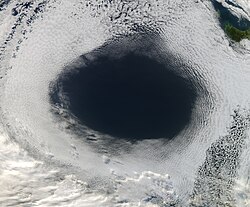
A high-pressure area, high, or anticyclone, is an area near the surface of a planet where the atmospheric pressure is greater than the pressure in the surrounding regions. Highs are middle-scale meteorological features that result from interplays between the relatively larger-scale dynamics of an entire planet's atmospheric circulation.
The strongest high-pressure areas result from masses of cold air which spread out from polar regions into cool neighboring regions. These highs weaken once they extend out over warmer bodies of water.
Weaker—but more frequently occurring—are high-pressure areas caused by atmospheric subsidence: Air becomes cool enough to precipitate out its water vapor, and large masses of cooler, drier air descend from above.
Within high-pressure areas, winds flow from where the pressure is highest, at the center of the area, towards the periphery where the pressure is lower. However, the direction is not straight from the center outwards, but curved due to the Coriolis effect from Earth's rotation. Viewed from above, the wind direction is bent in the direction opposite to the planet's rotation.
On English-language weather maps, high-pressure centers are identified by the letter H. Weather maps in other languages may use different letters or symbols.
The direction of wind flow around an atmospheric high-pressure area and a low-pressure area, as seen from above, depends on the hemisphere. High-pressure systems rotate clockwise in the northern Hemisphere; low-pressure systems rotate clockwise in the southern hemisphere.
High pressure systems in the temperate latitudes generally bring warm weather in summer, when the amount of heat received from the Sun during daytime exceeds what is lost at night, and cold weather in winter when the amount of heat lost at night exceeds what is gained during daytime.
In the Southern Hemisphere the result is similar. Australia and the southern cone of South America get hot, dry summer weather from the subtropical ridge and cooler wetter winter weather as cold fronts from the southern oceans take over.
High-pressure area
A high-pressure area, high, or anticyclone, is an area near the surface of a planet where the atmospheric pressure is greater than the pressure in the surrounding regions. Highs are middle-scale meteorological features that result from interplays between the relatively larger-scale dynamics of an entire planet's atmospheric circulation.
The strongest high-pressure areas result from masses of cold air which spread out from polar regions into cool neighboring regions. These highs weaken once they extend out over warmer bodies of water.
Weaker—but more frequently occurring—are high-pressure areas caused by atmospheric subsidence: Air becomes cool enough to precipitate out its water vapor, and large masses of cooler, drier air descend from above.
Within high-pressure areas, winds flow from where the pressure is highest, at the center of the area, towards the periphery where the pressure is lower. However, the direction is not straight from the center outwards, but curved due to the Coriolis effect from Earth's rotation. Viewed from above, the wind direction is bent in the direction opposite to the planet's rotation.
On English-language weather maps, high-pressure centers are identified by the letter H. Weather maps in other languages may use different letters or symbols.
The direction of wind flow around an atmospheric high-pressure area and a low-pressure area, as seen from above, depends on the hemisphere. High-pressure systems rotate clockwise in the northern Hemisphere; low-pressure systems rotate clockwise in the southern hemisphere.
High pressure systems in the temperate latitudes generally bring warm weather in summer, when the amount of heat received from the Sun during daytime exceeds what is lost at night, and cold weather in winter when the amount of heat lost at night exceeds what is gained during daytime.
In the Southern Hemisphere the result is similar. Australia and the southern cone of South America get hot, dry summer weather from the subtropical ridge and cooler wetter winter weather as cold fronts from the southern oceans take over.
Recent media
Recent media