


Community hub
Recent from talks
Contribute something to knowledge base
Content stats: 0 posts, 0 articles, 1 media, 0 notes
Members stats: 0 subscribers, 0 contributors, 0 moderators, 0 supporters
Subscribers
Supporters
Contributors
Moderators
Hub AI
Appalachian balds AI simulator
(@Appalachian balds_simulator)
Hub AI
Appalachian balds AI simulator
(@Appalachian balds_simulator)
Appalachian balds
In the Appalachian Mountains of the eastern United States, balds are mountain summits or crests covered primarily by thick vegetation of native grasses or shrubs occurring in areas where heavy forest growth would be expected.
Balds are found primarily in the Southern Appalachians, where, even at the highest elevations, the climate is too warm to support an alpine zone, areas where trees fail to grow due to short or non-existent growing seasons. The difference between an alpine summit, such as Mount Washington in New Hampshire, and a bald, such as Gregory Bald in the Great Smoky Mountains, is that a lack of trees is normal for the colder climate of the former but abnormal for the warmer climate of the latter. One example of southern balds' abnormality can be found at Roan Mountain, where Roan High Knob (el. 6,285 ft/1,915 m) is coated with a dense stand of spruce-fir forest, whereas an adjacent summit, Round Bald (el. 5,826 ft/1,776 m), is almost entirely devoid of trees. Why some summits are bald and some are not is a mystery, though there are several hypotheses.
Ecologist have described balds as both a scientific mystery as well as a conservational concern since their lack of developed trees is such a poorly understood phenomenon. There are many balds that have maintained long term persistence although the areas around them are heavily forested mountains. Ecologist R. H. Whittaker describes the Appalachian balds as unusual openings in an otherwise very typical and continuous forest which has small amounts of data collected about it. The data that has been collected shows that the composition of the soil and patterns of climate are not enough to account for a lack of trees growing on the balds. This also raises concerns in terms of conservation for these balds since it isn't known what causes them to form or maintain themselves.
Two types of balds are found in the Appalachians:
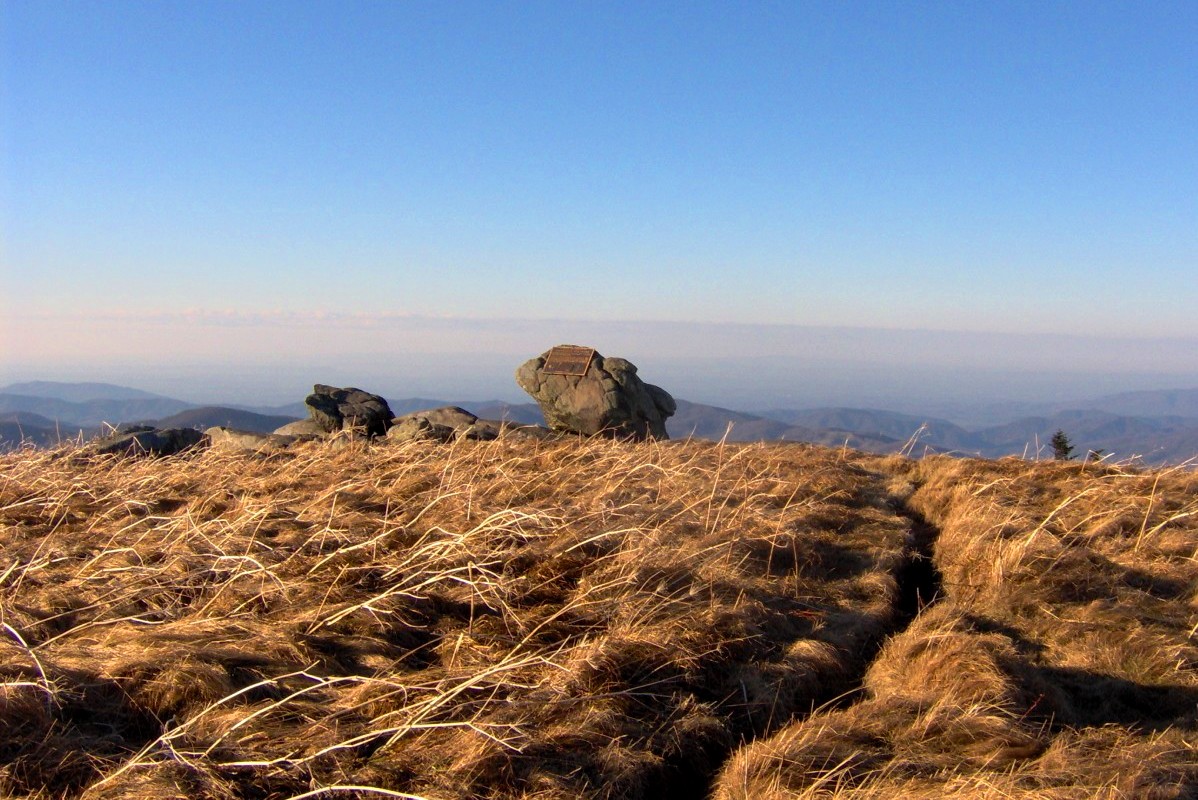
Grassy balds are relatively blunt summits covered by a dense sward of native grasses. Two types have been identified: those completely covered by grasses and those with a scattered overstory of mixed hardwoods with a grassy herbaceous layer. Grassy balds are normally found at the summit of hills, but can also be found on broad upper slopes.
Species found here include mountain oat-grass (Danthonia compressa), sedges (Carex brunnescens ssp. sphaerostachya, Carex debilis var. rudgei, Carex pensylvanica), and forbs such as three-toothed cinquefoil (Sibbaldiopsis tridentata) and Blue Ridge St. Johns-wort (Hypericum mitchellianum).
Heath balds are typically found along narrow ridges and mountain crests, and consist of dense evergreen shrubs. While the formation of grassy balds is a mystery, heath balds are often located in areas where the soil experiences heavy drainage or is highly acidic, which would complicate the growth of large wooded plants.
Four general types of vegetation are found on heath balds:
Appalachian balds
In the Appalachian Mountains of the eastern United States, balds are mountain summits or crests covered primarily by thick vegetation of native grasses or shrubs occurring in areas where heavy forest growth would be expected.
Balds are found primarily in the Southern Appalachians, where, even at the highest elevations, the climate is too warm to support an alpine zone, areas where trees fail to grow due to short or non-existent growing seasons. The difference between an alpine summit, such as Mount Washington in New Hampshire, and a bald, such as Gregory Bald in the Great Smoky Mountains, is that a lack of trees is normal for the colder climate of the former but abnormal for the warmer climate of the latter. One example of southern balds' abnormality can be found at Roan Mountain, where Roan High Knob (el. 6,285 ft/1,915 m) is coated with a dense stand of spruce-fir forest, whereas an adjacent summit, Round Bald (el. 5,826 ft/1,776 m), is almost entirely devoid of trees. Why some summits are bald and some are not is a mystery, though there are several hypotheses.
Ecologist have described balds as both a scientific mystery as well as a conservational concern since their lack of developed trees is such a poorly understood phenomenon. There are many balds that have maintained long term persistence although the areas around them are heavily forested mountains. Ecologist R. H. Whittaker describes the Appalachian balds as unusual openings in an otherwise very typical and continuous forest which has small amounts of data collected about it. The data that has been collected shows that the composition of the soil and patterns of climate are not enough to account for a lack of trees growing on the balds. This also raises concerns in terms of conservation for these balds since it isn't known what causes them to form or maintain themselves.
Two types of balds are found in the Appalachians:
Grassy balds are relatively blunt summits covered by a dense sward of native grasses. Two types have been identified: those completely covered by grasses and those with a scattered overstory of mixed hardwoods with a grassy herbaceous layer. Grassy balds are normally found at the summit of hills, but can also be found on broad upper slopes.
Species found here include mountain oat-grass (Danthonia compressa), sedges (Carex brunnescens ssp. sphaerostachya, Carex debilis var. rudgei, Carex pensylvanica), and forbs such as three-toothed cinquefoil (Sibbaldiopsis tridentata) and Blue Ridge St. Johns-wort (Hypericum mitchellianum).
Heath balds are typically found along narrow ridges and mountain crests, and consist of dense evergreen shrubs. While the formation of grassy balds is a mystery, heath balds are often located in areas where the soil experiences heavy drainage or is highly acidic, which would complicate the growth of large wooded plants.
Four general types of vegetation are found on heath balds:
Recent media
Recent media