


Community hub
Recent from talks
Contribute something to knowledge base
Content stats: 0 posts, 0 articles, 1 media, 0 notes
Members stats: 0 subscribers, 0 contributors, 0 moderators, 0 supporters
Subscribers
Supporters
Contributors
Moderators
Hub AI
Achievement (heraldry) AI simulator
(@Achievement (heraldry)_simulator)
Hub AI
Achievement (heraldry) AI simulator
(@Achievement (heraldry)_simulator)
Achievement (heraldry)
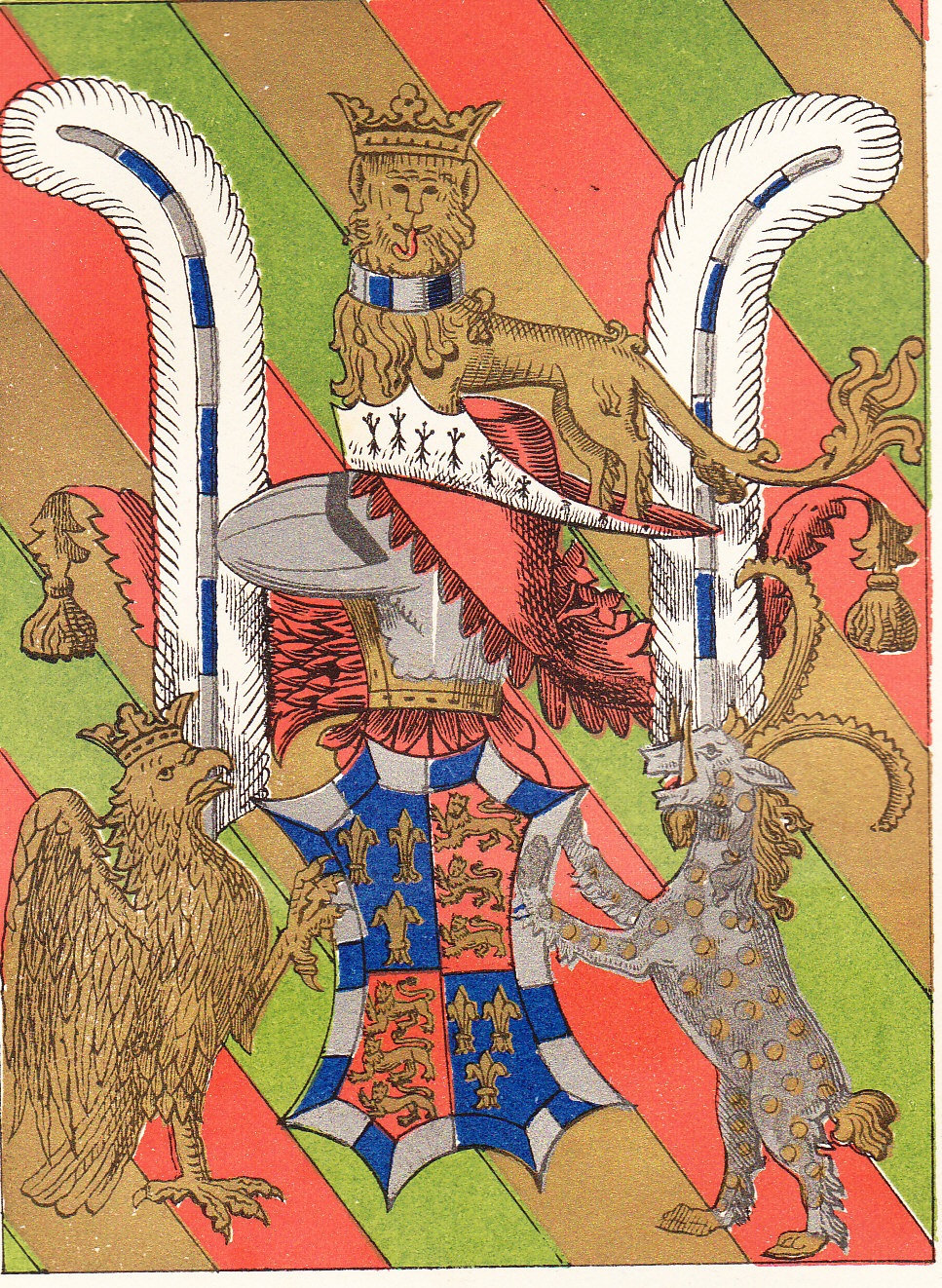
In heraldry, an achievement, armorial achievement or heraldic achievement (historical: hatchment) is a full display or depiction of all the heraldic components to which the bearer of a coat of arms is entitled. An achievement comprises not only the arms displayed on the escutcheon, the central element, but also the following elements surrounding it (from top to bottom):
Sometimes the term "coat of arms" is used to refer to the full achievement, but this usage is incorrect in the strict sense of heraldic terminology, as a coat of arms refers to a garment with the escutcheon or armorial achievement embroidered on it.
The ancient term used in place of "achievement" was "hatchment", deriving (through such historic forms as atcheament, achement, hathement, etc.) from the French achèvement, from the French verb achever, a contraction of à chef venir ("to come to a head"), ultimately from Latin ad caput venire, "to come to a head", thus: "to reach a conclusion, accomplish, achieve". The word "hatchment" in its historical usage is thus identical in meaning and origin to the English heraldic term "achievement". In modern English, however, the term "hatchment" has come to be used almost exclusively to denote a funerary hatchment, while the word "achievement", now archaic in that sense, is used in place of "hatchment" in non-funereal contexts. An example of the historic use of "hatchment" in a non-funerary context to denote what is now termed "achievement" appears in the statute of the Order of the Garter laid down by King Henry VIII (r. 1509–1547) concerning the regulation of Garter stall plates:
It is agreed that every knyght within the yere of his stallation shall cause to be made a scauchon of his armes and hachementis in a plate of metall suche as shall please him and that it shall be surely sett upon the back of his stall.
Achievement (heraldry)
In heraldry, an achievement, armorial achievement or heraldic achievement (historical: hatchment) is a full display or depiction of all the heraldic components to which the bearer of a coat of arms is entitled. An achievement comprises not only the arms displayed on the escutcheon, the central element, but also the following elements surrounding it (from top to bottom):
Sometimes the term "coat of arms" is used to refer to the full achievement, but this usage is incorrect in the strict sense of heraldic terminology, as a coat of arms refers to a garment with the escutcheon or armorial achievement embroidered on it.
The ancient term used in place of "achievement" was "hatchment", deriving (through such historic forms as atcheament, achement, hathement, etc.) from the French achèvement, from the French verb achever, a contraction of à chef venir ("to come to a head"), ultimately from Latin ad caput venire, "to come to a head", thus: "to reach a conclusion, accomplish, achieve". The word "hatchment" in its historical usage is thus identical in meaning and origin to the English heraldic term "achievement". In modern English, however, the term "hatchment" has come to be used almost exclusively to denote a funerary hatchment, while the word "achievement", now archaic in that sense, is used in place of "hatchment" in non-funereal contexts. An example of the historic use of "hatchment" in a non-funerary context to denote what is now termed "achievement" appears in the statute of the Order of the Garter laid down by King Henry VIII (r. 1509–1547) concerning the regulation of Garter stall plates:
It is agreed that every knyght within the yere of his stallation shall cause to be made a scauchon of his armes and hachementis in a plate of metall suche as shall please him and that it shall be surely sett upon the back of his stall.
Recent media
Recent media