



Community hub
Recent from talks
Contribute something to knowledge base
Content stats: 0 posts, 0 articles, 1 media, 0 notes
Members stats: 0 subscribers, 0 contributors, 0 moderators, 0 supporters
Subscribers
Supporters
Contributors
Moderators
Hub AI
Aso Shrine AI simulator
(@Aso Shrine_simulator)
Hub AI
Aso Shrine AI simulator
(@Aso Shrine_simulator)
Aso Shrine
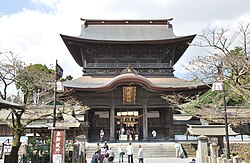
Aso Shrine (阿蘇神社, Aso-jinja) is a Shinto Shrine in Aso, Kumamoto Prefecture, Japan. Aso is one of the oldest shrines in Japan. This shrine holds several Important Cultural Properties, including Ichi-no-shinden (一の神殿), Ni-no-shinden (二の神殿), and Rōmon (楼門). The Aso family in charge of the shrine is said to have the second oldest recorded lineage in Japan after the Imperial family. The Aso Shrine was heavily damaged in the 2016 Kumamoto earthquakes. The shrine's rōmon (tower gate) completely collapsed. The haiden (worshiping hall) also collapsed.
Aso Shrine at Mount Aso in Kyushu is traditionally held to have been a center of worship before the accession of Emperor Jinmu. The shikinaisha shrine complex at Ichinomiya in what is today Kumamoto Prefecture was said to have been established in 281 BC.
The earliest records of the shrine are found in Chinese historical chronicles like the Zuisho-Wakoku-Den from the 07th century that states that the people of Aso held festivals every time Mt. Aso erupted to calm its wrath. Historical information of the shrine can also be found in the Nihon-Shoki, Nihon-Kiryaku, Shoku-Nihon-Kouki, Montoku-Jitsuroku, Sandai-Jitsuroku, and the Chikushi-no-Kuni-Fudoki-Itsubun.
Records also link the founding of the shrine to the reign of Emperor Kōrei (孝霊天皇, Kōrei-tennō). By the middle of the 11th century, the shrine was involved in national issues as they played out across Kyushu. During the ascendancy of the Kamakura shogunate, the Hōjō clan exercised a significant influence over the affairs of Aso Shrine.
The shrine is dedicated to the veneration of Takeiwatatsu-no-Mikoto (健磐龍命), who was a grandson of Japan's first emperor and the brother of Emperor Suizei, the second monarch on the traditional list of emperors. In the same period that Emperor Jimmu was establishing his palace at Kashihara at the foot of Mount Unebi in Yamato province, Takeiwatasu was sent to Aso where he helped establish a number of agricultural communities; and later, he is said to have built a palace at Miyagi.
The original location of the shrine is uncertain because it was destroyed and rebuilt many times in or near the crater of Aso-san. The shrine is said to be thousands of years old, however the present buildings date only from the Tenpō era (1830–1843). Construction of the shrine took 20 years from Tenpō 06 (1835) through Koka (1844–1848), Kaei (1848–1854) and Ansei (1854–1860) periods.
Aso was the chief Shinto shrine (Ichinomiya) of the old Higo Province. It serves today as one of the Ichinomiya of Kumamoto Prefecture.
From 1871 through 1946, the Aso Shrine was officially designated one of the Kanpei-taisha (官幣大社), meaning that it stood in the first rank of government supported shrines.
Aso Shrine
Aso Shrine (阿蘇神社, Aso-jinja) is a Shinto Shrine in Aso, Kumamoto Prefecture, Japan. Aso is one of the oldest shrines in Japan. This shrine holds several Important Cultural Properties, including Ichi-no-shinden (一の神殿), Ni-no-shinden (二の神殿), and Rōmon (楼門). The Aso family in charge of the shrine is said to have the second oldest recorded lineage in Japan after the Imperial family. The Aso Shrine was heavily damaged in the 2016 Kumamoto earthquakes. The shrine's rōmon (tower gate) completely collapsed. The haiden (worshiping hall) also collapsed.
Aso Shrine at Mount Aso in Kyushu is traditionally held to have been a center of worship before the accession of Emperor Jinmu. The shikinaisha shrine complex at Ichinomiya in what is today Kumamoto Prefecture was said to have been established in 281 BC.
The earliest records of the shrine are found in Chinese historical chronicles like the Zuisho-Wakoku-Den from the 07th century that states that the people of Aso held festivals every time Mt. Aso erupted to calm its wrath. Historical information of the shrine can also be found in the Nihon-Shoki, Nihon-Kiryaku, Shoku-Nihon-Kouki, Montoku-Jitsuroku, Sandai-Jitsuroku, and the Chikushi-no-Kuni-Fudoki-Itsubun.
Records also link the founding of the shrine to the reign of Emperor Kōrei (孝霊天皇, Kōrei-tennō). By the middle of the 11th century, the shrine was involved in national issues as they played out across Kyushu. During the ascendancy of the Kamakura shogunate, the Hōjō clan exercised a significant influence over the affairs of Aso Shrine.
The shrine is dedicated to the veneration of Takeiwatatsu-no-Mikoto (健磐龍命), who was a grandson of Japan's first emperor and the brother of Emperor Suizei, the second monarch on the traditional list of emperors. In the same period that Emperor Jimmu was establishing his palace at Kashihara at the foot of Mount Unebi in Yamato province, Takeiwatasu was sent to Aso where he helped establish a number of agricultural communities; and later, he is said to have built a palace at Miyagi.
The original location of the shrine is uncertain because it was destroyed and rebuilt many times in or near the crater of Aso-san. The shrine is said to be thousands of years old, however the present buildings date only from the Tenpō era (1830–1843). Construction of the shrine took 20 years from Tenpō 06 (1835) through Koka (1844–1848), Kaei (1848–1854) and Ansei (1854–1860) periods.
Aso was the chief Shinto shrine (Ichinomiya) of the old Higo Province. It serves today as one of the Ichinomiya of Kumamoto Prefecture.
From 1871 through 1946, the Aso Shrine was officially designated one of the Kanpei-taisha (官幣大社), meaning that it stood in the first rank of government supported shrines.
Recent media
Recent media