Hubbry Logo
AutobahnpolizeiAutobahnpolizeiMain
Open search
Autobahnpolizei
Community hub
Autobahnpolizei
logo
8 pages, 0 posts
0 subscribers
Be the first to start a discussion here.
Autobahnpolizei
Autobahnpolizei
from Wikipedia
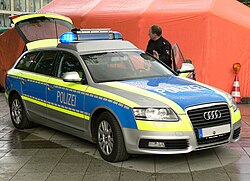
Autobahnpolizei car (Lower Saxony)
Autobahnpolizei in 1959, standing beside their Porsche 356 police cars

Autobahnpolizei is the term in Germany for the highway patrol. Heavy traffic and high-speed accidents resulted in the creation of special police units to patrol the expressways known as Autobahnen.

Organisation

[edit]

Although the autobahns are federal roads, the Autobahnpolizei are always part of the state police (Landespolizei in Germany). In Switzerland, the state police (Kantonspolizei) is responsible for highway patrols as well.

Operations

[edit]

Autobahnpolizei officers facilitate and regulate the flow of traffic, help motorists whose vehicles have broken down on the Autobahn and rapidly respond to accidents. Vehicle safety checks and crime prevention at rest stops are also part of the Autobahnpolizei duties.

Investigation sections probe crime at rest stops and the movement of criminals and smugglers on the Autobahn, often together with German Customs. The Autobahnpolizei also use fast unmarked vehicles with video cameras discreetly mounted front and back to follow and film reckless drivers and speeders. Approximately 30% of autobahns in Germany have a permanent speed limit of 130 km/h (80 mph) or less, primarily in urban areas. On the remainder, the 130 km/h speed limit is only advisory.

Media

[edit]

See also

[edit]
[edit]
Revisions and contributorsEdit on WikipediaRead on Wikipedia
from Grokipedia
The Autobahnpolizei is the specialized division within Germany's state police forces (), tasked with monitoring and enforcing traffic regulations on the federal network, responding to accidents, assisting stranded motorists, and pursuing fleeing criminals to maintain safety on these high-speed roadways. Established in response to the increasing volume of heavy traffic and high-speed accidents following the expansion of the system in the mid-20th century, the Autobahnpolizei operates as a decentralized unit under each of Germany's 16 federal states, with dedicated stations (Polizeiautobahnstationen) positioned strategically along the over 13,000 kilometers of motorways. This structure allows for localized oversight, such as in , where the unit covers 806 kilometers divided into four directional areas (north, east, south, and west) handling routes like the A2, A10, and A13, or in Hessen, where officers conduct routine patrols and inspections from regional bases. Officers are equipped with high-performance vehicles, including unmarked cars fitted with video cameras (such as ProViDa systems) for documenting violations like speeding and , enabling effective enforcement even at velocities exceeding 200 km/h. Key responsibilities extend beyond routine traffic control to include escorting oversized heavy-load transports, securing scenes, removing road hazards, and collaborating with other agencies on investigations involving or along the highways. Operating 24/7, the Autobahnpolizei plays a critical role in Germany's road safety framework, contributing to low fatality rates on the despite the absence of a general on many sections, through proactive measures like stationary speed traps and mobile pursuits. Their work demands specialized training in high-risk driving and rapid response, underscoring their essential function in one of Europe's most iconic and demanding systems.

History

Origins and Formation

The Reichsautobahnen project, launched in September 1933 as a cornerstone of Nazi infrastructure initiatives, marked the systematic development of Germany's high-speed highway network, designed to alleviate and symbolize technological progress under the regime. This effort built on pre-existing plans, with construction accelerating rapidly to connect major cities and support economic mobilization. The opening of the initial 19-kilometer stretch between and in August 1932—predating full Nazi control—highlighted the immediate regulatory needs for these innovative roads, prompting a dedicated police ordinance that prohibited , stopping, and access by non-motorized vehicles to maintain flow and safety. Under the Reichsautobahnen framework, the first official segment from to was inaugurated on May 19, 1935, further emphasizing the requirement for oversight amid rising vehicle speeds and volumes on purpose-built expressways. Initially, traffic control on these routes fell to the Bahnpolizei (railway police), but on August 14, 1936, the Chief of the German Police issued a decree transferring these duties exclusively to state police authorities, formalizing specialized enforcement under the centralized Reichsinnenministerium structure to align with the provisional Autobahn operating regulations of May 1935. These pre-war foundations evolved into state-level Landespolizei units after 1945. The network's expansion to approximately 3,860 kilometers of completed roadways by late —amid wartime priorities—intensified challenges, including a surge in high-speed accidents due to limited driver experience with unrestricted velocities and growing commercial traffic, which strained ad-hoc policing measures and necessitated ongoing refinements in patrol capabilities.

Post-War Development and Modernization

Following the of in May 1945, the Allied occupation authorities dissolved the centralized Nazi-era police structures, including those responsible for oversight, as part of broader efforts to dismantle the militarized . This dissolution left a vacuum in amid post-war chaos, with initial policing handled by Allied military forces in their respective zones. By 1949, with the establishment of the Federal Republic of Germany (), state-level forces were re-established in each of the western states, incorporating specialized units for emerging infrastructure needs, including early patrols integrated into these decentralized systems. The 1950s marked a period of significant expansion for the Autobahnpolizei, coinciding with the reconstruction and extension of the network in , where most war-damaged sections were repaired and new segments added to support economic recovery under the "." This growth necessitated enhanced police presence to manage increasing volumes and enforce safety regulations on the expanding roadways by the decade's end. A notable milestone was the introduction of patrol vehicles in the late 1950s, including white cabriolet models deployed for high-speed pursuits. In the 1970s, federal standardization advanced through the inaugural Bundesverkehrswegeplan of 1973, which outlined a coordinated national framework for Autobahn development, prompting uniform protocols across states for traffic enforcement and resource allocation to handle rising commercial and passenger volumes. Following in 1990, the Autobahnpolizei structure was adapted to incorporate the former East German network, expanding oversight to the unified 13,000+ kilometers of motorways while aligning eastern units with western standards. The late 20th and early 21st centuries saw further reorganization to integrate the Autobahnpolizei into broader state structures, exemplified by the 2007 reform in , where specialized Autobahn units were incorporated into five regional Polizeipräsidien (Köln, , , , and ) for more efficient, centralized operations while maintaining state-level autonomy. Since the , modernization has emphasized digital integration, including the adoption of cross-border communications tested successfully with neighboring countries like in 2010, facilitating real-time coordination under EU frameworks such as Schengen and the for rapid information exchange on transnational threats. These advancements align with escalating traffic demands, as the network now accommodates approximately 35 million vehicles daily as of 2023 amid growth driven by economic activity and EU mobility, requiring adaptive strategies like automated number plate recognition and enhanced EU protocols for pursuits and incident response.

Organization

Structure and Jurisdiction

The Autobahnpolizei operates as a specialized subunit within the state-level , specifically integrated into the branches responsible for uniformed patrol and traffic duties across Germany's 16 federal states. There is no centralized national Autobahnpolizei force; instead, responsibilities are decentralized according to the federal structure of German , with each state's interior ministry overseeing its . This integration ensures that Autobahnpolizei officers are subject to state-specific police laws (Landespolizeigesetze) while maintaining uniform operational standards for policing. Jurisdiction is strictly limited to , encompassing the entire Bundesautobahn network spanning approximately 13,192 kilometers, as well as selected restricted-access federal roads (Kraftfahrstraßen) and associated rest areas (Raststätten). Authority derives primarily from the Straßenverkehrsgesetz (Road Traffic Act) and related ordinances, which empower Autobahnpolizei to enforce traffic regulations, conduct patrols, and handle incidents exclusively within these designated areas, without extending to local or state roads unless in pursuit or emergency support scenarios. In cases of cross-state highway sections, coordination occurs through inter-state agreements to avoid jurisdictional overlaps. Organizationally, Autobahnpolizei units are structured around dedicated stations (Autobahnpolizeistationen, APS), districts or revier (Autobahnpolizeirevier, APrev), and watch posts (Autobahnpolizeiwachen, APW), which serve as operational bases for patrols and response teams. These units fall under regional police presidiums (Polizeipräsidien) or directorates within the (traffic police) department of each state's , with staffing distributed to cover high-traffic corridors. Staffing levels vary by state, with no centralized nationwide figure reported. State variations reflect differences in size, geography, and administrative priorities: 12 larger states, such as Bavaria, Hesse, and North Rhine-Westphalia, maintain dedicated Autobahnpolizei units with specialized stations and personnel focused solely on highways. Even smaller city-states like Hamburg maintain specialized Autobahnpolizei units integrated within the broader Verkehrspolizei operations. This decentralized approach allows for tailored responses to regional traffic volumes while adhering to federal highway management standards.

Personnel and Training

The Autobahnpolizei draws its personnel from general applicants, with recruitment handled through the respective systems across Germany's 16 states. Minimum requirements typically include German citizenship or nationality, an age range of 16 to 45 years at entry (varying by state and career level), demonstrated through standardized tests, and possession of a valid , as highway duties demand advanced vehicular proficiency. Initial training for police officers occurs at state-run police academies and lasts 2.5 to 3.5 years, combining theoretical instruction in , , and with practical exercises in procedures, weapons handling, and basic traffic enforcement. This foundational program prepares recruits for the middle or higher police service, culminating in probationary appointment as a Polizeimeister (police master). The Deutsche der Polizei in supports advanced education for leadership roles but is not the primary venue for entry-level training. Upon completion of basic training and assignment to an Autobahnpolizei unit—often as a Versetzung (transfer) based on performance and needs—officers receive additional specialized training varying by state, such as a 2-week orientation in , focused on highway-specific duties. This includes advanced high-speed driving techniques on closed tracks, accident reconstruction methods using forensic tools and software, strategies for high-stress traffic stops, and simulator-based training for pursuit and emergency scenarios to ensure safe intervention at speeds exceeding 200 km/h. Career progression within the Autobahnpolizei follows the standard state hierarchy, starting from Polizeimeister and advancing through ranks such as Polizeiobermeister, Polizeihauptmeister, and up to commissioned levels like Polizeikommissar or higher, based on service length, , and evaluations. Officers must maintain ongoing certifications in accident prevention (Unfallverhütung) through regular refresher courses on traffic safety protocols and EU-harmonized standards, particularly for border-adjacent patrols requiring multilingual capabilities in English, French, or Polish. Demographics of Autobahnpolizei personnel reflect broader trends, with over 70% male officers and an average age of 35 to 45 years; emphasis is placed on recruiting multilingual candidates for cross-border operations near frontiers.

Responsibilities

Traffic Enforcement

The Autobahnpolizei primarily enforces speed limits on Germany's , where an advisory maximum of 130 km/h applies on unrestricted sections that constitute about 70% of the network, while the remaining 30% features strict limits due to density, , or environmental factors. Officers deploy mobile and speed measurement devices from vehicles or stationary positions to detect exceedances, issuing on-the-spot fines ranging from €30 for minor infractions to over €1,000 for excessive speeding (e.g., more than 66 km/h over the limit), often accompanied by penalty points and potential license suspensions. In addition to speed control, the Autobahnpolizei addresses common violations including tailgating (failure to maintain safe following distance), improper lane usage (e.g., lingering in the left lane), and distractions from mobile phone use, which are monitored using video technology and visual observation. These offenses result in fines starting at €100, with points added to the driver's record; nationwide, German police issue millions of traffic violation tickets annually, with highway patrols playing a significant role in enforcement on motorways. Preventive measures form a key component of their role, including random vehicle inspections at roadside checkpoints to verify technical compliance, tire conditions, and load security, particularly for commercial trucks. also supports national awareness campaigns, such as the BMV's "Runter vom Gas" initiative promoting "Null Alkohol am Steuer" (zero alcohol tolerance) through signage and enforcement drives to deter impaired driving, aligning with stricter zero-promille rules for novice drivers and those under 21. All enforcement actions are grounded in the Straßenverkehrs-Ordnung (StVO), Germany's road traffic regulations, which outline prohibited behaviors and sanctions; violations lead to entries in the Flensburg Register (Fahreignungsregister), where accumulating 8 or more points can result in license revocation.

Accident and Emergency Response

The Autobahnpolizei plays a critical role in responding to collisions and emergencies on Germany's federal motorways, prioritizing rapid intervention to minimize further risks and support victims. Upon notification via the integrated emergency system or direct calls to 110, officers aim to reach the scene quickly, typically within 10-15 minutes in most cases, depending on location and traffic conditions, to secure the area by establishing protective perimeters and directing traffic flow away from the incident site. Officers provide immediate first aid to the injured using onboard medical kits and await or coordinate the arrival of professional services, ensuring compliance with Germany's integrated public safety framework where police lead initial scene management. Coordination with external agencies is a core element of their protocol; the Autobahnpolizei liaises directly with Feuerwehr (fire departments) for fire suppression, structural extrication, or , and Rettungsdienste () for advanced care and transport. This collaboration is facilitated through the nationwide Notruf 112 system, which dispatches multiple responders simultaneously based on incident severity, allowing for seamless handover of responsibilities such as victim stabilization and evidence preservation at the scene. In cases of vehicle breakdowns, Autobahnpolizei officers assist stranded motorists by assessing safety, activating hazard signals if needed, and arranging towing through services like or authorized providers while diverting traffic to prevent secondary incidents. For hazardous materials spills, which pose elevated risks on high-speed routes, officers follow specialized protocols under the Gefahrstoffunfall-Verordnung, including immediate evacuation of nearby areas, using available absorbents, and notification of environmental authorities and hazmat teams to mitigate and ensure safe cleanup. Annually, Germany's autobahns see approximately 30,000 reported accidents, including around 19,000 with , resulting in about 277 fatalities as of (preliminary data); the Autobahnpolizei's swift actions, such as site securing and medical , contribute to lowering severe injury rates by enabling faster access for ambulances and reducing exposure to ongoing traffic hazards. For major incidents involving multiple vehicles or complex scenarios, specialized units are deployed, including mobile command posts equipped for on-site coordination, communication, and to manage large-scale operations efficiently.

Equipment and Vehicles

Patrol Vehicles

The Autobahnpolizei, as specialized units within Germany's forces, primarily utilize a fleet of modified sedans and station wagons from premium manufacturers to meet the demands of high-speed enforcement and rapid response on motorways. Standard patrol vehicles include models such as the , , and Audi A6, which are selected for their balance of performance, reliability, and spaciousness for transporting equipment. For instance, in , the 520d Touring serves as a core patrol vehicle, equipped with diesel engines for extended range and tactical modifications to support 24/7 operations. These vehicles often feature all-wheel drive, suitable for pursuits at high speeds where necessary. Historically, the Autobahnpolizei employed more agile sports cars to match the era's high-speed traffic. A notable example is the 1960 356 Cabriolet, deployed by the Autobahnpolizei in , which produced 75 horsepower and covered nearly 160,000 kilometers until its retirement in 1966; it included custom features like blue flashing beacons, loudspeakers, and radio telephones for effective motorway interdiction. In modern operations, unmarked civilian vehicles—such as the or —are integrated into the fleet for discreet surveillance, allowing officers to monitor traffic without alerting speeders or violators. These unmarked cars, often equipped with concealed video systems, complement marked patrols in enforcing regulations on unrestricted autobahn sections. Key features across the fleet enhance visibility and safety, including integrated blue LED emergency lighting mounted on the roof and reinforced body structures for durability during pursuits or accident responses. Many states apply high-visibility neon yellow reflector stripes to the vehicles' sides and rear; for example, Lower Saxony introduced broad yellow stripes in 2010 to improve detectability in low-light conditions, while similar fluorescent yellow foils are standard in North Rhine-Westphalia and Rheinland-Pfalz. The Autobahnpolizei maintains a fleet of specialized vehicles through state-level procurement, with regular maintenance and renewals ensuring operational readiness; in Baden-Württemberg alone, nearly 1,000 new units were procured in 2024 to modernize about 20% of the total police inventory. Since 2023, trials of electric and hybrid models have begun for sustainability, such as plug-in hybrids like the BMW X1 xDrive30e (with an 80 km electric range) in Baden-Württemberg and fully electric variants in Bavaria's Autobahnpolizei stations; as of 2025, Bavaria began testing high-performance electric models with 340 PS for highway patrols.

Technology and Gear

The Autobahnpolizei, within Germany's state police forces, employs advanced surveillance technologies to enhance traffic monitoring and enforcement on Germany's highways. In-car video systems, including front- and rear-facing cameras, are integrated into patrol vehicles to record interactions, pursuits, and incidents, providing evidentiary support for investigations and improving officer accountability. Automatic Number Plate Recognition (ANPR) systems, utilizing optical character recognition to scan license plates in real time, are deployed to identify stolen or wanted vehicles, integrating with national databases for immediate alerts during patrols. Communication infrastructure relies on the TETRA (Terrestrial Trunked Radio) digital radio network, which ensures secure, encrypted voice and data transmission across federal and state agencies, enabling coordinated responses to highway emergencies. Drone support has been incorporated for aerial traffic monitoring since the early 2020s, with unmanned aerial vehicles equipped with cameras used to oversee congestion, accidents, and violations from above, particularly on high-traffic routes like the A2 and A72. Officers are equipped with personal protective and operational gear tailored to highway environments. Body-worn cameras, authorized for use since , capture frontline interactions to document evidence and de-escalate situations, with models like those from deployed in select operations. Non-lethal tools include tasers (Distanz-Elektroimpulsgeräte), which were approved for the federal police in 2025 and are used in varying capacities across forces to incapacitate suspects without firearms, alongside extendable batons for close-quarters control. Protective vests, typically rated SK1 for ballistic resistance against handgun ammunition and enhanced for impact from highway debris, are standard issue to mitigate risks during high-speed interventions. Recent innovations include AI-assisted speed detection systems from providers like VITRONIC, which use and to measure velocities across multiple lanes without roadside infrastructure, improving accuracy in variable weather conditions. Additionally, integration with the automobile club provides real-time traffic and breakdown data, allowing officers to anticipate hazards and coordinate rescues more effectively through shared platforms.

Operations

Daily Procedures

The Autobahnpolizei maintains round-the-clock operations to provide continuous surveillance and response capabilities on Germany's federal highways. Shifts are structured in rotations typically lasting 8 to 12 hours, divided into early morning, daytime, and night duties, with heightened focus on peak traffic periods such as mornings and evenings when congestion and speeding risks increase. Patrol units generally consist of two officers per vehicle to ensure safety during high-speed interventions and to facilitate coordinated responses. Daily routines center on mobile patrols along assigned highway sections, where officers monitor traffic flow, conduct vehicle checks, and enforce speed limits using specialized tools like ProViDa camera systems mounted in patrol vehicles to securely record violations. Rest areas and service stations are regularly inspected for compliance with parking regulations and driver fatigue issues, particularly for commercial trucks. Traffic information is integrated from national systems managed by the , allowing officers to anticipate and respond to congestion or incidents in real time. Standard protocols for stops involve activating lights and sirens to signal vehicles and directing the driver to a safe location off the roadway to minimize risks on the fast-moving , often using displays or signals indicating "Bitte folgen" (Please follow). All interactions, from initial contact to violation documentation, are logged digitally through integrated police reporting systems to ensure accurate records and chain-of-evidence integrity. Procedures adapt to seasonal conditions, with winter patrols emphasizing enforcement of winter tire requirements under § 2 StVO when road surfaces are icy or snowy, including spot checks on trucks for mandatory or alternative equipment in designated areas. During adverse weather, officers prioritize de-icing coordination and hazard mitigation to prevent chain-reaction accidents.

Interagency Cooperation

The Autobahnpolizei, as part of Germany's state-level police forces, maintains close domestic cooperation with the federal Bundespolizei, particularly on border-adjacent Autobahns where responsibilities overlap in securing transportation routes and combating cross-state threats. This partnership involves joint patrols and controls to address issues such as unauthorized migration and , leveraging the Bundespoliziei's federal mandate for railway, airport, and border security alongside the Autobahnpolizie's highway expertise. Similarly, the Autobahnpolizei collaborates extensively with the Zoll (German customs administration) during targeted operations on Autobahns to detect smuggling, illegal employment, and customs violations. These joint controls often include vehicle inspections and document checks, as demonstrated in a 2023 operation on Autobahn 44 where Zoll and police teams identified violations related to illegal employment and labor laws. In another instance, a 2024 large-scale check on the A7 near Schuby involved state police (including Autobahnpolizei), Bundespolizei, and Zoll, resulting in detections of traffic offenses, smuggling attempts, and administrative irregularities. Such collaborations enhance enforcement efficiency by combining customs expertise with police authority. On the international front, the Autobahnpolizei participates in EU-wide protocols under the Schengen Agreement, which facilitates seamless cross-border policing without internal frontier checks while enabling coordinated responses to transnational threats. This includes hot pursuit rights and mutual assistance in investigations along shared highways. Joint operations with neighboring countries, such as Austria and Poland, occur through Police Cooperation Centres (PCCs), like the one in Passau for German-Austrian efforts, focusing on traffic safety, smuggling prevention, and pursuit across borders. For example, the Autobahnpolizei serves as a designated contact point in Cologne for cross-border joint operations, supporting rapid information exchange and tactical coordination. Support networks further bolster the Autobahnpolizie's capabilities through coordination with organizations like the (General German Automobile Club) for roadside rescues and traffic management during high-volume periods. Additionally, the Autobahnpolizei accesses the shared INPOL database, a nationwide police information system managed by the Bundeskriminalamt, which provides real-time data on persons, vehicles, and objects to all federal and state forces for swift verification during patrols. In anti-trafficking efforts, the Autobahnpolizei engages in operations coordinated by , contributing to EU-wide initiatives that have safeguarded victims and led to arrests along major transit routes. For example, in the 2025 Operation Global Chain, led by Austrian and Romanian authorities with German participation, law enforcement across 43 countries, including , identified 1,194 potential victims and arrested 158 suspects involved in networks. These efforts highlight the Autobahnpolizie's role in disrupting on international highways.

Cultural and Media Impact

Public Perception and Statistics

The Autobahnpolizei is generally perceived as an efficient and authoritative force in maintaining order on Germany's highways, with in as a whole standing at 77 percent according to a 2024 survey conducted by the . This high approval reflects views of the unit as strict enforcers who contribute to road safety, though some drivers criticize their rigorous speed and checks as overly punitive. Key statistics highlight the unit's operational scope: in 2024, German police processed approximately 4.1 million violations nationwide, with a significant portion handled by the Autobahnpolizei on motorways, including around 59,000 offenses in in 2023. Despite Autobahns accounting for about 30 percent of national vehicle kilometers traveled, they represented only 6.7 percent of all accidents in recent years, underscoring the relative of these routes. In 2023, motorways saw 19,086 accidents with and 302 fatalities; preliminary 2024 data indicates approximately 20,113 accidents and around 280 fatalities on motorways, continuing the downward trend. This marks a stark improvement from the when annual Autobahn fatalities exceeded 1,200 amid higher volumes and fewer measures, with overall fatalities declining to 2,780 in 2024. The Autobahnpolizei's effectiveness is evident in the overall decline in fatalities, from over 1,500 in 1990 to 302 in 2023 and further to around 280 in 2024, attributed in part to targeted patrols, advanced technologies, and interagency efforts that have reduced severe crashes by enhancing compliance with speed limits and spacing rules. However, challenges persist, including understaffing in rural sections, where the Bundespolizei faces a projected shortfall of up to 1,000 positions in 2024, potentially straining response times and coverage. Controversies involving the Autobahnpolizei are rare but include isolated incidents during operations, often balanced by the unit's transparency measures such as body cameras and public reporting on actions. These incidents represent a small fraction of operations, with the overall focus remaining on preventive policing to sustain declining accident rates.

Representation in Media

The Autobahnpolizei has been prominently featured in German television, most notably through the long-running action series Alarm für Cobra 11 – Die Autobahnpolizei, which premiered on RTL in 1996 and has produced over 400 episodes as of 2025. The show follows a team of officers based in the Bonn-Cologne area who engage in high-stakes pursuits against criminals, emphasizing explosive car chases, stunts, and shootouts that portray the officers as daring heroes navigating the dangers of Germany's motorways. This dramatized depiction has made the series a staple of German pop , drawing comparisons to Hollywood action formats like while showcasing the Autobahnpolizei's role in traffic enforcement and crime prevention. Stereotypical portrayals in Alarm für Cobra 11 often cast Autobahnpolizei officers as adrenaline-fueled "speed demons" piloting high-performance vehicles, reinforcing an image of stern, unflinching enforcers who prioritize pursuit over protocol. The series has faced criticism for perpetuating clichés, including oversimplified representations of ethnic minorities such as the Turkish-German community through lead character Semir Gerkhan, portrayed by Erdoğan Atalay since 1997, which serves as a symbol of but occasionally relies on orientalist tropes. These elements contribute to a romanticized view of the force as elite thrill-seekers, contrasting with more grounded procedural shows like that occasionally feature highway units in episodic stories. Historical depictions romanticize the Autobahnpolizei's early days, particularly the use of Porsche 356 cabriolets introduced in 1959 for rapid response on the expanding motorway network. Archival footage and documentaries highlight these vehicles as icons of efficiency, with officers shown as vigilant guardians of the Autobahn's speed and order, often in black-and-white clips from Austrian and West German broadcasts that emphasize their agility in pursuits. Such portrayals in mid-20th-century media, including newsreels, underscore a narrative of technological prowess and national pride in infrastructure policing. Media representations like Alarm für Cobra 11 have positively influenced recruitment by glamorizing the profession, though they exaggerate operational risks and dangers, potentially shaping public narratives around real-world incident statistics. In coverage of events such as the 2015 European refugee crisis, news outlets briefly depicted patrols aiding migrant transports on highways, blending factual reporting with dramatic undertones of border security. In the 2020s, streaming platforms have amplified these portrayals through international access to Alarm für Cobra 11 episodes and related content on services like , where modern German crime thrillers such as (2017–present) provide historical context for Weimar-era policing that indirectly informs contemporary highway force imagery, focusing on advanced tech in urban-rural chases.

References

Add your contribution
Related Hubs
User Avatar
No comments yet.