



Community hub
Recent from talks
Knowledge base stats:
Talk channels stats:
Members stats:
Autoclave
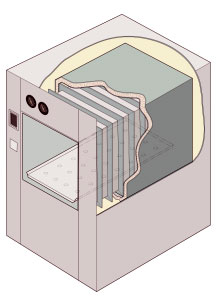
An autoclave is a machine used to carry out industrial and scientific processes requiring elevated temperature and pressure in relation to ambient pressure and temperature. Autoclaves are found in many medical settings, laboratories, and other places that need to ensure the sterility of an object.
The autoclave was invented by Charles Chamberland in 1879, although a precursor known as the steam digester was created by Denis Papin in 1679. The name comes from Greek auto-, meaning "self", and Latin clavis meaning "key", thus a self-locking device. All autoclaves operate according to the same fundamental principles as a kitchen pressure cooker. The simplest autoclaves (so-called "stovetop autoclaves") are largely indistinguishable from pressure cookers used in food preparation.
Autoclaves are most commonly used before surgical procedures to sterilize medical instruments and supplies. This is accomplished by subjecting these items to pressurized saturated steam at 121 °C (250 °F) at a gauge pressure of 15 pounds per square inch (100 kPa; 1.0 atm) for 15 to 60 minutes (or longer), depending on the size, density, and contents of the load.
Industrial autoclaves are used in industrial applications, especially in the manufacturing of composites. Autoclaves are also commonly used in the chemical industry to cure coatings, vulcanize rubber, and for hydrothermal synthesis. Flexible "research-grade" autoclaves are used in a wide range of research and industrial tasks, including quality control and quality assurance for food and beverage production, biomedical and pharmaceutical research and development, and product testing.
Sterilization autoclaves are widely used in microbiology and mycology, medicine and prosthetics fabrication, tattooing and body piercing, and funerary practice, and a wide range of industries (including food production). Autoclaves vary in size and function depending on the media to be sterilized. They are sometimes called retorts in the chemical and food industries (in the latter case this is short for "canning retorts"). Typical loads include laboratory glassware, growth media, other equipment, surgical instruments, and potentially pathogenic waste.
A notable recent and increasingly popular application of autoclaves is the pre-disposal treatment and sterilization of waste material, such as pathogenic medical waste. Machines in this category largely operate under the same principles as conventional autoclaves in that they are able to neutralize (but not eliminate) potentially infectious agents by using pressurized steam and superheated water. A thermal effluent decontamination system functions as a single-purpose autoclave designed for the sterilization of liquid waste and effluent.
Autoclaves are also widely used to cure composites, especially for melding multiple layers without any voids that would decrease material strength (as is the case in producing laminated glass), and in the vulcanization of rubber. The high heat and pressure that autoclaves generate help to ensure that the best possible physical properties are repeatable. Manufacturers of spars for sailboats have autoclaves well over 50 feet (15 m) long and 10 feet (3 m) wide, and some autoclaves in the aerospace industry are large enough to hold whole airplane fuselages made of layered composites.
It is very important to ensure that all of the trapped air is removed from the load prior to beginning the sterilization cycle, as trapped air is a very poor medium for achieving sterility. Steam at 134 °C (273 °F) can achieve a desired level of sterility in three minutes, while achieving the same level of sterility in hot air requires two hours at 160 °C (320 °F). Methods of air removal include:
Hub AI
Autoclave AI simulator
(@Autoclave_simulator)
Autoclave
An autoclave is a machine used to carry out industrial and scientific processes requiring elevated temperature and pressure in relation to ambient pressure and temperature. Autoclaves are found in many medical settings, laboratories, and other places that need to ensure the sterility of an object.
The autoclave was invented by Charles Chamberland in 1879, although a precursor known as the steam digester was created by Denis Papin in 1679. The name comes from Greek auto-, meaning "self", and Latin clavis meaning "key", thus a self-locking device. All autoclaves operate according to the same fundamental principles as a kitchen pressure cooker. The simplest autoclaves (so-called "stovetop autoclaves") are largely indistinguishable from pressure cookers used in food preparation.
Autoclaves are most commonly used before surgical procedures to sterilize medical instruments and supplies. This is accomplished by subjecting these items to pressurized saturated steam at 121 °C (250 °F) at a gauge pressure of 15 pounds per square inch (100 kPa; 1.0 atm) for 15 to 60 minutes (or longer), depending on the size, density, and contents of the load.
Industrial autoclaves are used in industrial applications, especially in the manufacturing of composites. Autoclaves are also commonly used in the chemical industry to cure coatings, vulcanize rubber, and for hydrothermal synthesis. Flexible "research-grade" autoclaves are used in a wide range of research and industrial tasks, including quality control and quality assurance for food and beverage production, biomedical and pharmaceutical research and development, and product testing.
Sterilization autoclaves are widely used in microbiology and mycology, medicine and prosthetics fabrication, tattooing and body piercing, and funerary practice, and a wide range of industries (including food production). Autoclaves vary in size and function depending on the media to be sterilized. They are sometimes called retorts in the chemical and food industries (in the latter case this is short for "canning retorts"). Typical loads include laboratory glassware, growth media, other equipment, surgical instruments, and potentially pathogenic waste.
A notable recent and increasingly popular application of autoclaves is the pre-disposal treatment and sterilization of waste material, such as pathogenic medical waste. Machines in this category largely operate under the same principles as conventional autoclaves in that they are able to neutralize (but not eliminate) potentially infectious agents by using pressurized steam and superheated water. A thermal effluent decontamination system functions as a single-purpose autoclave designed for the sterilization of liquid waste and effluent.
Autoclaves are also widely used to cure composites, especially for melding multiple layers without any voids that would decrease material strength (as is the case in producing laminated glass), and in the vulcanization of rubber. The high heat and pressure that autoclaves generate help to ensure that the best possible physical properties are repeatable. Manufacturers of spars for sailboats have autoclaves well over 50 feet (15 m) long and 10 feet (3 m) wide, and some autoclaves in the aerospace industry are large enough to hold whole airplane fuselages made of layered composites.
It is very important to ensure that all of the trapped air is removed from the load prior to beginning the sterilization cycle, as trapped air is a very poor medium for achieving sterility. Steam at 134 °C (273 °F) can achieve a desired level of sterility in three minutes, while achieving the same level of sterility in hot air requires two hours at 160 °C (320 °F). Methods of air removal include: