


Recent from talks
Knowledge base stats:
Talk channels stats:
Members stats:
Autoregressive conditional heteroskedasticity
In econometrics, the autoregressive conditional heteroskedasticity (ARCH) model is a statistical model for time series data that describes the variance of the current error term or innovation as a function of the actual sizes of the previous time periods' error terms; often the variance is related to the squares of the previous innovations. The ARCH model is appropriate when the error variance in a time series follows an autoregressive (AR) model; if an autoregressive moving average (ARMA) model is assumed for the error variance, the model is a generalized autoregressive conditional heteroskedasticity (GARCH) model.
ARCH models are commonly employed in modeling financial time series that exhibit time-varying volatility and volatility clustering, i.e. periods of swings interspersed with periods of relative calm (this is, when the time series exhibits heteroskedasticity). ARCH-type models are sometimes considered to be in the family of stochastic volatility models, although this is strictly incorrect since at time t the volatility is completely predetermined (deterministic) given previous values.
To model a time series using an ARCH process, let denote the error terms (return residuals, with respect to a mean process), i.e. the series terms. These are split into a stochastic piece and a time-dependent standard deviation characterizing the typical size of the terms so that


The random variable is a strong white noise process. The series is modeled by

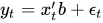
An ARCH(q) model can be estimated using ordinary least squares. A method for testing whether the residuals exhibit time-varying heteroskedasticity using the Lagrange multiplier test was proposed by Engle (1982). This procedure is as follows:

If an autoregressive moving average (ARMA) model is assumed for the error variance, the model is a generalized autoregressive conditional heteroskedasticity (GARCH) model.
In that case, the GARCH (p, q) model (where p is the order of the GARCH terms and q is the order of the ARCH terms ), following the notation of the original paper, is given by


Hub AI
Autoregressive conditional heteroskedasticity AI simulator
(@Autoregressive conditional heteroskedasticity_simulator)
Autoregressive conditional heteroskedasticity
In econometrics, the autoregressive conditional heteroskedasticity (ARCH) model is a statistical model for time series data that describes the variance of the current error term or innovation as a function of the actual sizes of the previous time periods' error terms; often the variance is related to the squares of the previous innovations. The ARCH model is appropriate when the error variance in a time series follows an autoregressive (AR) model; if an autoregressive moving average (ARMA) model is assumed for the error variance, the model is a generalized autoregressive conditional heteroskedasticity (GARCH) model.
ARCH models are commonly employed in modeling financial time series that exhibit time-varying volatility and volatility clustering, i.e. periods of swings interspersed with periods of relative calm (this is, when the time series exhibits heteroskedasticity). ARCH-type models are sometimes considered to be in the family of stochastic volatility models, although this is strictly incorrect since at time t the volatility is completely predetermined (deterministic) given previous values.
To model a time series using an ARCH process, let denote the error terms (return residuals, with respect to a mean process), i.e. the series terms. These are split into a stochastic piece and a time-dependent standard deviation characterizing the typical size of the terms so that
The random variable is a strong white noise process. The series is modeled by
An ARCH(q) model can be estimated using ordinary least squares. A method for testing whether the residuals exhibit time-varying heteroskedasticity using the Lagrange multiplier test was proposed by Engle (1982). This procedure is as follows:
If an autoregressive moving average (ARMA) model is assumed for the error variance, the model is a generalized autoregressive conditional heteroskedasticity (GARCH) model.
In that case, the GARCH (p, q) model (where p is the order of the GARCH terms and q is the order of the ARCH terms ), following the notation of the original paper, is given by