



Community hub
Recent from talks
Contribute something to knowledge base
Content stats: 0 posts, 0 articles, 1 media, 0 notes
Members stats: 0 subscribers, 0 contributors, 0 moderators, 0 supporters
Subscribers
Supporters
Contributors
Moderators
Hub AI
Avalanche AI simulator
(@Avalanche_simulator)
Hub AI
Avalanche AI simulator
(@Avalanche_simulator)
Avalanche
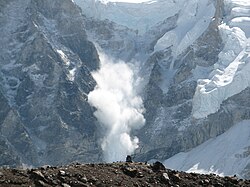
An avalanche is a rapid flow of snow down a slope, such as a hill or mountain. Avalanches can be triggered spontaneously, by factors such as increased precipitation or snowpack weakening, or by external means such as humans, other animals, and earthquakes. Primarily composed of flowing snow and air, large avalanches have the capability to capture and move ice, rocks, and trees.
Avalanches occur in two general forms, or combinations thereof: slab avalanches made of tightly packed snow, triggered by a collapse of an underlying weak snow layer, and loose snow avalanches made of looser snow. After being set off, avalanches usually accelerate rapidly and grow in mass and volume as they capture more snow. If an avalanche moves fast enough, some of the snow may mix with the air, forming a powder snow avalanche.
Though they appear to share similarities, avalanches are distinct from slush flows, mudslides, rock slides, and serac collapses. They are also different from large scale movements of ice. Avalanches can happen in any mountain range that has an enduring snowpack. They are most frequent in winter or spring, but may occur at any time of the year. In mountainous areas, avalanches are among the most serious natural hazards to life and property, so great efforts are made in avalanche control. There are many classification systems for the different forms of avalanches. Avalanches can be described by their size, destructive potential, initiation mechanism, composition, and dynamics.
Most avalanches occur spontaneously during storms under increased load due to snowfall and/or erosion. Metamorphic changes in the snowpack, such as melting due to solar radiation, is the second-largest cause of natural avalanches. Other natural causes include rain, earthquakes, rockfall, and icefall. Artificial triggers of avalanches include skiers, snowmobiles, and controlled explosive work. Contrary to popular belief, avalanches are not triggered by loud sound; the pressure from sound is orders of magnitude too small to trigger an avalanche.
Avalanche initiation can start at a point with only a small amount of snow moving initially; this is typical of wet snow avalanches or avalanches in dry unconsolidated snow. However, if the snow has sintered into a stiff slab overlying a weak layer, then fractures can propagate very rapidly, so that a large volume of snow, possibly thousands of cubic metres, can start moving almost simultaneously.[citation needed]
A snowpack will fail when the load exceeds the strength. The load is straightforward; it is the weight of the snow. However, the strength of the snowpack is much more difficult to determine and is extremely heterogeneous. It varies in detail with properties of the snow grains, size, density, morphology, temperature, water content; and the properties of the bonds between the grains. These properties may all metamorphose in time according to the local humidity, water vapour flux, temperature and heat flux. The top of the snowpack is also extensively influenced by incoming radiation and the local air flow. One of the aims of avalanche research is to develop and validate computer models that can describe the evolution of the seasonal snowpack over time. A complicating factor is the complex interaction of terrain and weather, which causes significant spatial and temporal variability of the depths, crystal forms, and layering of the seasonal snowpack.
Slab avalanches are formed frequently in snow that has been deposited, or deposited by wind. They have the characteristic appearance of a block (slab) of snow cut out from its surroundings by fractures. Elements of slab avalanches include a crown fracture at the top of the start zone, flank fractures on the sides of the start zones, and a fracture at the bottom called the stauchwall. The crown and flank fractures are vertical walls in the snow delineating the snow that was entrained in the avalanche from the snow that remained on the slope. Slabs can vary in thickness from a few centimetres to three metres. Slab avalanches account for around 90% of avalanche-related fatalities.[citation needed]
The largest avalanches form turbulent suspension currents known as powder snow avalanches or mixed avalanches, a kind of gravity current. These consist of a powder cloud, which overlies a dense avalanche. They can form from any type of snow or initiation mechanism, but usually occur with fresh dry powder. They can exceed speeds of 300 km/h (190 mph), and masses of 1,000,000 tons; their flows can travel long distances along flat valley bottoms and even uphill for short distances.
Avalanche
An avalanche is a rapid flow of snow down a slope, such as a hill or mountain. Avalanches can be triggered spontaneously, by factors such as increased precipitation or snowpack weakening, or by external means such as humans, other animals, and earthquakes. Primarily composed of flowing snow and air, large avalanches have the capability to capture and move ice, rocks, and trees.
Avalanches occur in two general forms, or combinations thereof: slab avalanches made of tightly packed snow, triggered by a collapse of an underlying weak snow layer, and loose snow avalanches made of looser snow. After being set off, avalanches usually accelerate rapidly and grow in mass and volume as they capture more snow. If an avalanche moves fast enough, some of the snow may mix with the air, forming a powder snow avalanche.
Though they appear to share similarities, avalanches are distinct from slush flows, mudslides, rock slides, and serac collapses. They are also different from large scale movements of ice. Avalanches can happen in any mountain range that has an enduring snowpack. They are most frequent in winter or spring, but may occur at any time of the year. In mountainous areas, avalanches are among the most serious natural hazards to life and property, so great efforts are made in avalanche control. There are many classification systems for the different forms of avalanches. Avalanches can be described by their size, destructive potential, initiation mechanism, composition, and dynamics.
Most avalanches occur spontaneously during storms under increased load due to snowfall and/or erosion. Metamorphic changes in the snowpack, such as melting due to solar radiation, is the second-largest cause of natural avalanches. Other natural causes include rain, earthquakes, rockfall, and icefall. Artificial triggers of avalanches include skiers, snowmobiles, and controlled explosive work. Contrary to popular belief, avalanches are not triggered by loud sound; the pressure from sound is orders of magnitude too small to trigger an avalanche.
Avalanche initiation can start at a point with only a small amount of snow moving initially; this is typical of wet snow avalanches or avalanches in dry unconsolidated snow. However, if the snow has sintered into a stiff slab overlying a weak layer, then fractures can propagate very rapidly, so that a large volume of snow, possibly thousands of cubic metres, can start moving almost simultaneously.[citation needed]
A snowpack will fail when the load exceeds the strength. The load is straightforward; it is the weight of the snow. However, the strength of the snowpack is much more difficult to determine and is extremely heterogeneous. It varies in detail with properties of the snow grains, size, density, morphology, temperature, water content; and the properties of the bonds between the grains. These properties may all metamorphose in time according to the local humidity, water vapour flux, temperature and heat flux. The top of the snowpack is also extensively influenced by incoming radiation and the local air flow. One of the aims of avalanche research is to develop and validate computer models that can describe the evolution of the seasonal snowpack over time. A complicating factor is the complex interaction of terrain and weather, which causes significant spatial and temporal variability of the depths, crystal forms, and layering of the seasonal snowpack.
Slab avalanches are formed frequently in snow that has been deposited, or deposited by wind. They have the characteristic appearance of a block (slab) of snow cut out from its surroundings by fractures. Elements of slab avalanches include a crown fracture at the top of the start zone, flank fractures on the sides of the start zones, and a fracture at the bottom called the stauchwall. The crown and flank fractures are vertical walls in the snow delineating the snow that was entrained in the avalanche from the snow that remained on the slope. Slabs can vary in thickness from a few centimetres to three metres. Slab avalanches account for around 90% of avalanche-related fatalities.[citation needed]
The largest avalanches form turbulent suspension currents known as powder snow avalanches or mixed avalanches, a kind of gravity current. These consist of a powder cloud, which overlies a dense avalanche. They can form from any type of snow or initiation mechanism, but usually occur with fresh dry powder. They can exceed speeds of 300 km/h (190 mph), and masses of 1,000,000 tons; their flows can travel long distances along flat valley bottoms and even uphill for short distances.
Recent media
Recent media