



Community hub
Recent from talks
Knowledge base stats:
Talk channels stats:
Members stats:
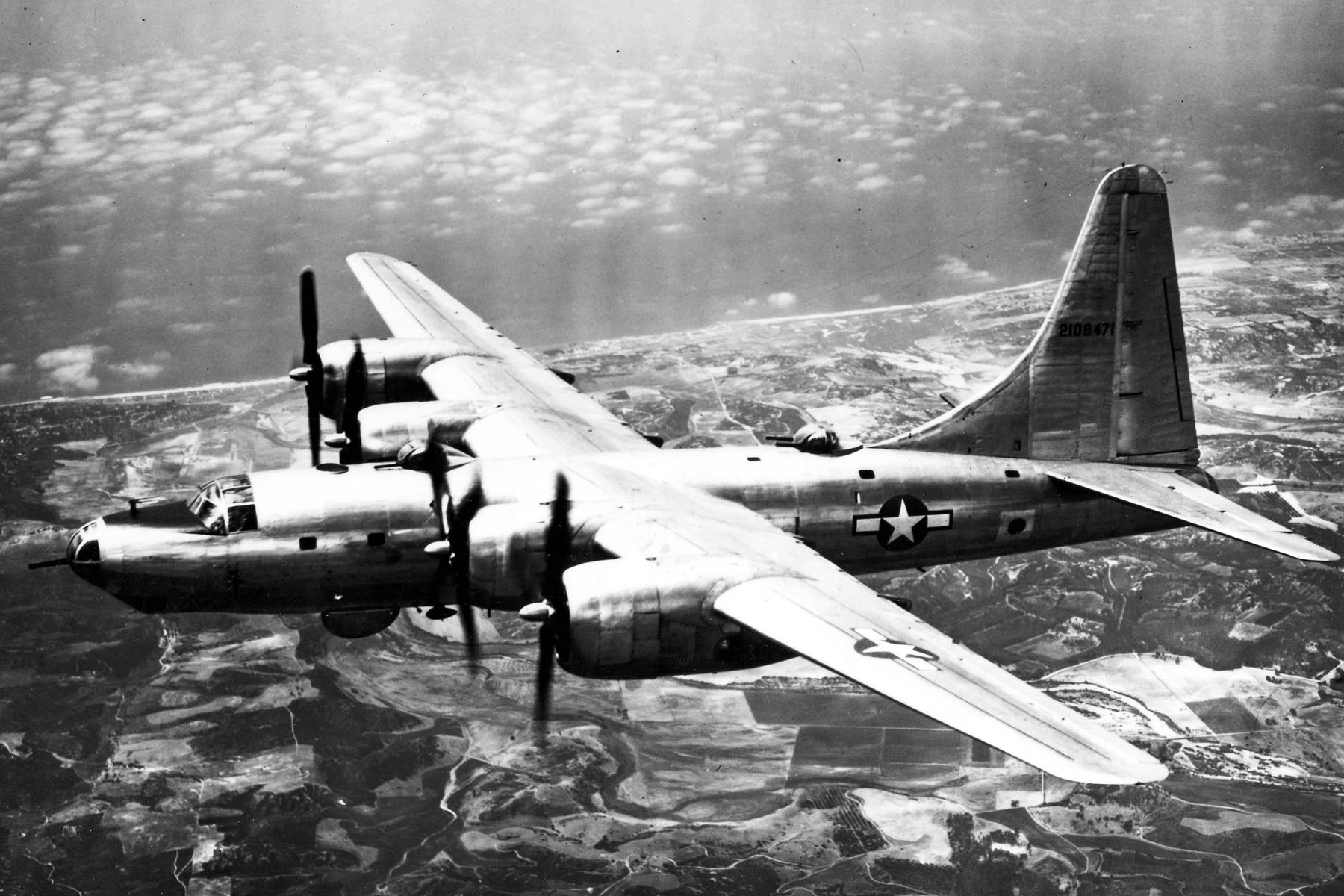
Consolidated B-32 Dominator
The Consolidated B-32 Dominator (Consolidated Model 34) was an American heavy strategic bomber built for the United States Army Air Forces during World War II. A B-32 was involved in the last air combat engagement of the war, resulting in the war's last American air combat death. It was developed by Consolidated Aircraft in parallel with the Boeing B-29 Superfortress as a fallback design should the B-29 prove unsuccessful. The B-32 reached units in the Pacific only in mid-May 1945, and subsequently saw only limited combat operations against Japanese targets before the end of the war on 2 September 1945. Most of the extant orders of the B-32 were canceled shortly thereafter and only 118 B-32 airframes of all types were built.
The engineering development of the B-29 had been underway since mid-1938 when, in June 1940, the United States Army Air Corps requested a similar design from the Consolidated Aircraft Company in case of development difficulties with the B-29.
The Model 33 on which Consolidated based its proposal was similar to the B-24 Liberator. Like the B-24 it was originally designed with a twin tail and a large Davis wing, but with a longer, rounder fuselage and a rounded nose. As can be seen in pictures, the B-32 also retained the B-24's tambour-panel "roller-type" bomb bay doors, which operated very much like the movable enclosure of a rolltop desk, retracted into the fuselage. These types of doors created a minimum of aerodynamic drag to keep speed high over the target area; they also allowed the bomb bays to be opened while on the ground since the low ground clearance prevented the use of normal bomb bay doors. The powerplants were to be the same quartet of eighteen-cylinder, 2,200 horsepower (1,600 kW) Wright Duplex-Cyclones, as specified for B-29s. The aircraft was designed to be pressurized, and have remote-controlled retractable gun turrets with fourteen .50 in (12.7 mm) machine guns. It was to have an estimated gross weight of 101,000 lb (46,000 kg). The first contract for two XB-32s was signed on 6 September 1940, the same day as the contract for the Boeing prototype XB-29.
The first XB-32-CO, AAF s/n 41-141, was constructed next to the Army Air Forces (AAF) Base Tarrant Field Airdrome at the AAF Aircraft Plant No. 4 just west of Fort Worth, Texas along the south side of Lake Worth. The Consolidated Vultee Bomber Plant assembly line was six months behind schedule, the aircraft making its first flight on 7 September 1942. Due to problems with the pressurization system, the gun turrets and landing gear doors, these items were omitted on the first prototype. The aircraft had R-3350-13 engines inboard and R-3350-21s outboard, with all four powerplants driving three-bladed propellers. The XB-32 had persistent problems with engine oil leaks and poor cooling, much like issues encountered during B-29 development. The inboard propellers' pitch could be reversed to shorten the landing roll or to roll back in ground maneuvers.
The first XB-32 was armed with eight .50 in (12.7 mm) machine guns in dorsal and ventral turrets, and an odd combination of two .50 caliber and one 20 mm (0.787 in) cannon in each outboard engine nacelle firing rearwards, plus two .50 caliber machine guns in the wings outboard of the propellers. The turrets were remotely controlled from periscopic sights in aiming stations inside the aircraft. The sights were coordinated by a sophisticated analog computer system developed by Sperry Gyroscope Company.
On 17 March 1943, the initial contract was signed for 300 B-32-CFs but development problems continued. On 10 May 1943, the first XB-32 crashed on takeoff after making a total of 30 flights before the second XB-32, s/n 41-142, finally flew on 2 July 1943. This aircraft had a traditional stepped cockpit canopy. Upon examination and testing, the USAAF recommended a large number of changes that included more conventional gun stations.
The pressurization system had problems which were never solved and so the role of the aircraft was changed to operating at low to medium altitude. This decision meant that the pressurization system was easily eliminated from production aircraft. Problems with the remote-controlled gun turrets were never solved and the armament on production aircraft was changed to 10 .50 caliber machine guns in manually operated turrets: Sperry A-17 turrets in the nose and tail, two Martin A-3F-A dorsal turrets, and one Sperry A-13-A ball turret. The bomb load was increased by 4,000 pounds (1,800 kg) to 20,000 pounds (9,100 kg).
The second XB-32 continued to have stability problems. In an attempt to resolve this a B-29 style tail was fitted to the aircraft after its 25th flight but this did not resolve the problem and a Consolidated-designed 19.5 ft (5.9 m) vertical tail was added and first flown on the third XB-32, s/n 41-18336 on 3 November 1943. The first production aircraft was fitted with a B-29 vertical tail until the new Consolidated tail was available for installation.
Hub AI
Consolidated B-32 Dominator AI simulator
(@Consolidated B-32 Dominator_simulator)
Consolidated B-32 Dominator
The Consolidated B-32 Dominator (Consolidated Model 34) was an American heavy strategic bomber built for the United States Army Air Forces during World War II. A B-32 was involved in the last air combat engagement of the war, resulting in the war's last American air combat death. It was developed by Consolidated Aircraft in parallel with the Boeing B-29 Superfortress as a fallback design should the B-29 prove unsuccessful. The B-32 reached units in the Pacific only in mid-May 1945, and subsequently saw only limited combat operations against Japanese targets before the end of the war on 2 September 1945. Most of the extant orders of the B-32 were canceled shortly thereafter and only 118 B-32 airframes of all types were built.
The engineering development of the B-29 had been underway since mid-1938 when, in June 1940, the United States Army Air Corps requested a similar design from the Consolidated Aircraft Company in case of development difficulties with the B-29.
The Model 33 on which Consolidated based its proposal was similar to the B-24 Liberator. Like the B-24 it was originally designed with a twin tail and a large Davis wing, but with a longer, rounder fuselage and a rounded nose. As can be seen in pictures, the B-32 also retained the B-24's tambour-panel "roller-type" bomb bay doors, which operated very much like the movable enclosure of a rolltop desk, retracted into the fuselage. These types of doors created a minimum of aerodynamic drag to keep speed high over the target area; they also allowed the bomb bays to be opened while on the ground since the low ground clearance prevented the use of normal bomb bay doors. The powerplants were to be the same quartet of eighteen-cylinder, 2,200 horsepower (1,600 kW) Wright Duplex-Cyclones, as specified for B-29s. The aircraft was designed to be pressurized, and have remote-controlled retractable gun turrets with fourteen .50 in (12.7 mm) machine guns. It was to have an estimated gross weight of 101,000 lb (46,000 kg). The first contract for two XB-32s was signed on 6 September 1940, the same day as the contract for the Boeing prototype XB-29.
The first XB-32-CO, AAF s/n 41-141, was constructed next to the Army Air Forces (AAF) Base Tarrant Field Airdrome at the AAF Aircraft Plant No. 4 just west of Fort Worth, Texas along the south side of Lake Worth. The Consolidated Vultee Bomber Plant assembly line was six months behind schedule, the aircraft making its first flight on 7 September 1942. Due to problems with the pressurization system, the gun turrets and landing gear doors, these items were omitted on the first prototype. The aircraft had R-3350-13 engines inboard and R-3350-21s outboard, with all four powerplants driving three-bladed propellers. The XB-32 had persistent problems with engine oil leaks and poor cooling, much like issues encountered during B-29 development. The inboard propellers' pitch could be reversed to shorten the landing roll or to roll back in ground maneuvers.
The first XB-32 was armed with eight .50 in (12.7 mm) machine guns in dorsal and ventral turrets, and an odd combination of two .50 caliber and one 20 mm (0.787 in) cannon in each outboard engine nacelle firing rearwards, plus two .50 caliber machine guns in the wings outboard of the propellers. The turrets were remotely controlled from periscopic sights in aiming stations inside the aircraft. The sights were coordinated by a sophisticated analog computer system developed by Sperry Gyroscope Company.
On 17 March 1943, the initial contract was signed for 300 B-32-CFs but development problems continued. On 10 May 1943, the first XB-32 crashed on takeoff after making a total of 30 flights before the second XB-32, s/n 41-142, finally flew on 2 July 1943. This aircraft had a traditional stepped cockpit canopy. Upon examination and testing, the USAAF recommended a large number of changes that included more conventional gun stations.
The pressurization system had problems which were never solved and so the role of the aircraft was changed to operating at low to medium altitude. This decision meant that the pressurization system was easily eliminated from production aircraft. Problems with the remote-controlled gun turrets were never solved and the armament on production aircraft was changed to 10 .50 caliber machine guns in manually operated turrets: Sperry A-17 turrets in the nose and tail, two Martin A-3F-A dorsal turrets, and one Sperry A-13-A ball turret. The bomb load was increased by 4,000 pounds (1,800 kg) to 20,000 pounds (9,100 kg).
The second XB-32 continued to have stability problems. In an attempt to resolve this a B-29 style tail was fitted to the aircraft after its 25th flight but this did not resolve the problem and a Consolidated-designed 19.5 ft (5.9 m) vertical tail was added and first flown on the third XB-32, s/n 41-18336 on 3 November 1943. The first production aircraft was fitted with a B-29 vertical tail until the new Consolidated tail was available for installation.