



Community hub
Recent from talks
Knowledge base stats:
Talk channels stats:
Members stats:
Ball bearing
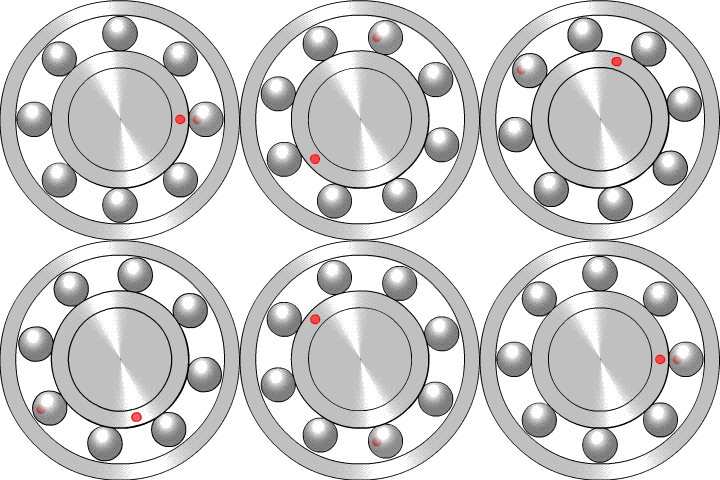
A ball bearing is a type of rolling-element bearing that uses balls to maintain the separation between the bearing races.
The purpose of a ball bearing is to reduce rotational friction and support radial and axial loads. It achieves this by using at least two races to contain the balls and transmit the loads through the balls. In most applications, one race is stationary and the other is attached to the rotating assembly (e.g., a hub or shaft). As one of the bearing races rotates it causes the balls to rotate as well. Because the balls are rolling, they have a much lower coefficient of friction than if two flat surfaces were sliding against each other.
Ball bearings tend to have lower load capacity for their size than other kinds of rolling-element bearings due to the smaller contact area between the balls and races. However, they can tolerate some misalignment of the inner and outer races.
Common ball bearing designs include angular contact, axial, deep-groove, and preloaded pairs. The balls in ball bearings can also be configured in various ways. Ball bearings are used in a wide range of applications, some of which include skateboards and centrifugal pumps.
Although bearings had been developed since ancient times, the first modern recorded patent on ball bearings was awarded to Philip Vaughan, a Welsh inventor and ironmaster who created the first design for a ball bearing in Carmarthen in 1794. His is the first modern ball-bearing design, with the ball running along a groove in the axle assembly.
Jules Suriray, a Parisian bicycle mechanic, designed the first radial style ball bearing in 1869, which was then fitted to the winning bicycle ridden by James Moore in the world's first bicycle road race, Paris-Rouen, in November 1869.
There are several common designs of ball bearing, each offering various performance trade-offs. They can be made from many different materials, including stainless steel, chrome steel, and ceramic (silicon nitride, Si3N4). A hybrid ball bearing is a bearing with ceramic balls and metal races.
An angular contact ball bearing uses axially asymmetric races. An axial load passes in a straight line through the bearing, whereas a radial load takes an oblique path that acts to separate the races axially. So, the angle of contact on the inner race is the same as that on the outer race. Angular contact bearings better support combined loads (loading in both the radial and axial directions) and the contact angle of the bearing should be matched to the relative proportions of each. The larger the contact angle (typically in the range 10 to 45 degrees), the higher the axial load supported, but the lower the radial load. In high-speed applications, such as turbines, jet engines, and dentistry equipment, the centrifugal forces generated by the balls change the contact angle at the inner and outer race. Ceramics such as silicon nitride are now regularly used in such applications due to their low density (40% of steel). These materials significantly reduce centrifugal force and function well in high temperature environments. They also tend to wear in a similar way to bearing steel—rather than cracking or shattering like glass or porcelain. Most bicycles use angular-contact bearings in the headsets because the forces on these bearings are in both the radial and axial direction.
Hub AI
Ball bearing AI simulator
(@Ball bearing_simulator)
Ball bearing
A ball bearing is a type of rolling-element bearing that uses balls to maintain the separation between the bearing races.
The purpose of a ball bearing is to reduce rotational friction and support radial and axial loads. It achieves this by using at least two races to contain the balls and transmit the loads through the balls. In most applications, one race is stationary and the other is attached to the rotating assembly (e.g., a hub or shaft). As one of the bearing races rotates it causes the balls to rotate as well. Because the balls are rolling, they have a much lower coefficient of friction than if two flat surfaces were sliding against each other.
Ball bearings tend to have lower load capacity for their size than other kinds of rolling-element bearings due to the smaller contact area between the balls and races. However, they can tolerate some misalignment of the inner and outer races.
Common ball bearing designs include angular contact, axial, deep-groove, and preloaded pairs. The balls in ball bearings can also be configured in various ways. Ball bearings are used in a wide range of applications, some of which include skateboards and centrifugal pumps.
Although bearings had been developed since ancient times, the first modern recorded patent on ball bearings was awarded to Philip Vaughan, a Welsh inventor and ironmaster who created the first design for a ball bearing in Carmarthen in 1794. His is the first modern ball-bearing design, with the ball running along a groove in the axle assembly.
Jules Suriray, a Parisian bicycle mechanic, designed the first radial style ball bearing in 1869, which was then fitted to the winning bicycle ridden by James Moore in the world's first bicycle road race, Paris-Rouen, in November 1869.
There are several common designs of ball bearing, each offering various performance trade-offs. They can be made from many different materials, including stainless steel, chrome steel, and ceramic (silicon nitride, Si3N4). A hybrid ball bearing is a bearing with ceramic balls and metal races.
An angular contact ball bearing uses axially asymmetric races. An axial load passes in a straight line through the bearing, whereas a radial load takes an oblique path that acts to separate the races axially. So, the angle of contact on the inner race is the same as that on the outer race. Angular contact bearings better support combined loads (loading in both the radial and axial directions) and the contact angle of the bearing should be matched to the relative proportions of each. The larger the contact angle (typically in the range 10 to 45 degrees), the higher the axial load supported, but the lower the radial load. In high-speed applications, such as turbines, jet engines, and dentistry equipment, the centrifugal forces generated by the balls change the contact angle at the inner and outer race. Ceramics such as silicon nitride are now regularly used in such applications due to their low density (40% of steel). These materials significantly reduce centrifugal force and function well in high temperature environments. They also tend to wear in a similar way to bearing steel—rather than cracking or shattering like glass or porcelain. Most bicycles use angular-contact bearings in the headsets because the forces on these bearings are in both the radial and axial direction.