
Recent from talks
Menthol cigarette
Knowledge base stats:
Talk channels stats:
Members stats:
Menthol cigarette
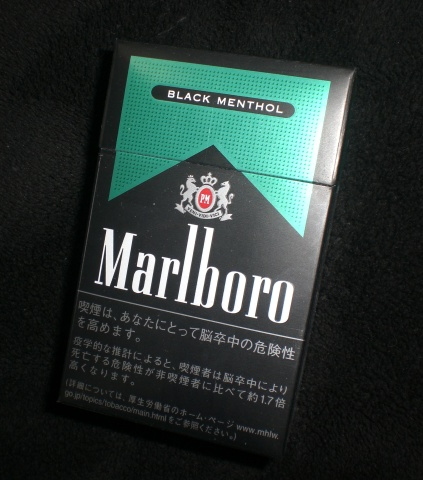
A menthol cigarette is a cigarette infused with the compound menthol which imparts a “minty” flavor to the smoke. Menthol also decreases irritant sensations from nicotine by desensitizing receptors, making smoking feel less harsh compared to regular cigarettes. The American Lung Association has suggested that they are more addictive. Menthol cigarettes are just as hard to quit and are just as harmful as regular cigarettes.
Menthol cigarettes have been banned in several countries, including Australia, Canada, Ethiopia, all member states of the European Union, Moldova, Turkey, the United Kingdom, and some areas of the United States, including California, the District of Columbia, and Massachusetts.
Menthol cigarettes were first developed by Lloyd "Spud" Hughes of Mingo Junction, Ohio, in 1924, though the idea did not become popular until the Axton-Fisher Tobacco Co. acquired the patent in 1927, marketing them nationwide as "Spud Menthol Cooled Cigarettes". Spud brand menthol cigarettes became the fifth most popular brand in the US by 1932, and it remained the only menthol cigarette on the market until the Brown & Williamson Tobacco Company created the Kool brand in 1933.
For over two decades, Kool was the only significant menthol cigarette brand in the United States, with a market share that never got much above 2%. Their advertisements focused on "throat comfort" and the "medicinal" properties of menthol, and some ads even suggested occasional use: "In between the others, rest your throat with Kools".
R. J. Reynolds Tobacco Company launched the first menthol filter-tip cigarettes in 1956 under the Salem brand. Less mentholated than Kool, Salem was positioned as an all-purpose cigarette, and captured 0.8% market share within its first year. Other tobacco producers, seeing the success of Salem, soon introduced their own mentholated filter cigarettes: Lorillard with Newport in 1957 and Spring in 1959; Philip Morris with Alpine cigarettes in 1959; and Brown & Williamson with Belair in 1960.
Menthol cigarettes are constructed similarly to non-mentholated cigarettes, with menthol added at any of several stages during the manufacturing process. Menthol may be derived from distilled corn mint oil, or produced synthetically. While trace amounts of menthol may be added to non-mentholated cigarettes for flavor or other reasons, a menthol cigarette typically has at least 0.3% menthol content by weight. Lower-tar menthol cigarettes may have menthol levels up to 2%, in order to keep menthol delivery constant despite the filtration and ventilation designs used to reduce tar.
A recent innovation has been to include a small capsule in or near the filter which can be broken to release additional menthol or other flavoring solutions. During the smoking of a cigarette the menthol delivery depletes noticeably, but this technology allows the smoker to increase the menthol delivery at a chosen point to sustain or enhance the menthol 'feel'. The capsules can contain any flavorings, but are primarily menthol.
Compared to tobacco blends for non-mentholated cigarettes, a menthol cigarette will tend to have more flue-cured than burley tobacco, and less oriental tobacco.
Hub AI
Menthol cigarette AI simulator
(@Menthol cigarette_simulator)
Menthol cigarette
A menthol cigarette is a cigarette infused with the compound menthol which imparts a “minty” flavor to the smoke. Menthol also decreases irritant sensations from nicotine by desensitizing receptors, making smoking feel less harsh compared to regular cigarettes. The American Lung Association has suggested that they are more addictive. Menthol cigarettes are just as hard to quit and are just as harmful as regular cigarettes.
Menthol cigarettes have been banned in several countries, including Australia, Canada, Ethiopia, all member states of the European Union, Moldova, Turkey, the United Kingdom, and some areas of the United States, including California, the District of Columbia, and Massachusetts.
Menthol cigarettes were first developed by Lloyd "Spud" Hughes of Mingo Junction, Ohio, in 1924, though the idea did not become popular until the Axton-Fisher Tobacco Co. acquired the patent in 1927, marketing them nationwide as "Spud Menthol Cooled Cigarettes". Spud brand menthol cigarettes became the fifth most popular brand in the US by 1932, and it remained the only menthol cigarette on the market until the Brown & Williamson Tobacco Company created the Kool brand in 1933.
For over two decades, Kool was the only significant menthol cigarette brand in the United States, with a market share that never got much above 2%. Their advertisements focused on "throat comfort" and the "medicinal" properties of menthol, and some ads even suggested occasional use: "In between the others, rest your throat with Kools".
R. J. Reynolds Tobacco Company launched the first menthol filter-tip cigarettes in 1956 under the Salem brand. Less mentholated than Kool, Salem was positioned as an all-purpose cigarette, and captured 0.8% market share within its first year. Other tobacco producers, seeing the success of Salem, soon introduced their own mentholated filter cigarettes: Lorillard with Newport in 1957 and Spring in 1959; Philip Morris with Alpine cigarettes in 1959; and Brown & Williamson with Belair in 1960.
Menthol cigarettes are constructed similarly to non-mentholated cigarettes, with menthol added at any of several stages during the manufacturing process. Menthol may be derived from distilled corn mint oil, or produced synthetically. While trace amounts of menthol may be added to non-mentholated cigarettes for flavor or other reasons, a menthol cigarette typically has at least 0.3% menthol content by weight. Lower-tar menthol cigarettes may have menthol levels up to 2%, in order to keep menthol delivery constant despite the filtration and ventilation designs used to reduce tar.
A recent innovation has been to include a small capsule in or near the filter which can be broken to release additional menthol or other flavoring solutions. During the smoking of a cigarette the menthol delivery depletes noticeably, but this technology allows the smoker to increase the menthol delivery at a chosen point to sustain or enhance the menthol 'feel'. The capsules can contain any flavorings, but are primarily menthol.
Compared to tobacco blends for non-mentholated cigarettes, a menthol cigarette will tend to have more flue-cured than burley tobacco, and less oriental tobacco.
Recent media