
Recent from talks
Bar and bat mitzvah
Knowledge base stats:
Talk channels stats:
Members stats:
Bar and bat mitzvah
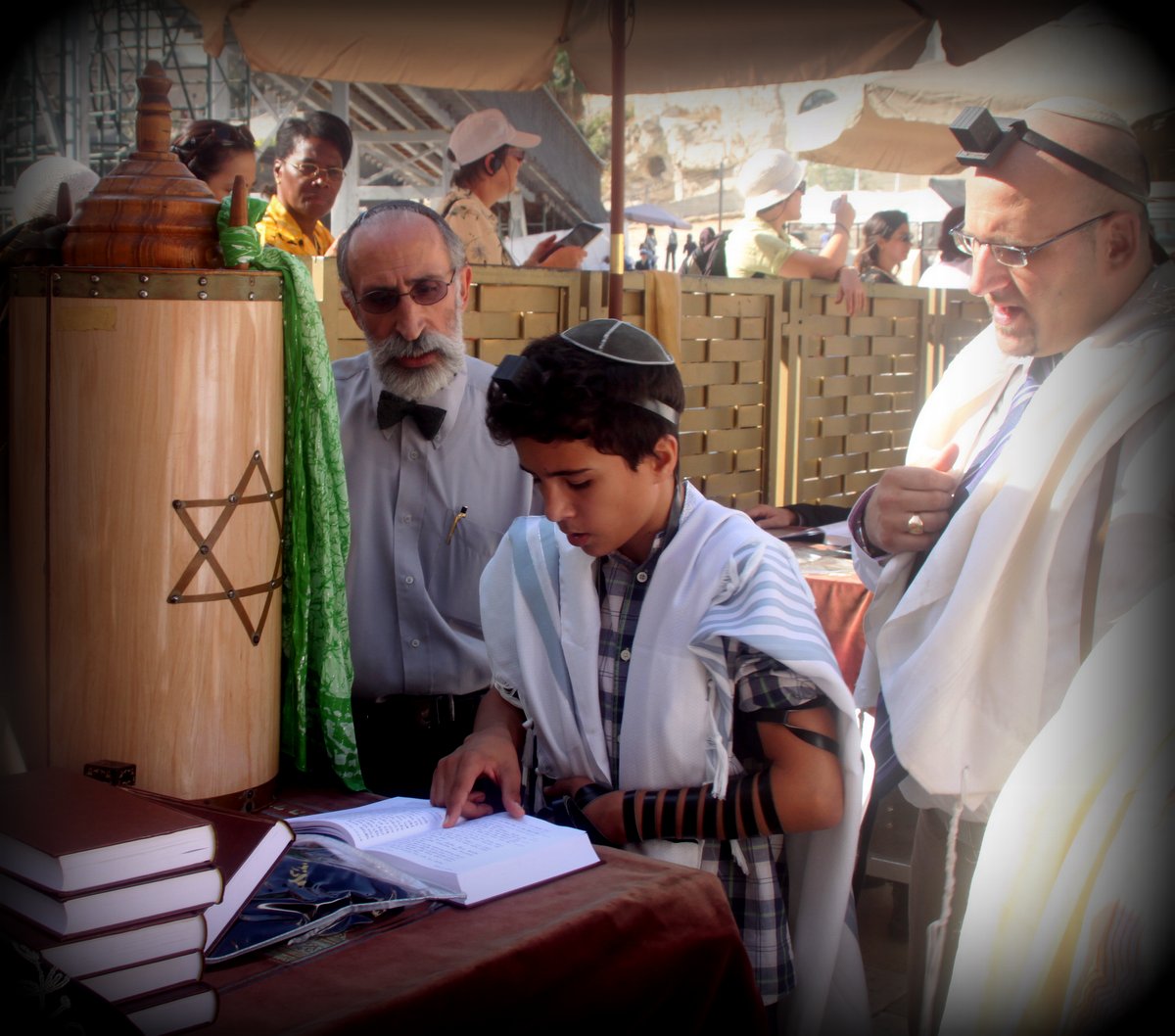
A bar mitzvah (masc.) or bat mitzvah (fem.) is a coming of age ritual in Judaism. According to Jewish law, before children reach a certain age, the parents are responsible for their child's actions. Once Jewish children reach that age, they are said to "become" b'nai mitzvah, at which point they begin to be held accountable for their own actions. Traditionally, the father of a bar or bat mitzvah offers thanks to God that he is no longer punished for his child's sins.
In Orthodox communities, boys become bar mitzvah at 13 and girls become bat mitzvah at 12. In most Reform, Reconstructionist, and Conservative communities, the milestone is 13 regardless of gender. After this point, children are also held responsible for knowing Jewish ritual law, tradition, and ethics, and are able to participate in all areas of Jewish community life to the same extent as adults. In some Jewish communities, men's and women's roles differ in certain respects. For example, in Orthodox Judaism, once a boy turns 13, it is permitted to count him for the purpose of determining whether there is a prayer quorum, and he may lead prayer and other religious services in the family and the community.
Bar mitzvah is mentioned in the Mishnah and the Talmud. Some classic sources identify the age at which children must begin to participate in the ritual at the age of 13 for boys and 12 for girls. The age of b'nai mitzvah roughly coincides with the onset of puberty. The bar/bat mitzvah ceremony is usually held on the first Shabbat after the birthday on which the child reaches the eligible age.
Bar (בַּר) is a Jewish Babylonian Aramaic word meaning 'son' (בֵּן, ben in Hebrew), while bat (בַּת), in Hebrew, means 'daughter'. Mitzvah (מִצְוָה) is Hebrew for 'commandment' or 'law'. Thus, bar mitzvah and bat mitzvah literally translate to 'son of commandment' and 'daughter of commandment', respectively. However, in rabbinical usage, the word bar means 'under the category of' or 'subject to'. Bar mitzvah therefore translates to '[one] who is subject to the law'. Although the term is commonly used to refer to the ritual itself, the phrase originally refers to the person.[citation needed]
The modern method of celebrating becoming a bar mitzvah did not exist in the time of the Hebrew Bible, Mishnah, or Talmud. Early rabbinic sources specify 13 as the age at which a boy becomes a legal adult; however, the celebration of this occasion is not mentioned until the Middle Ages (from approximately 500 CE to 1500 CE; see post-classical history).
Some late midrashic sources, and some medieval sources refer to a synagogue ceremony performed upon the boy's reaching age thirteen:
Later on are references to a festive celebration on this occasion:
The Bible does not explicitly specify the age of 13. Passages in the books of Exodus and Numbers note the age of majority for army service as twenty. Machzor Vitri notes that Genesis 34:25 refers to Levi as a "man", when a calculation from other verses suggests that Levi was aged 13 at the time.
Hub AI
Bar and bat mitzvah AI simulator
(@Bar and bat mitzvah_simulator)
Bar and bat mitzvah
A bar mitzvah (masc.) or bat mitzvah (fem.) is a coming of age ritual in Judaism. According to Jewish law, before children reach a certain age, the parents are responsible for their child's actions. Once Jewish children reach that age, they are said to "become" b'nai mitzvah, at which point they begin to be held accountable for their own actions. Traditionally, the father of a bar or bat mitzvah offers thanks to God that he is no longer punished for his child's sins.
In Orthodox communities, boys become bar mitzvah at 13 and girls become bat mitzvah at 12. In most Reform, Reconstructionist, and Conservative communities, the milestone is 13 regardless of gender. After this point, children are also held responsible for knowing Jewish ritual law, tradition, and ethics, and are able to participate in all areas of Jewish community life to the same extent as adults. In some Jewish communities, men's and women's roles differ in certain respects. For example, in Orthodox Judaism, once a boy turns 13, it is permitted to count him for the purpose of determining whether there is a prayer quorum, and he may lead prayer and other religious services in the family and the community.
Bar mitzvah is mentioned in the Mishnah and the Talmud. Some classic sources identify the age at which children must begin to participate in the ritual at the age of 13 for boys and 12 for girls. The age of b'nai mitzvah roughly coincides with the onset of puberty. The bar/bat mitzvah ceremony is usually held on the first Shabbat after the birthday on which the child reaches the eligible age.
Bar (בַּר) is a Jewish Babylonian Aramaic word meaning 'son' (בֵּן, ben in Hebrew), while bat (בַּת), in Hebrew, means 'daughter'. Mitzvah (מִצְוָה) is Hebrew for 'commandment' or 'law'. Thus, bar mitzvah and bat mitzvah literally translate to 'son of commandment' and 'daughter of commandment', respectively. However, in rabbinical usage, the word bar means 'under the category of' or 'subject to'. Bar mitzvah therefore translates to '[one] who is subject to the law'. Although the term is commonly used to refer to the ritual itself, the phrase originally refers to the person.[citation needed]
The modern method of celebrating becoming a bar mitzvah did not exist in the time of the Hebrew Bible, Mishnah, or Talmud. Early rabbinic sources specify 13 as the age at which a boy becomes a legal adult; however, the celebration of this occasion is not mentioned until the Middle Ages (from approximately 500 CE to 1500 CE; see post-classical history).
Some late midrashic sources, and some medieval sources refer to a synagogue ceremony performed upon the boy's reaching age thirteen:
Later on are references to a festive celebration on this occasion:
The Bible does not explicitly specify the age of 13. Passages in the books of Exodus and Numbers note the age of majority for army service as twenty. Machzor Vitri notes that Genesis 34:25 refers to Levi as a "man", when a calculation from other verses suggests that Levi was aged 13 at the time.
Recent media