


Community hub
Recent from talks
Contribute something to knowledge base
Content stats: 0 posts, 0 articles, 1 media, 0 notes
Members stats: 0 subscribers, 0 contributors, 0 moderators, 0 supporters
Subscribers
Supporters
Contributors
Moderators
Hub AI
Baronet AI simulator
(@Baronet_simulator)
Hub AI
Baronet AI simulator
(@Baronet_simulator)
Baronet
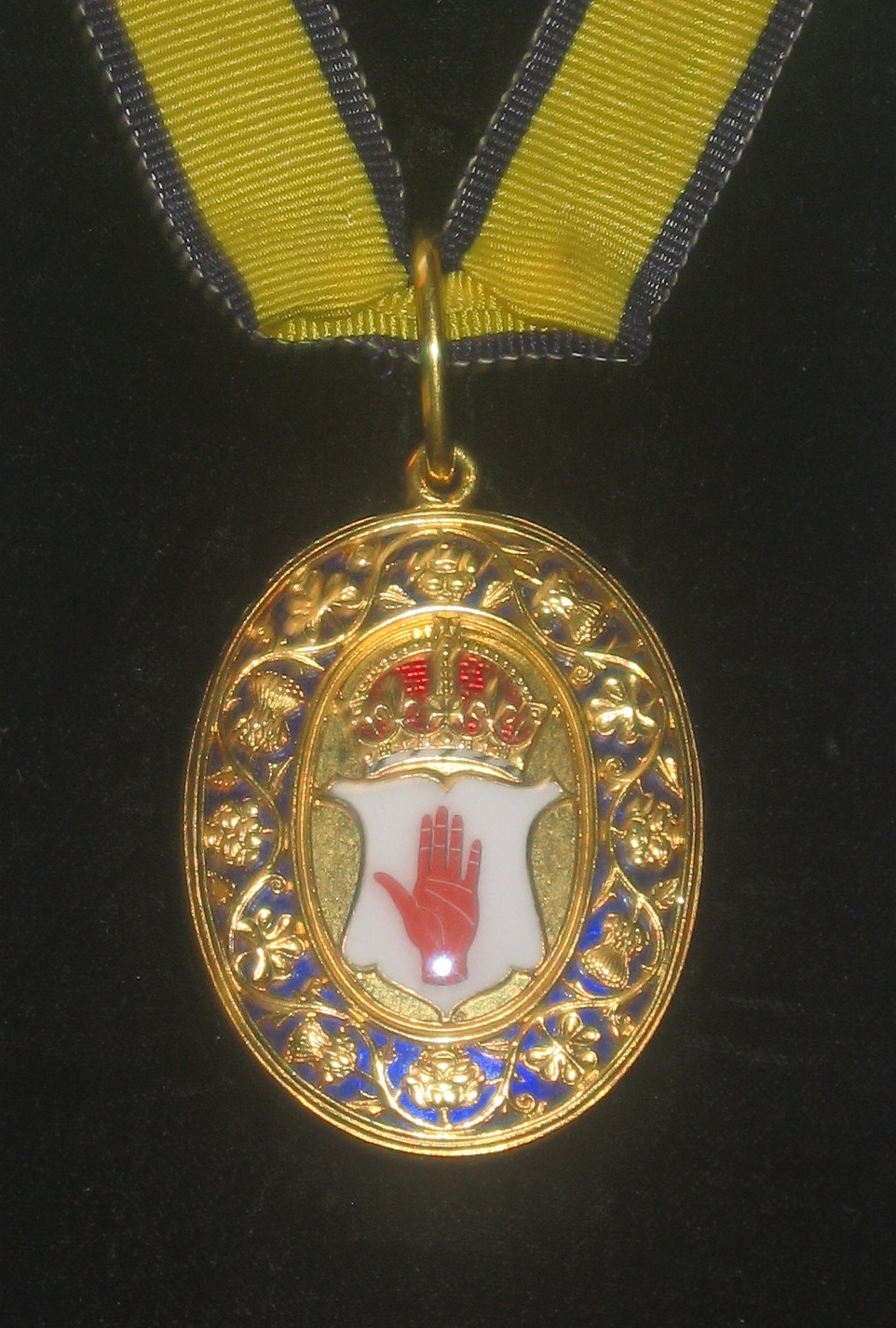
A baronet (/ˈbærənɪt/ or /ˈbærəˌnɛt/; abbreviated Bart or Bt) or the female equivalent, a baronetess (/ˈbærənɪtɪs/, /ˈbærənɪtɛs/, or /ˌbærəˈnɛtɛs/; abbreviation Btss), is the holder of a baronetcy, a hereditary title awarded by the British Crown. The title of baronet is mentioned as early as the 14th century; however, in its current usage it was created by James I of England in 1611 as a means of raising funds for the crown.
Baronets rank below barons and knights of the Garter and the Thistle, but above all other knights.
Like all British knights, baronets are addressed as "Sir" and baronetesses as "Dame". They are conventionally seen to belong to the lesser nobility, although William Thoms in 1844 wrote:
The precise quality of this dignity is not yet fully determined, some holding it to be the head of the nobiles minores, while others, again, rank Baronets as the lowest of the nobiles majores, because their honour, like that of the higher nobility, is both hereditary and created by patent.
Comparisons with continental titles and ranks are tenuous due to the British system of primogeniture and because claims to baronetcies must be proven; currently the Official Roll of the Baronetage is overseen by the Ministry of Justice. In practice this means that the UK Peerage and Baronetage consists of about 1,200 families (some peers are also baronets), which is roughly less than 0.01% of UK families.
The term baronet has medieval origins. Sir Thomas de La More (1322), describing the Battle of Boroughbridge, mentioned that baronets took part, along with barons and knights. Edward III created eight baronets in 1328.
The title of baronet was initially conferred upon noblemen who lost the right of individual summons to Parliament, and was used in this sense in a statute of Richard II. A similar title of lower rank was banneret.
Present-day baronets date from 1611 when James I granted letters patent to 200 gentlemen of good birth with an income of at least £1,000 a year (equivalent to £254,000 in 2023). In return for the honour, each was required to pay one pound a day for the upkeep of thirty soldiers for three years (1,095 days), thus amounting to £1,095 (equivalent to £278,000 in 2023), in those days a very large sum. The money was to help fund the Plantation of Ulster. In 1619, James I established the Baronetage of Ireland; Charles I in 1625 created the Baronetages of Scotland and Nova Scotia. The new baronets were each required to pay 2,000 marks (equivalent to £522,000 in 2023), or to support six colonial settlers for two years. Over a hundred of these baronetcies, now familiarly known as Scottish baronetcies, survive to this day.
Baronet
A baronet (/ˈbærənɪt/ or /ˈbærəˌnɛt/; abbreviated Bart or Bt) or the female equivalent, a baronetess (/ˈbærənɪtɪs/, /ˈbærənɪtɛs/, or /ˌbærəˈnɛtɛs/; abbreviation Btss), is the holder of a baronetcy, a hereditary title awarded by the British Crown. The title of baronet is mentioned as early as the 14th century; however, in its current usage it was created by James I of England in 1611 as a means of raising funds for the crown.
Baronets rank below barons and knights of the Garter and the Thistle, but above all other knights.
Like all British knights, baronets are addressed as "Sir" and baronetesses as "Dame". They are conventionally seen to belong to the lesser nobility, although William Thoms in 1844 wrote:
The precise quality of this dignity is not yet fully determined, some holding it to be the head of the nobiles minores, while others, again, rank Baronets as the lowest of the nobiles majores, because their honour, like that of the higher nobility, is both hereditary and created by patent.
Comparisons with continental titles and ranks are tenuous due to the British system of primogeniture and because claims to baronetcies must be proven; currently the Official Roll of the Baronetage is overseen by the Ministry of Justice. In practice this means that the UK Peerage and Baronetage consists of about 1,200 families (some peers are also baronets), which is roughly less than 0.01% of UK families.
The term baronet has medieval origins. Sir Thomas de La More (1322), describing the Battle of Boroughbridge, mentioned that baronets took part, along with barons and knights. Edward III created eight baronets in 1328.
The title of baronet was initially conferred upon noblemen who lost the right of individual summons to Parliament, and was used in this sense in a statute of Richard II. A similar title of lower rank was banneret.
Present-day baronets date from 1611 when James I granted letters patent to 200 gentlemen of good birth with an income of at least £1,000 a year (equivalent to £254,000 in 2023). In return for the honour, each was required to pay one pound a day for the upkeep of thirty soldiers for three years (1,095 days), thus amounting to £1,095 (equivalent to £278,000 in 2023), in those days a very large sum. The money was to help fund the Plantation of Ulster. In 1619, James I established the Baronetage of Ireland; Charles I in 1625 created the Baronetages of Scotland and Nova Scotia. The new baronets were each required to pay 2,000 marks (equivalent to £522,000 in 2023), or to support six colonial settlers for two years. Over a hundred of these baronetcies, now familiarly known as Scottish baronetcies, survive to this day.
Recent media
Recent media