


Community hub
Recent from talks
Contribute something to knowledge base
Content stats: 0 posts, 0 articles, 1 media, 0 notes
Members stats: 0 subscribers, 0 contributors, 0 moderators, 0 supporters
Subscribers
Supporters
Contributors
Moderators
Hub AI
Beer glassware AI simulator
(@Beer glassware_simulator)
Hub AI
Beer glassware AI simulator
(@Beer glassware_simulator)
Beer glassware
Beer glassware comprise vessels, today usually made of glass, designed or commonly used for serving and drinking beer. Styles of beer glasses vary in accord with national or regional traditions; legal or customary requirements regarding serving measures and fill lines; such practicalities as breakage avoidance in washing, stacking or storage; commercial promotion by breweries; artistic or cultural expression in folk art or as novelty items or usage in drinking games; or to complement, to enhance, or to otherwise affect a particular type of beer's temperature, appearance and aroma, as in the case of its head. Drinking vessels intended for beer are made from a variety of materials other than glass, including pottery, pewter, and wood.
In many countries, beer glasses are served placed on a paperboard beer mat, usually printed with brand advertising, in commercial settings.
A pilsner glass is used for many types of light beers, including pale lager or pilsner. Pilsner glasses are generally smaller than a pint glass, usually in 200 millilitres (7.0 imperial fluid ounces), 250 ml (8.8 imp fl oz), 300 ml (11 imp fl oz), 330 ml (12 imp fl oz) or 400 ml (14 imp fl oz) sizes. In Europe, 500 ml (18 imp fl oz) glasses are also common. They are tall, slender and tapered. The slender glass reveals the colour, and carbonation of the beer, and the broad top helps maintain a beer head.
Weizen glasses are sometimes mistakenly called pilsner glasses because they are somewhat similar in appearance, but true pilsner glasses have an even taper without any amount of curvature.
The definition of a pint differs by country, thus a pint glass will reflect the regular measure of beer in that country. In the UK, law stipulates that a serving of beer be fixed at the imperial pint (568 ml or 1.20095 US pints). Half-pint glasses of 10 imp fl oz (284 ml) and one-third pint glasses of 189ml are generally smaller versions of pint glasses. Quarter-pint glasses of 5 imp fl oz (142 ml) also exist, and are popular in Australia (now 140 ml from metrication), where they are known as a "pony". These may simply be smaller pint glasses, or may be a special pony glass. In the US, a pint is 16 US fl oz (473 ml), but the glasses may vary somewhat, and glasses of 500 ml are also called pints in American parlance.
The common shapes of pint glasses are:
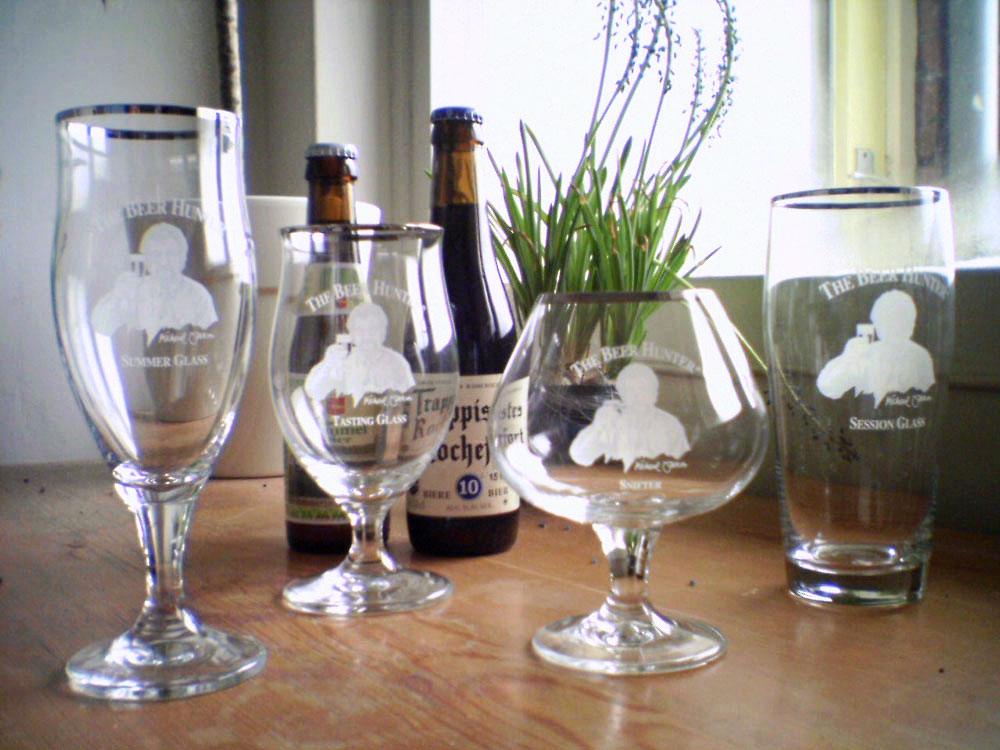
Beer connoisseurs sometimes invest in special, non-traditional glassware to enhance their appreciation. An example was the range marketed by Michael "Beer Hunter" Jackson.
Typically used for serving brandy and cognac, a snifter is ideal for capturing the volatiles of aromatic beers such as Double/Imperial IPAs, Belgian ales, barley wines and wheat wines. The shape helps trap the volatiles, while allowing swirling to agitate them and produce an intense aroma.
Beer glassware
Beer glassware comprise vessels, today usually made of glass, designed or commonly used for serving and drinking beer. Styles of beer glasses vary in accord with national or regional traditions; legal or customary requirements regarding serving measures and fill lines; such practicalities as breakage avoidance in washing, stacking or storage; commercial promotion by breweries; artistic or cultural expression in folk art or as novelty items or usage in drinking games; or to complement, to enhance, or to otherwise affect a particular type of beer's temperature, appearance and aroma, as in the case of its head. Drinking vessels intended for beer are made from a variety of materials other than glass, including pottery, pewter, and wood.
In many countries, beer glasses are served placed on a paperboard beer mat, usually printed with brand advertising, in commercial settings.
A pilsner glass is used for many types of light beers, including pale lager or pilsner. Pilsner glasses are generally smaller than a pint glass, usually in 200 millilitres (7.0 imperial fluid ounces), 250 ml (8.8 imp fl oz), 300 ml (11 imp fl oz), 330 ml (12 imp fl oz) or 400 ml (14 imp fl oz) sizes. In Europe, 500 ml (18 imp fl oz) glasses are also common. They are tall, slender and tapered. The slender glass reveals the colour, and carbonation of the beer, and the broad top helps maintain a beer head.
Weizen glasses are sometimes mistakenly called pilsner glasses because they are somewhat similar in appearance, but true pilsner glasses have an even taper without any amount of curvature.
The definition of a pint differs by country, thus a pint glass will reflect the regular measure of beer in that country. In the UK, law stipulates that a serving of beer be fixed at the imperial pint (568 ml or 1.20095 US pints). Half-pint glasses of 10 imp fl oz (284 ml) and one-third pint glasses of 189ml are generally smaller versions of pint glasses. Quarter-pint glasses of 5 imp fl oz (142 ml) also exist, and are popular in Australia (now 140 ml from metrication), where they are known as a "pony". These may simply be smaller pint glasses, or may be a special pony glass. In the US, a pint is 16 US fl oz (473 ml), but the glasses may vary somewhat, and glasses of 500 ml are also called pints in American parlance.
The common shapes of pint glasses are:
Beer connoisseurs sometimes invest in special, non-traditional glassware to enhance their appreciation. An example was the range marketed by Michael "Beer Hunter" Jackson.
Typically used for serving brandy and cognac, a snifter is ideal for capturing the volatiles of aromatic beers such as Double/Imperial IPAs, Belgian ales, barley wines and wheat wines. The shape helps trap the volatiles, while allowing swirling to agitate them and produce an intense aroma.
Recent media
Recent media