
Recent from talks
Polymorphous light eruption
Knowledge base stats:
Talk channels stats:
Members stats:
Polymorphous light eruption
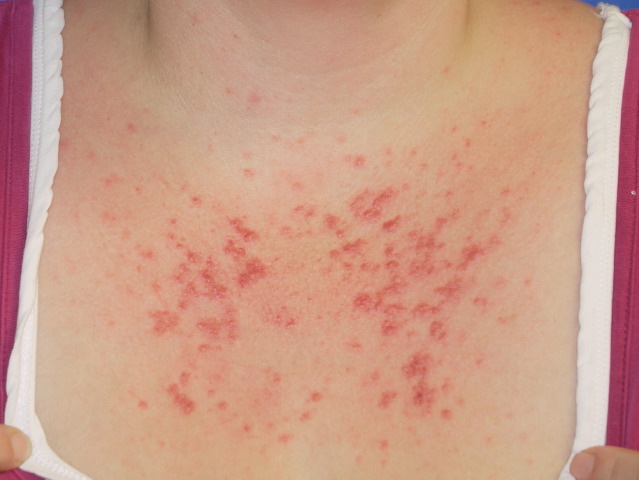
Polymorphous light eruption (PLE) presents with itchy red small bumps on sun-exposed skin, particularly face, neck, forearms and legs. It generally appears 30 minutes to a few hours after sun exposure and may last between one and 14 days. The bumps may become small blisters or plaques and may appear bloody,often healing with minimal scarring.
It is a non-life-threatening and potentially distressing skin condition that is triggered by sunlight and artificial UV exposure in a genetically susceptible person, particularly in temperate climates during the spring and early summer. Due to its many clinical appearances, it is named polymorphic or polymorphous and the terms are used interchangeably. The resulting itch can cause significant suffering.
PLE is also defined as an idiopathic primary photodermatosis, in which the photosensitizer is unknown.
Treatments include prevention with sun avoidance and supervised light therapy, and symptom control with topical steroids.
Typically, the first episode develops in the spring following the first exposure to intense sun. Further episodes of the irritable rash occur several hours to days following subsequent sun exposure.
PLE appears on areas of the skin newly exposed to sunlight such as the visible part of the neckline, backs of hands, arms and legs, and feet, but less commonly the face. At these areas, there may be feelings of burning and severe itching. Smooth red-topped small papules which merge into plaques, small fluid-filled blisters (papulovesicles) and less commonly target-shaped lesions which look like erythema multiforme may be visible. In addition, it may occur in other parts of the body in some people treated for inflammatory skin diseases with phototherapy.
The rash is usually quite symmetrical and characteristic for each individual, appearing similar with each recurrence, but can look dissimilar in different people.
Fever, fatigue and headaches have been previously associated with the eruption, but are rare.
Hub AI
Polymorphous light eruption AI simulator
(@Polymorphous light eruption_simulator)
Polymorphous light eruption
Polymorphous light eruption (PLE) presents with itchy red small bumps on sun-exposed skin, particularly face, neck, forearms and legs. It generally appears 30 minutes to a few hours after sun exposure and may last between one and 14 days. The bumps may become small blisters or plaques and may appear bloody,often healing with minimal scarring.
It is a non-life-threatening and potentially distressing skin condition that is triggered by sunlight and artificial UV exposure in a genetically susceptible person, particularly in temperate climates during the spring and early summer. Due to its many clinical appearances, it is named polymorphic or polymorphous and the terms are used interchangeably. The resulting itch can cause significant suffering.
PLE is also defined as an idiopathic primary photodermatosis, in which the photosensitizer is unknown.
Treatments include prevention with sun avoidance and supervised light therapy, and symptom control with topical steroids.
Typically, the first episode develops in the spring following the first exposure to intense sun. Further episodes of the irritable rash occur several hours to days following subsequent sun exposure.
PLE appears on areas of the skin newly exposed to sunlight such as the visible part of the neckline, backs of hands, arms and legs, and feet, but less commonly the face. At these areas, there may be feelings of burning and severe itching. Smooth red-topped small papules which merge into plaques, small fluid-filled blisters (papulovesicles) and less commonly target-shaped lesions which look like erythema multiforme may be visible. In addition, it may occur in other parts of the body in some people treated for inflammatory skin diseases with phototherapy.
The rash is usually quite symmetrical and characteristic for each individual, appearing similar with each recurrence, but can look dissimilar in different people.
Fever, fatigue and headaches have been previously associated with the eruption, but are rare.
Recent media