
Recent from talks
Betting in poker
Knowledge base stats:
Talk channels stats:
Members stats:
Betting in poker
In the game of poker, the play largely centers on the act of betting, and as such, a protocol has been developed to speed up play, lessen confusion, and increase security while playing. Different games are played using different types of bets, and small variations in etiquette exist between cardrooms, but for the most part the following rules and protocol are observed by the majority of poker players.
Players in a poker game act in turn, in clockwise rotation (acting out of turn can negatively affect other players). When it is a player's turn to act, the first verbal declaration or action they take binds them to their choice of action; this rule prevents a player from changing their action after seeing how other players react to their initial action.
Until the first bet is made each player in turn may "check", which is to not place a bet, or "open", which is to make the first bet. After the first bet each player may "fold", which is to drop out of the hand losing any bets they have already made; "call", which is to match the highest bet so far made; or "raise", which is to increase the previous high bet.
A player may fold by surrendering one's cards. (Some games may have specific rules regarding how to fold: for example in stud poker one must turn one's upcards face down.) A player may check by tapping the table or making any similar motion. All other bets are made by placing chips in front of the player, but not directly into the pot ("splashing the pot" prevents other players from verifying the bet amount).
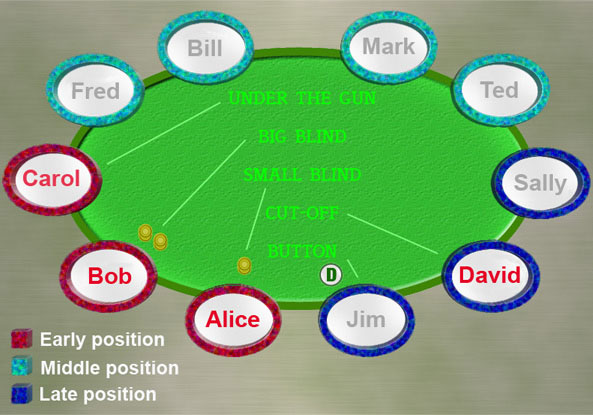
In general, the person to the left of the dealer acts first and action proceeds in a clockwise fashion. If any player has folded earlier, action proceeds to next player. In games with blinds, the first round of betting begins with the player to the left of the blinds. In stud games, the action begins with the player showing the strongest cards and proceeds clockwise. If there is a bring-in, the first round of betting begins with the player obliged to post the bring-in.
If no one has yet opened the betting round, a player may pass or check, which is equivalent to betting zero and/or to call the current bet of zero. When checking, a player declines to make a bet; this indicates that they do not wish to open, but do wish to keep their cards and retain the right to call or raise later in the same round if an opponent opens. In games played with blinds, players may not check on the opening round because the blinds are live bets and must be called or raised to remain in the hand. A player who has posted the big blind has the right to raise on the first round, called the option, if no other player has raised; if they decline to raise they are said to check their option. If all players check, the betting round is over with no additional money placed in the pot (often called a free round or free card). A common way to signify checking is to tap the table, either with a fist, knuckles, an open hand or the index finger(s).
If in any betting round it is a player's turn to act and the action is unopened, then the player can open action in a betting round by making a bet—the act of making the first voluntary bet in a betting round is called opening the round. On the first betting round, it is also called opening the pot, though in variants where blind bets are common, the blind bets "open" the first betting round and other players call and/or raise the "big blind" bet. Some poker variations have special rules about opening a round that may not apply to other bets. For example, a game may have a betting structure that specifies different allowable amounts for opening than for other bets, or may require a player to hold certain cards (such as "Jacks or better") to open.
Normally, a player makes a bet by placing the chips they wish to wager into the pot. Under normal circumstances, all other players still in the pot must either call the full amount of the bet or raise if they wish to remain in, the only exceptions being when a player does not have sufficient stake remaining to call the full amount of the bet (in which case they may either call with their remaining stake to go "all-in" or fold) or when the player is already all-in.
Hub AI
Betting in poker AI simulator
(@Betting in poker_simulator)
Betting in poker
In the game of poker, the play largely centers on the act of betting, and as such, a protocol has been developed to speed up play, lessen confusion, and increase security while playing. Different games are played using different types of bets, and small variations in etiquette exist between cardrooms, but for the most part the following rules and protocol are observed by the majority of poker players.
Players in a poker game act in turn, in clockwise rotation (acting out of turn can negatively affect other players). When it is a player's turn to act, the first verbal declaration or action they take binds them to their choice of action; this rule prevents a player from changing their action after seeing how other players react to their initial action.
Until the first bet is made each player in turn may "check", which is to not place a bet, or "open", which is to make the first bet. After the first bet each player may "fold", which is to drop out of the hand losing any bets they have already made; "call", which is to match the highest bet so far made; or "raise", which is to increase the previous high bet.
A player may fold by surrendering one's cards. (Some games may have specific rules regarding how to fold: for example in stud poker one must turn one's upcards face down.) A player may check by tapping the table or making any similar motion. All other bets are made by placing chips in front of the player, but not directly into the pot ("splashing the pot" prevents other players from verifying the bet amount).
In general, the person to the left of the dealer acts first and action proceeds in a clockwise fashion. If any player has folded earlier, action proceeds to next player. In games with blinds, the first round of betting begins with the player to the left of the blinds. In stud games, the action begins with the player showing the strongest cards and proceeds clockwise. If there is a bring-in, the first round of betting begins with the player obliged to post the bring-in.
If no one has yet opened the betting round, a player may pass or check, which is equivalent to betting zero and/or to call the current bet of zero. When checking, a player declines to make a bet; this indicates that they do not wish to open, but do wish to keep their cards and retain the right to call or raise later in the same round if an opponent opens. In games played with blinds, players may not check on the opening round because the blinds are live bets and must be called or raised to remain in the hand. A player who has posted the big blind has the right to raise on the first round, called the option, if no other player has raised; if they decline to raise they are said to check their option. If all players check, the betting round is over with no additional money placed in the pot (often called a free round or free card). A common way to signify checking is to tap the table, either with a fist, knuckles, an open hand or the index finger(s).
If in any betting round it is a player's turn to act and the action is unopened, then the player can open action in a betting round by making a bet—the act of making the first voluntary bet in a betting round is called opening the round. On the first betting round, it is also called opening the pot, though in variants where blind bets are common, the blind bets "open" the first betting round and other players call and/or raise the "big blind" bet. Some poker variations have special rules about opening a round that may not apply to other bets. For example, a game may have a betting structure that specifies different allowable amounts for opening than for other bets, or may require a player to hold certain cards (such as "Jacks or better") to open.
Normally, a player makes a bet by placing the chips they wish to wager into the pot. Under normal circumstances, all other players still in the pot must either call the full amount of the bet or raise if they wish to remain in, the only exceptions being when a player does not have sufficient stake remaining to call the full amount of the bet (in which case they may either call with their remaining stake to go "all-in" or fold) or when the player is already all-in.
Recent media