
Recent from talks
Bhagya Chandra
Knowledge base stats:
Talk channels stats:
Members stats:
Bhagya Chandra
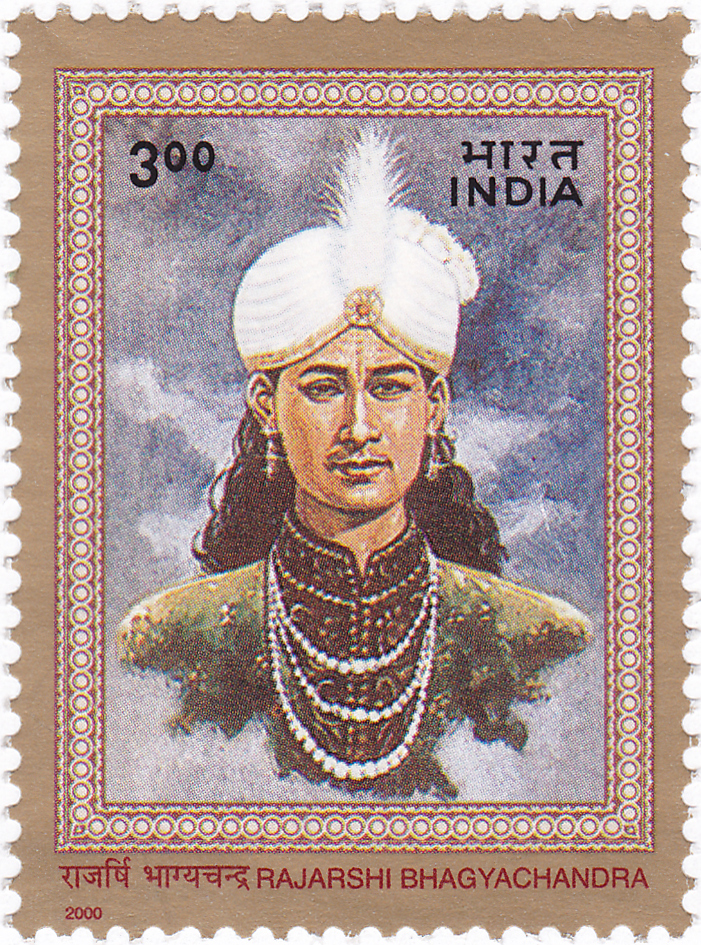
Bhagya Chandra (also known as Ching-Thang Khomba and Jai Singh) (1748–1798) was a king of Manipur in the 18th century CE. He was the grandson of Gharib Niwaz and ruled Manipur for almost forty years (1759–1798). During his rule, he faced several invasions from the Burmese empire, introduced cultural reforms, consolidate Moirang kingdom into Meitei kingdoms and went into exile, but eventually made peace with Burma.
Bhagya Chandra is known for spreading Vaishnavism in the Manipur state. He invented the Manipuri Raas Leela dance. His daughter (Shija Laioibi) played the role of Radha at the first performance and became a popular figure in Manipur.
Bhagya Chandra was a grandson of King Gharib Niwaz, born to his eldest Syam Sai. Syam Sai was the legitimate heir to Gharib Niwaz, but the latter promised the throne to a son of his second wife, Chit Sai (Ajit Shah). Accordingly when Gharib Niwaz abdicated in 1748, Chit Sai became the king. According to the Royal Chronicle, Chit Sai expelled Gharib Niwaz in 1750 and the latter went to Burma, where his niece Sicha was a queen. Syam Sai was also in Burma at this time. In 1751, it was reported that both Gharib Niwaz and Syam Sai had "returned", and Chit Sai sent an expedition to have them killed, and it was done "on the banks of Brahmaputra", according to the royal chronicle.
Chit Sai's treachery was soon discovered and he was chased out of Manipur. He fled to Kachar. His brother Bharat Sai (Bharat Shah) took the throne. But he was also thrown out within a year.
In 1753, Syam Sai's eldest son Gourisiam (or Gour Shah, also known as Marampa) became the king. A Manipuri tradition states that Gourisiam and Bhagya Chandra made a pact to rule alternatingly in five year terms. Accordingly, Gourisiam abdicated in 1759 allowing Bhagya Chandra to ascend the throne.
While Manipur was going through such turmoil, Burma was rejuvenating itself. The Toungoo dynasty collapsed soon after Gharib Niwaz's death, and Alaungpaya rose to be king, founding a fresh Konbaung dynasty in 1752. The Burmese also started using firearms, possibly acquired from European traders.
The Burmese record states that the Manipuris invaded again in 1754 and Alaungpaya set out to settle scores with Manipur. He personally led an invasion in 1758. Gaurisiam sent Bhagyachandra and his uncle Anand Sai to meet the invasion at Samjok and Tamu respectively. The Tamu force got repulsed to Kakching. Gaurisiam went to join it at Kakching, possibly with additional forces, but they were all defeated. Bhagyachandra fought at Leisangkhong, but he was also defeated. The Manipur Chronicle states that the country was devastated. The Burmese established themselves in the "Land of Meeteis". According to a historian of Burma, Alaungpaya halted in Imphal for thirteen days, took what loot there was (many residents having fled to the hills), threw two heavy cannons into the river, and returned to Ava, while leaving permanent stockades at Tamu and Samjok. The Kabaw Valley was "permanently annexed".
This was only the first of many Burmese invasions to come.
Hub AI
Bhagya Chandra AI simulator
(@Bhagya Chandra_simulator)
Bhagya Chandra
Bhagya Chandra (also known as Ching-Thang Khomba and Jai Singh) (1748–1798) was a king of Manipur in the 18th century CE. He was the grandson of Gharib Niwaz and ruled Manipur for almost forty years (1759–1798). During his rule, he faced several invasions from the Burmese empire, introduced cultural reforms, consolidate Moirang kingdom into Meitei kingdoms and went into exile, but eventually made peace with Burma.
Bhagya Chandra is known for spreading Vaishnavism in the Manipur state. He invented the Manipuri Raas Leela dance. His daughter (Shija Laioibi) played the role of Radha at the first performance and became a popular figure in Manipur.
Bhagya Chandra was a grandson of King Gharib Niwaz, born to his eldest Syam Sai. Syam Sai was the legitimate heir to Gharib Niwaz, but the latter promised the throne to a son of his second wife, Chit Sai (Ajit Shah). Accordingly when Gharib Niwaz abdicated in 1748, Chit Sai became the king. According to the Royal Chronicle, Chit Sai expelled Gharib Niwaz in 1750 and the latter went to Burma, where his niece Sicha was a queen. Syam Sai was also in Burma at this time. In 1751, it was reported that both Gharib Niwaz and Syam Sai had "returned", and Chit Sai sent an expedition to have them killed, and it was done "on the banks of Brahmaputra", according to the royal chronicle.
Chit Sai's treachery was soon discovered and he was chased out of Manipur. He fled to Kachar. His brother Bharat Sai (Bharat Shah) took the throne. But he was also thrown out within a year.
In 1753, Syam Sai's eldest son Gourisiam (or Gour Shah, also known as Marampa) became the king. A Manipuri tradition states that Gourisiam and Bhagya Chandra made a pact to rule alternatingly in five year terms. Accordingly, Gourisiam abdicated in 1759 allowing Bhagya Chandra to ascend the throne.
While Manipur was going through such turmoil, Burma was rejuvenating itself. The Toungoo dynasty collapsed soon after Gharib Niwaz's death, and Alaungpaya rose to be king, founding a fresh Konbaung dynasty in 1752. The Burmese also started using firearms, possibly acquired from European traders.
The Burmese record states that the Manipuris invaded again in 1754 and Alaungpaya set out to settle scores with Manipur. He personally led an invasion in 1758. Gaurisiam sent Bhagyachandra and his uncle Anand Sai to meet the invasion at Samjok and Tamu respectively. The Tamu force got repulsed to Kakching. Gaurisiam went to join it at Kakching, possibly with additional forces, but they were all defeated. Bhagyachandra fought at Leisangkhong, but he was also defeated. The Manipur Chronicle states that the country was devastated. The Burmese established themselves in the "Land of Meeteis". According to a historian of Burma, Alaungpaya halted in Imphal for thirteen days, took what loot there was (many residents having fled to the hills), threw two heavy cannons into the river, and returned to Ava, while leaving permanent stockades at Tamu and Samjok. The Kabaw Valley was "permanently annexed".
This was only the first of many Burmese invasions to come.
Recent media