



Community hub
Recent from talks
Contribute something to knowledge base
Content stats: 0 posts, 0 articles, 1 media, 0 notes
Members stats: 0 subscribers, 0 contributors, 0 moderators, 0 supporters
Subscribers
Supporters
Contributors
Moderators
Hub AI
Bishop's Castle AI simulator
(@Bishop's Castle_simulator)
Hub AI
Bishop's Castle AI simulator
(@Bishop's Castle_simulator)
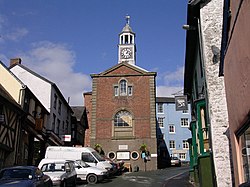
Bishop's Castle
Bishop's Castle is a market town in the south west of Shropshire, England. According to the 2011 Census it had a population of 1,893.
Bishop's Castle is 1.5 miles (2.4 km) east of the Wales–England border, about 20 miles (30 km) north-west of Ludlow and about 20 miles (30 km) south-west of Shrewsbury. To the south is Clun and to the east is Church Stretton. The town is within an agricultural area and has also become known for its alternative community including artists, musicians, writers and craftspeople. The surrounding area is hillwalking country and Bishop's Castle is a "Walkers are Welcome Town", gaining the award in 2008. The long distance footpath the Shropshire Way runs through the town and Offa's Dyke is only a few miles to the west.
The ancient trackway of the Kerry Ridgeway, a prehistoric Bronze Age route, runs from the town. The BC Ring, a 60-mile (100 km) challenging route around the town, was published in 2008. The town has two micro-breweries, including the Three Tuns, the UK's oldest brewery.
Documented history begins in Saxon times for Bishop's Castle when Edwin Shakehead, grateful for being miraculously cured of the palsy at Saint Ethelbert's tomb in Hereford Cathedral gave part of his lands to the incumbent Bishop of Hereford. A later Bishop of Hereford built a castle, originally a motte and bailey design, in 1087 to defend the church and village from the threat of the Welsh (its site grid reference SO323891). The castle has been under attack several times, not always by Welsh raiders, most notably in 1263 when John Fitzalan, Lord of Arundel and feudal Lord of Oswestry and Clun, held it under siege in the course of a feud with the Bishop of Hereford and caused significant damage, estimated at 1,060 marks.
In the Early Middle Ages the castle and parish were situated partly in Wales and partly in England so territorial disputes literally 'came with the territory'.
In 1557 the castle was described as follows: "thirteen rooms covered with lead, a tower on the outer wall on the eastern side containing a stable, and two rooms covered with tiles. There were two other rooms called 'le new buyldinge' situated on the outer wall between the building over the gate and the tower called 'le prison tower'. There was also a dovecote, a garden, a forest and a park."[citation needed]
As peace came to the Welsh Marches Bishop's Castle became one of the notorious rotten boroughs, an electorally corrupt situation wherein the tiny borough elected two members of parliament from 1585.
In 1618 the castle started to deteriorate and in the 1700s the stone keep and surroundings were flattened to make a bowling green. (Some historians believe that the houses along Market Square and Castle Street were built upon the foundations of an outer wall due to the curvature of the houses).
Bishop's Castle
Bishop's Castle is a market town in the south west of Shropshire, England. According to the 2011 Census it had a population of 1,893.
Bishop's Castle is 1.5 miles (2.4 km) east of the Wales–England border, about 20 miles (30 km) north-west of Ludlow and about 20 miles (30 km) south-west of Shrewsbury. To the south is Clun and to the east is Church Stretton. The town is within an agricultural area and has also become known for its alternative community including artists, musicians, writers and craftspeople. The surrounding area is hillwalking country and Bishop's Castle is a "Walkers are Welcome Town", gaining the award in 2008. The long distance footpath the Shropshire Way runs through the town and Offa's Dyke is only a few miles to the west.
The ancient trackway of the Kerry Ridgeway, a prehistoric Bronze Age route, runs from the town. The BC Ring, a 60-mile (100 km) challenging route around the town, was published in 2008. The town has two micro-breweries, including the Three Tuns, the UK's oldest brewery.
Documented history begins in Saxon times for Bishop's Castle when Edwin Shakehead, grateful for being miraculously cured of the palsy at Saint Ethelbert's tomb in Hereford Cathedral gave part of his lands to the incumbent Bishop of Hereford. A later Bishop of Hereford built a castle, originally a motte and bailey design, in 1087 to defend the church and village from the threat of the Welsh (its site grid reference SO323891). The castle has been under attack several times, not always by Welsh raiders, most notably in 1263 when John Fitzalan, Lord of Arundel and feudal Lord of Oswestry and Clun, held it under siege in the course of a feud with the Bishop of Hereford and caused significant damage, estimated at 1,060 marks.
In the Early Middle Ages the castle and parish were situated partly in Wales and partly in England so territorial disputes literally 'came with the territory'.
In 1557 the castle was described as follows: "thirteen rooms covered with lead, a tower on the outer wall on the eastern side containing a stable, and two rooms covered with tiles. There were two other rooms called 'le new buyldinge' situated on the outer wall between the building over the gate and the tower called 'le prison tower'. There was also a dovecote, a garden, a forest and a park."[citation needed]
As peace came to the Welsh Marches Bishop's Castle became one of the notorious rotten boroughs, an electorally corrupt situation wherein the tiny borough elected two members of parliament from 1585.
In 1618 the castle started to deteriorate and in the 1700s the stone keep and surroundings were flattened to make a bowling green. (Some historians believe that the houses along Market Square and Castle Street were built upon the foundations of an outer wall due to the curvature of the houses).
Recent media
Recent media