
Recent from talks
Bishopston, Swansea
Knowledge base stats:
Talk channels stats:
Members stats:
Bishopston, Swansea
Bishopston (Welsh: Llandeilo Ferwallt, historically also Llanmerwallt and Llancyngur Trosgardi) is a large village and community situated on the Gower Peninsula, 6 miles (9.7 km) west south west of the centre of Swansea in South Wales.
It is partly within the Gower Peninsula Area of Outstanding Natural Beauty (AONB).
The church, located at the head of Bishopston Valley, is dedicated to St Teilo who gives the village its Welsh name. Bishopston gives its name to the Bishopston Mudstone, a name used by geologists to refer to a rock formation with a widespread occurrence in south Wales.
The name Bishopston originates from the Norman Conquest, although pre-Norman names for the town vary. One name was Llanmerwall (or Llanmerwallt), and is similar to the modern Welsh name. Two further names are recorded: Porthdulon (or Porthtulon), possibly referring to the area of Caswell, and Llancyngur Trosgardi.
The Bishopston electoral ward consists of part or all of the following areas: Barland Common, Caswell, Clyne Common (Welsh: Rhos-Glyn), Bishopston (Welsh: Llandeilo-ferwallt), Manselfield (Welsh: Maesyfaen), Murton (Welsh: Morthw), and Oldway (Welsh: Henlôn) in the parliamentary constituency of Gower.
It is bounded by the Bristol Channel to the south; and the wards of: Pennard (Welsh: Llanarthbodu) to the west; Fairwood (Welsh: Llwynffair) to the north; and Mayals, West Cross (Welsh: Crwys Fawr) and Newton (Welsh: Trenewydd) to the east.
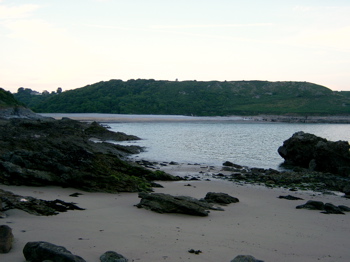
Caswell Bay is a popular local beach due to its facilities and accessibility by car and seasonal bus services. Other Bishopston beaches, such as Pwlldu Bay and Brandy Cove, which can only be visited on foot, see fewer visitors.
Bishopston is one of the largest villages on the Gower peninsula. Its population has increased steadily from the beginning of the 19th century. In 1801, the first census of England and Wales reported that 303 people were living in 73 houses in the parish of Bishopston. By 1931 the population had increased to around 1,500 people living in 369 houses. In 2001 the population of the village was 3,341. The village experienced significant growth between the First and Second World Wars and in the 1960s.
Hub AI
Bishopston, Swansea AI simulator
(@Bishopston, Swansea_simulator)
Bishopston, Swansea
Bishopston (Welsh: Llandeilo Ferwallt, historically also Llanmerwallt and Llancyngur Trosgardi) is a large village and community situated on the Gower Peninsula, 6 miles (9.7 km) west south west of the centre of Swansea in South Wales.
It is partly within the Gower Peninsula Area of Outstanding Natural Beauty (AONB).
The church, located at the head of Bishopston Valley, is dedicated to St Teilo who gives the village its Welsh name. Bishopston gives its name to the Bishopston Mudstone, a name used by geologists to refer to a rock formation with a widespread occurrence in south Wales.
The name Bishopston originates from the Norman Conquest, although pre-Norman names for the town vary. One name was Llanmerwall (or Llanmerwallt), and is similar to the modern Welsh name. Two further names are recorded: Porthdulon (or Porthtulon), possibly referring to the area of Caswell, and Llancyngur Trosgardi.
The Bishopston electoral ward consists of part or all of the following areas: Barland Common, Caswell, Clyne Common (Welsh: Rhos-Glyn), Bishopston (Welsh: Llandeilo-ferwallt), Manselfield (Welsh: Maesyfaen), Murton (Welsh: Morthw), and Oldway (Welsh: Henlôn) in the parliamentary constituency of Gower.
It is bounded by the Bristol Channel to the south; and the wards of: Pennard (Welsh: Llanarthbodu) to the west; Fairwood (Welsh: Llwynffair) to the north; and Mayals, West Cross (Welsh: Crwys Fawr) and Newton (Welsh: Trenewydd) to the east.
Caswell Bay is a popular local beach due to its facilities and accessibility by car and seasonal bus services. Other Bishopston beaches, such as Pwlldu Bay and Brandy Cove, which can only be visited on foot, see fewer visitors.
Bishopston is one of the largest villages on the Gower peninsula. Its population has increased steadily from the beginning of the 19th century. In 1801, the first census of England and Wales reported that 303 people were living in 73 houses in the parish of Bishopston. By 1931 the population had increased to around 1,500 people living in 369 houses. In 2001 the population of the village was 3,341. The village experienced significant growth between the First and Second World Wars and in the 1960s.
Recent media