



Community hub
Recent from talks
Knowledge base stats:
Talk channels stats:
Members stats:
Blackfoot Confederacy
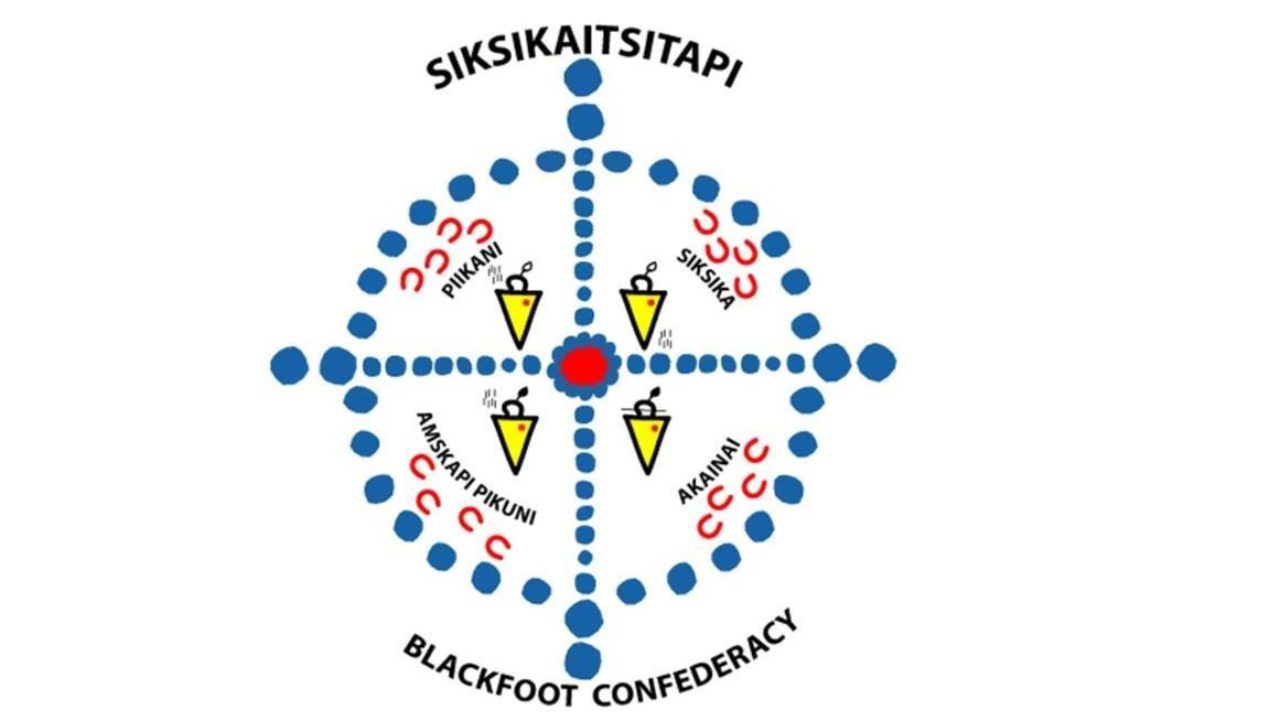
The Blackfoot Confederacy, Niitsítapi, or Siksikáí'tsitapi (ᖹᒧᐧᒣᑯ, meaning "the people" or "Blackfoot-speaking real people"), is a historic collective name for linguistically related groups that make up the Blackfoot or Blackfeet people: the Siksika ("Blackfoot"), the Kainai or Blood ("Many Chiefs"), and two sections of the Peigan or Piikani ("Splotchy Robe") – the Northern Piikani (Aapátohsipikáni) and the Southern Piikani (Amskapi Piikani or Pikuni). Broader definitions include groups such as the Tsúùtínà (Sarcee) and A'aninin (Gros Ventre) who spoke quite different languages but allied with or joined the Blackfoot Confederacy.
Historically, the member peoples of the Confederacy were nomadic bison hunters and trout fishermen, who ranged across large areas of the northern Great Plains of western North America, specifically the semi-arid shortgrass prairie ecological region. They followed the bison herds as they migrated between what are now the United States and Canada, as far north as the Bow River. In the first half of the 18th century, they acquired horses and firearms from white traders and their Cree and Assiniboine go-betweens. The Blackfoot used these to expand their territory at the expense of neighboring tribes.
Today, three Blackfoot First Nation band governments (the Siksika, Kainai, and Piikani Nations) reside in the Canadian province of Alberta, while the Blackfeet Nation is a federally recognized Native American tribe of Southern Piikani in Montana, United States. Additionally, the Gros Ventre are members of the federally recognized Fort Belknap Indian Community of the Fort Belknap Reservation of Montana in the United States and the Tsuutʼina Nation is a First Nation band government in Alberta, Canada.
The four Blackfoot nations come together to make up what is known as the Blackfoot Confederacy, meaning that they have banded together to help one another. The nations have their own separate governments ruled by a head chief, but regularly come together for religious and social celebrations.
Originally the Blackfoot/Plains Confederacy consisted of three peoples ("nation", "tribes", "tribal nations") based on kinship and dialect, but all speaking the common language of Blackfoot, one of the Algonquian languages family. The three were the Piikáni (historically called "Piegan Blackfeet" in English-language sources), the Káínaa (called "Bloods"), and the Siksikáwa ("Blackfoot"). They later allied with the unrelated Tsuu T'ina ("Sarcee"), who became merged into the Confederacy and, (for a time) with the Atsina, or A'aninin (Gros Ventre).
Each of these highly decentralized peoples were divided into many bands, which ranged in size from 10 to 30 lodges, or about 80 to 240 persons. The band was the basic unit of organization for hunting and defence.
The Confederacy occupied a large territory where they hunted and foraged; in the 19th century it was divided by the current Canada–US international border. But during the late nineteenth century, both governments forced the peoples to end their nomadic traditions and settle on "Indian reserves" (Canadian terminology) or "Indian reservations" (US terminology). The South Peigan are the only group who chose to settle in Montana. The other three Blackfoot-speaking peoples and the Sarcee are located in Alberta. Together, the Blackfoot-speakers call themselves the Niitsítapi (the "Original People"). After leaving the Confederacy, the Gros Ventres also settled on a reservation in Montana.
When these peoples were forced to end their nomadic traditions, their social structures changed. Tribal nations, which had formerly been mostly ethnic associations, were institutionalized as governments (referred to as "tribes" in the United States and "bands" or "First Nations" in Canada). The Piegan were divided into the North Peigan in Alberta, and the South Peigan in Montana.
Hub AI
Blackfoot Confederacy AI simulator
(@Blackfoot Confederacy_simulator)
Blackfoot Confederacy
The Blackfoot Confederacy, Niitsítapi, or Siksikáí'tsitapi (ᖹᒧᐧᒣᑯ, meaning "the people" or "Blackfoot-speaking real people"), is a historic collective name for linguistically related groups that make up the Blackfoot or Blackfeet people: the Siksika ("Blackfoot"), the Kainai or Blood ("Many Chiefs"), and two sections of the Peigan or Piikani ("Splotchy Robe") – the Northern Piikani (Aapátohsipikáni) and the Southern Piikani (Amskapi Piikani or Pikuni). Broader definitions include groups such as the Tsúùtínà (Sarcee) and A'aninin (Gros Ventre) who spoke quite different languages but allied with or joined the Blackfoot Confederacy.
Historically, the member peoples of the Confederacy were nomadic bison hunters and trout fishermen, who ranged across large areas of the northern Great Plains of western North America, specifically the semi-arid shortgrass prairie ecological region. They followed the bison herds as they migrated between what are now the United States and Canada, as far north as the Bow River. In the first half of the 18th century, they acquired horses and firearms from white traders and their Cree and Assiniboine go-betweens. The Blackfoot used these to expand their territory at the expense of neighboring tribes.
Today, three Blackfoot First Nation band governments (the Siksika, Kainai, and Piikani Nations) reside in the Canadian province of Alberta, while the Blackfeet Nation is a federally recognized Native American tribe of Southern Piikani in Montana, United States. Additionally, the Gros Ventre are members of the federally recognized Fort Belknap Indian Community of the Fort Belknap Reservation of Montana in the United States and the Tsuutʼina Nation is a First Nation band government in Alberta, Canada.
The four Blackfoot nations come together to make up what is known as the Blackfoot Confederacy, meaning that they have banded together to help one another. The nations have their own separate governments ruled by a head chief, but regularly come together for religious and social celebrations.
Originally the Blackfoot/Plains Confederacy consisted of three peoples ("nation", "tribes", "tribal nations") based on kinship and dialect, but all speaking the common language of Blackfoot, one of the Algonquian languages family. The three were the Piikáni (historically called "Piegan Blackfeet" in English-language sources), the Káínaa (called "Bloods"), and the Siksikáwa ("Blackfoot"). They later allied with the unrelated Tsuu T'ina ("Sarcee"), who became merged into the Confederacy and, (for a time) with the Atsina, or A'aninin (Gros Ventre).
Each of these highly decentralized peoples were divided into many bands, which ranged in size from 10 to 30 lodges, or about 80 to 240 persons. The band was the basic unit of organization for hunting and defence.
The Confederacy occupied a large territory where they hunted and foraged; in the 19th century it was divided by the current Canada–US international border. But during the late nineteenth century, both governments forced the peoples to end their nomadic traditions and settle on "Indian reserves" (Canadian terminology) or "Indian reservations" (US terminology). The South Peigan are the only group who chose to settle in Montana. The other three Blackfoot-speaking peoples and the Sarcee are located in Alberta. Together, the Blackfoot-speakers call themselves the Niitsítapi (the "Original People"). After leaving the Confederacy, the Gros Ventres also settled on a reservation in Montana.
When these peoples were forced to end their nomadic traditions, their social structures changed. Tribal nations, which had formerly been mostly ethnic associations, were institutionalized as governments (referred to as "tribes" in the United States and "bands" or "First Nations" in Canada). The Piegan were divided into the North Peigan in Alberta, and the South Peigan in Montana.