


Community hub
Recent from talks
Contribute something to knowledge base
Content stats: 0 posts, 0 articles, 1 media, 0 notes
Members stats: 0 subscribers, 0 contributors, 0 moderators, 0 supporters
Subscribers
Supporters
Contributors
Moderators
Hub AI
Bloor–Yonge station AI simulator
(@Bloor–Yonge station_simulator)
Hub AI
Bloor–Yonge station AI simulator
(@Bloor–Yonge station_simulator)
Bloor–Yonge station
Bloor–Yonge is a subway station on Line 1 Yonge–University and Line 2 Bloor–Danforth in Toronto, Ontario, Canada. Located in Downtown Toronto, under the intersection of Yonge Street and Bloor Street, it is the busiest subway station in the system, handling over 200,000 passengers on an average weekday.
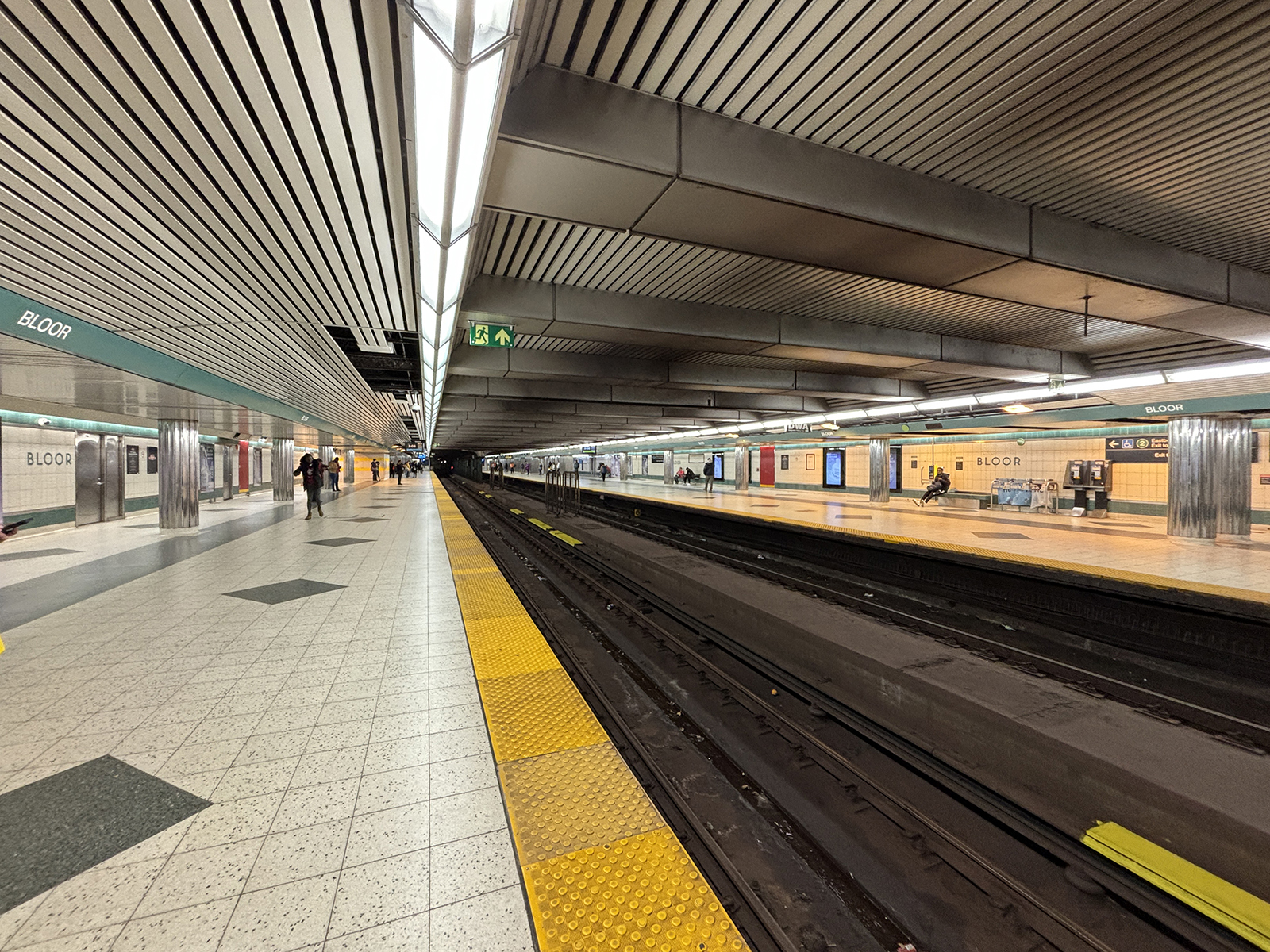
The station was opened in 1954 and designed by Charles B. Dolphin. It was originally named "Bloor", and connected with a pair of enclosed platforms in the centre of Bloor Street to allow interchange with Bloor streetcars within the fare-paid zone. When the streetcars were replaced with the Bloor-Danforth subway in 1966, the station began to be shown on maps as "Bloor–Yonge". However, actual platform signs still show "Bloor" on the Yonge–University line and "Yonge" on the Bloor–Danforth line, following a naming style common in New York subway station complexes, where only the platform's cross street is shown on the platform signs.
Similarly, the automated station announcement system installed on trains from 2007 to 2008 refers to the station as "Bloor" on Line 1 and "Yonge" on Line 2 respectively. The announcements on the Toronto Rocket subway trains that have operated on Line 1 since 2011 refer to the station as "Bloor–Yonge" along with "transfer for Line 2 Bloor–Danforth" (as of December 2025). It is the only TTC station named in this way; all other interchanges share the same name for both lines; i.e. Sheppard–Yonge.
The station used to feature a small retail concourse along the corridor leading from the entrance at the south side of Bloor Street. This concourse was closed and disappeared during the construction of the office building at 33 Bloor Street East in the late 1980s.
Due to its congestion, the TTC has had to expand the station. In 1992, it took advantage of building construction over the Yonge–University portion of the station to open it out and widen the platforms.
In 1996, the station became accessible with elevators as one of the TTC's first accessible stations.
The TTC experimented with crowd-control measures on the southbound platform of the Yonge–University level on November 24, 2009, and made these permanent as they allowed for improved passenger flow by discouraging crowding near the stairs leading to the Bloor–Danforth level. These measures also reduced dwell times by a few seconds, such that a few more trains can enter the station during rush hour without building additional capacity.
Increasing ridership has led to overcrowding of the station and discussion of a potential Relief Line. The TTC took various crowd-control measures during peak periods; empty trains were often dispatched to the station to clear the platform. Signal upgrades and other improvements on Line 1 have relieved the station and line of some crowding, but a study conducted by Metrolinx concluded that the benefits would only last until 2031.
Bloor–Yonge station
Bloor–Yonge is a subway station on Line 1 Yonge–University and Line 2 Bloor–Danforth in Toronto, Ontario, Canada. Located in Downtown Toronto, under the intersection of Yonge Street and Bloor Street, it is the busiest subway station in the system, handling over 200,000 passengers on an average weekday.
The station was opened in 1954 and designed by Charles B. Dolphin. It was originally named "Bloor", and connected with a pair of enclosed platforms in the centre of Bloor Street to allow interchange with Bloor streetcars within the fare-paid zone. When the streetcars were replaced with the Bloor-Danforth subway in 1966, the station began to be shown on maps as "Bloor–Yonge". However, actual platform signs still show "Bloor" on the Yonge–University line and "Yonge" on the Bloor–Danforth line, following a naming style common in New York subway station complexes, where only the platform's cross street is shown on the platform signs.
Similarly, the automated station announcement system installed on trains from 2007 to 2008 refers to the station as "Bloor" on Line 1 and "Yonge" on Line 2 respectively. The announcements on the Toronto Rocket subway trains that have operated on Line 1 since 2011 refer to the station as "Bloor–Yonge" along with "transfer for Line 2 Bloor–Danforth" (as of December 2025). It is the only TTC station named in this way; all other interchanges share the same name for both lines; i.e. Sheppard–Yonge.
The station used to feature a small retail concourse along the corridor leading from the entrance at the south side of Bloor Street. This concourse was closed and disappeared during the construction of the office building at 33 Bloor Street East in the late 1980s.
Due to its congestion, the TTC has had to expand the station. In 1992, it took advantage of building construction over the Yonge–University portion of the station to open it out and widen the platforms.
In 1996, the station became accessible with elevators as one of the TTC's first accessible stations.
The TTC experimented with crowd-control measures on the southbound platform of the Yonge–University level on November 24, 2009, and made these permanent as they allowed for improved passenger flow by discouraging crowding near the stairs leading to the Bloor–Danforth level. These measures also reduced dwell times by a few seconds, such that a few more trains can enter the station during rush hour without building additional capacity.
Increasing ridership has led to overcrowding of the station and discussion of a potential Relief Line. The TTC took various crowd-control measures during peak periods; empty trains were often dispatched to the station to clear the platform. Signal upgrades and other improvements on Line 1 have relieved the station and line of some crowding, but a study conducted by Metrolinx concluded that the benefits would only last until 2031.
Recent media
Recent media