


Community hub
Recent from talks
Contribute something to knowledge base
Content stats: 0 posts, 0 articles, 1 media, 0 notes
Members stats: 0 subscribers, 0 contributors, 0 moderators, 0 supporters
Subscribers
Supporters
Contributors
Moderators
Hub AI
Boeing KC-97 Stratofreighter AI simulator
(@Boeing KC-97 Stratofreighter_simulator)
Hub AI
Boeing KC-97 Stratofreighter AI simulator
(@Boeing KC-97 Stratofreighter_simulator)
Boeing KC-97 Stratofreighter
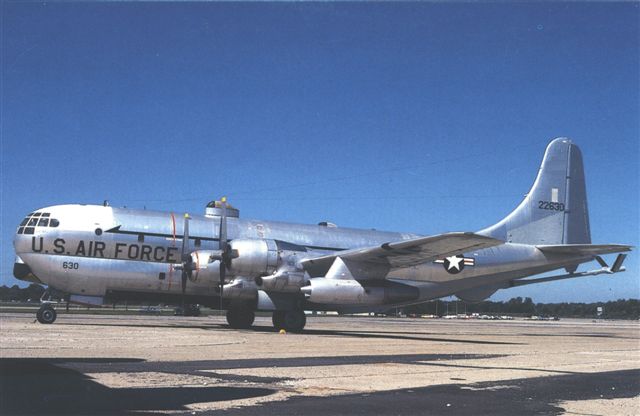
The Boeing KC-97 Stratofreighter is a four-engined, piston-powered United States strategic tanker aircraft based on the Boeing C-97 Stratofreighter. It replaced the KB-29 and was succeeded by the Boeing KC-135 Stratotanker.
The KC-97 Stratofreighter was an aerial refueling tanker variant of the C-97 Stratofreighter (which was itself based on the Boeing B-29 Superfortress), greatly modified with all the necessary tanks, plumbing, and a flying boom first developed for the KB-29 bomber. The cavernous upper deck was capable of accommodating oversize cargo accessed through a very large right-side door. In addition, transferable jet fuel was contained in tanks on the lower deck (G-L models). Both decks were heated and pressurized for high altitude operations. The boom operator lay prone, viewing operations through a window at the bottom of the tail, a configuration later used on the KC-135.
Note: Occasionally the KC-97 has been referred to as "Stratotanker". However, all reputable sources refer to the KC-97 as Stratofreighter, not -tanker. This includes both Boeing and the USAF themselves.
The USAF began operating the KC-97 in 1950. It received a total of 811 KC-97s from Boeing, as opposed to only 74 of the C-97 cargo version, while ordering 819 KC-97s and 74 C-97s. The KC-97 carried aviation gasoline for its own piston engines but it carried jet fuel for its refueling mission, this required an independent system for each type of fuel. However in an emergency, it was able to also offload its aviation gas to a receiver in a procedure universally known as a "save".
These tankers were vitally important to the world-wide Boeing B-47 Stratojet strategic operations. An example was the support of Arctic reconnaissance flights from Thule Air Base.[citation needed]
During Operation Creek Party, which started in 1967 and lasted for 10 years, Air National Guard and Air Force Reserve tankers supported active duty USAF and NATO units in Europe, including an 160th Air Refueling Group Ohio Air National Guard KC-97L.
While it was an effective tanker, the KC-97's slow speed and low operational altitude complicated refueling operations with jet aircraft. B-52s typically lowered their flaps and rear landing gear to slow the aircraft enough to refuel from the KC-97. In addition, a typical B-52 refueling engagement profile would involve a descent that allowed the aircraft pair to maintain a higher airspeed (220–240 knots). In the early 1960s, the Tactical Air Command added General Electric J47 two twin- jet pods from retired KB-50 aerial tankers to produce the KC-97L. These jet pods increased the speed of the KC-97 (for short periods of time) and made it more compatible with jet fighter planes like the F-84, F-100, and F-101.
In 1956, the Strategic Air Command began phasing out its KC-97s in favor of the KC-135 Stratotanker. KC-97s continued flying with Tactical Air Command, the Air Force Reserve, and the Air National Guard. The rest of the KC-97s were retired completely in 1978, when the Texas Air National Guard and the Utah Air National Guard exchanged their KC-97Ls for the C-130 Hercules and the KC-135 Stratotanker, respectively.
Boeing KC-97 Stratofreighter
The Boeing KC-97 Stratofreighter is a four-engined, piston-powered United States strategic tanker aircraft based on the Boeing C-97 Stratofreighter. It replaced the KB-29 and was succeeded by the Boeing KC-135 Stratotanker.
The KC-97 Stratofreighter was an aerial refueling tanker variant of the C-97 Stratofreighter (which was itself based on the Boeing B-29 Superfortress), greatly modified with all the necessary tanks, plumbing, and a flying boom first developed for the KB-29 bomber. The cavernous upper deck was capable of accommodating oversize cargo accessed through a very large right-side door. In addition, transferable jet fuel was contained in tanks on the lower deck (G-L models). Both decks were heated and pressurized for high altitude operations. The boom operator lay prone, viewing operations through a window at the bottom of the tail, a configuration later used on the KC-135.
Note: Occasionally the KC-97 has been referred to as "Stratotanker". However, all reputable sources refer to the KC-97 as Stratofreighter, not -tanker. This includes both Boeing and the USAF themselves.
The USAF began operating the KC-97 in 1950. It received a total of 811 KC-97s from Boeing, as opposed to only 74 of the C-97 cargo version, while ordering 819 KC-97s and 74 C-97s. The KC-97 carried aviation gasoline for its own piston engines but it carried jet fuel for its refueling mission, this required an independent system for each type of fuel. However in an emergency, it was able to also offload its aviation gas to a receiver in a procedure universally known as a "save".
These tankers were vitally important to the world-wide Boeing B-47 Stratojet strategic operations. An example was the support of Arctic reconnaissance flights from Thule Air Base.[citation needed]
During Operation Creek Party, which started in 1967 and lasted for 10 years, Air National Guard and Air Force Reserve tankers supported active duty USAF and NATO units in Europe, including an 160th Air Refueling Group Ohio Air National Guard KC-97L.
While it was an effective tanker, the KC-97's slow speed and low operational altitude complicated refueling operations with jet aircraft. B-52s typically lowered their flaps and rear landing gear to slow the aircraft enough to refuel from the KC-97. In addition, a typical B-52 refueling engagement profile would involve a descent that allowed the aircraft pair to maintain a higher airspeed (220–240 knots). In the early 1960s, the Tactical Air Command added General Electric J47 two twin- jet pods from retired KB-50 aerial tankers to produce the KC-97L. These jet pods increased the speed of the KC-97 (for short periods of time) and made it more compatible with jet fighter planes like the F-84, F-100, and F-101.
In 1956, the Strategic Air Command began phasing out its KC-97s in favor of the KC-135 Stratotanker. KC-97s continued flying with Tactical Air Command, the Air Force Reserve, and the Air National Guard. The rest of the KC-97s were retired completely in 1978, when the Texas Air National Guard and the Utah Air National Guard exchanged their KC-97Ls for the C-130 Hercules and the KC-135 Stratotanker, respectively.
Recent media
Recent media