
Recent from talks
Boeing 377 Stratocruiser
Knowledge base stats:
Talk channels stats:
Members stats:
Boeing 377 Stratocruiser
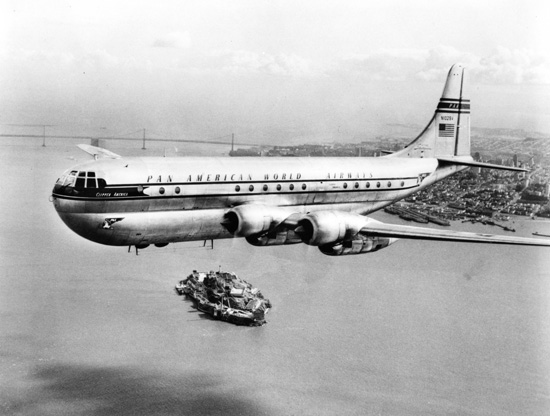
The Boeing 377 Stratocruiser was a large long-range airliner developed from the C-97 Stratofreighter military transport, itself a derivative of the B-29 Superfortress. The Stratocruiser's first flight was on July 8, 1947. Design features included passenger decks and a pressurized cabin. It could carry up to 100 passengers on the main deck plus 14 in the lower deck lounge; typical seating was for 63 or 84 passengers or 28 berthed and five seated passengers.
The Stratocruiser was larger than the Douglas DC-6 and Lockheed Constellation and cost more to buy and operate. Its reliability was poor, mainly due to problems with the four 28-cylinder Pratt & Whitney R-4360 Wasp Major radial engines and structural and control problems with their propellers. Only 55 Stratocruisers were built for airlines, along with the single prototype. One was converted into the Aero Spacelines Pregnant Guppy by John M. Conroy for NASA’s Gemini space program.
The Boeing 377 Stratocruiser was a civil derivative of the Boeing Model 367, the Boeing C-97 Stratofreighter, which first flew in late 1944. William Allen, who had become president of the Boeing Company in September 1945, sought to introduce a new civilian aircraft to replace reduced military production after World War II. Boeing saw in their large-bodied, fast, and long-ranged military transport potential for a passenger aircraft suited for premium service on long transoceanic routes, expanding on the precedent set by their Boeing 314 Clipper with Pan American World Airways. Despite a recession in late 1945, Allen ordered 50 Stratocruisers, spending capital on the project without an order from an airline customer.
On November 29, 1945, Pan American World Airways (Pan Am) became the launch customer with the largest commercial aircraft order in history, a $24.5 million order for 20 Stratocruisers. Earlier in 1945, a Boeing C-97 had flown from Seattle to Washington, D.C. nonstop in six hours and four minutes; with this knowledge, and with Pan Am President Juan Trippe's high regard for Boeing after their success with the Boeing 314 Clipper, Pan Am was confident about ordering the expensive plane.
The 377 shared the distinctive design of the C-97, with a "double-bubble" fuselage cross-section, resembling a figure-8, with the smaller loop on the bottom, and 6,600 cubic feet (190 m3) of interior space shared between two passenger decks. Outside diameter of the upper lobe was 132 inches, compared to 125 inches for the DC-6 and other Douglas types (and 148 inches for today's 737). The lower deck served as a lounge, seating 14. The 377 had innovations such as higher cabin pressure and air conditioning; the superchargers on the four Pratt & Whitney R-4360 engines increased power at altitude and allowed constant cabin pressure.
The wing was the Boeing 117 airfoil. In all, 4 million man-hours went into the engineering of the 377. It was one of only a few double-deck aircraft ever built for commercial use, another being its French contemporary, the Breguet Deux-Ponts, as well as later models, the 747 and the Airbus A380.
The first flight of the 377 was on July 8, 1947, two years after the first commercial order. The flight test fleet of three 377s underwent 250,000 mi (217,000 nmi; 402,000 km) of flying to test its limits before certification.
Other carriers who adopted the Stratocruiser were British Overseas Airways Corporation, American Overseas Airlines (merged with Pan Am in 1950) and United Airlines. The last 377 was delivered to BOAC in May 1950. On this delivery flight, Boeing engineer Wellwood Beall accompanied the final 377 to England, and returned with news of the de Havilland Comet, the first jet airliner, and its appeal. The tenure of the Stratocruiser with United ended in 1954, when United had the opportunity to sell them to BOAC after finding them unprofitable without the extra mail subsidies enjoyed by Pan Am and Northwest.
Hub AI
Boeing 377 Stratocruiser AI simulator
(@Boeing 377 Stratocruiser_simulator)
Boeing 377 Stratocruiser
The Boeing 377 Stratocruiser was a large long-range airliner developed from the C-97 Stratofreighter military transport, itself a derivative of the B-29 Superfortress. The Stratocruiser's first flight was on July 8, 1947. Design features included passenger decks and a pressurized cabin. It could carry up to 100 passengers on the main deck plus 14 in the lower deck lounge; typical seating was for 63 or 84 passengers or 28 berthed and five seated passengers.
The Stratocruiser was larger than the Douglas DC-6 and Lockheed Constellation and cost more to buy and operate. Its reliability was poor, mainly due to problems with the four 28-cylinder Pratt & Whitney R-4360 Wasp Major radial engines and structural and control problems with their propellers. Only 55 Stratocruisers were built for airlines, along with the single prototype. One was converted into the Aero Spacelines Pregnant Guppy by John M. Conroy for NASA’s Gemini space program.
The Boeing 377 Stratocruiser was a civil derivative of the Boeing Model 367, the Boeing C-97 Stratofreighter, which first flew in late 1944. William Allen, who had become president of the Boeing Company in September 1945, sought to introduce a new civilian aircraft to replace reduced military production after World War II. Boeing saw in their large-bodied, fast, and long-ranged military transport potential for a passenger aircraft suited for premium service on long transoceanic routes, expanding on the precedent set by their Boeing 314 Clipper with Pan American World Airways. Despite a recession in late 1945, Allen ordered 50 Stratocruisers, spending capital on the project without an order from an airline customer.
On November 29, 1945, Pan American World Airways (Pan Am) became the launch customer with the largest commercial aircraft order in history, a $24.5 million order for 20 Stratocruisers. Earlier in 1945, a Boeing C-97 had flown from Seattle to Washington, D.C. nonstop in six hours and four minutes; with this knowledge, and with Pan Am President Juan Trippe's high regard for Boeing after their success with the Boeing 314 Clipper, Pan Am was confident about ordering the expensive plane.
The 377 shared the distinctive design of the C-97, with a "double-bubble" fuselage cross-section, resembling a figure-8, with the smaller loop on the bottom, and 6,600 cubic feet (190 m3) of interior space shared between two passenger decks. Outside diameter of the upper lobe was 132 inches, compared to 125 inches for the DC-6 and other Douglas types (and 148 inches for today's 737). The lower deck served as a lounge, seating 14. The 377 had innovations such as higher cabin pressure and air conditioning; the superchargers on the four Pratt & Whitney R-4360 engines increased power at altitude and allowed constant cabin pressure.
The wing was the Boeing 117 airfoil. In all, 4 million man-hours went into the engineering of the 377. It was one of only a few double-deck aircraft ever built for commercial use, another being its French contemporary, the Breguet Deux-Ponts, as well as later models, the 747 and the Airbus A380.
The first flight of the 377 was on July 8, 1947, two years after the first commercial order. The flight test fleet of three 377s underwent 250,000 mi (217,000 nmi; 402,000 km) of flying to test its limits before certification.
Other carriers who adopted the Stratocruiser were British Overseas Airways Corporation, American Overseas Airlines (merged with Pan Am in 1950) and United Airlines. The last 377 was delivered to BOAC in May 1950. On this delivery flight, Boeing engineer Wellwood Beall accompanied the final 377 to England, and returned with news of the de Havilland Comet, the first jet airliner, and its appeal. The tenure of the Stratocruiser with United ended in 1954, when United had the opportunity to sell them to BOAC after finding them unprofitable without the extra mail subsidies enjoyed by Pan Am and Northwest.
Recent media