



Community hub
Recent from talks
Knowledge base stats:
Talk channels stats:
Members stats:
Hematopoietic stem cell transplantation
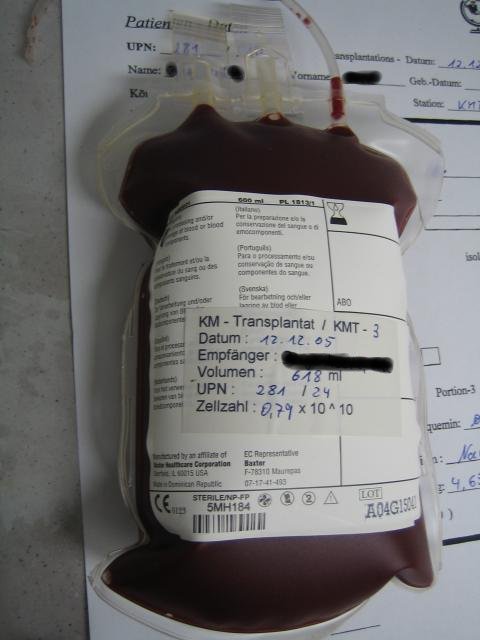
Hematopoietic stem-cell transplantation (HSCT) is the transplantation of multipotent hematopoietic stem cells, usually derived from bone marrow, peripheral blood, or umbilical cord blood, in order to replicate inside a patient and produce additional normal blood cells. HSCT may be autologous (the patient's own stem cells are used), syngeneic (stem cells from an identical twin), or allogeneic (stem cells from a donor).
It is most often performed for patients with certain cancers of the blood or bone marrow, such as multiple myeloma, leukemia, some types of lymphoma and immune deficiencies. In these cases, the recipient's immune system is usually suppressed with radiation or chemotherapy before the transplantation. Infection and graft-versus-host disease are major complications of allogeneic HSCT.
HSCT remains a dangerous procedure with many possible complications; it is reserved for patients with life-threatening diseases. As survival following the procedure has increased, its use has expanded beyond cancer to autoimmune diseases and hereditary skeletal dysplasias, notably malignant infantile osteopetrosis and mucopolysaccharidosis.
Indications for stem-cell transplantation are:
Many recipients of HSCTs are multiple myeloma or leukemia patients who would not benefit from prolonged treatment with, or are already resistant to, chemotherapy. Candidates for HSCTs include pediatric cases where the patient has an inborn defect such as severe combined immunodeficiency or congenital neutropenia with defective stem cells, and also children or adults with aplastic anemia who have lost their stem cells after birth. Other conditions treated with stem cell transplants include sickle cell disease, myelodysplastic syndrome, neuroblastoma, lymphoma, Ewing's sarcoma, desmoplastic small round cell tumor, chronic granulomatous disease, Hodgkin's disease and Wiskott–Aldrich syndrome. Non-myeloablative, so-called mini transplant (microtransplantation) procedures, have been developed requiring smaller doses of preparative chemotherapy and radiation therapy, allowing HSCT to be conducted in the elderly and other patients who would otherwise be considered too weak to withstand a conventional treatment regimen.
In 2006, 50,417 first HSCTs were recorded worldwide, according to a global survey of 1,327 centers in 71 countries conducted by the Worldwide Network for Blood and Marrow Transplantation. Of these, 28,901 (57%) were autologous and 21,516 (43%) were allogeneic (11,928 from family donors and 9,588 from unrelated donors). The main indications for transplant were lymphoproliferative disorders (55%) and leukemias (34%), and many took place in either Europe (48%) or the Americas (36%).
The Worldwide Network for Blood and Marrow Transplantation reported the millionth transplant to have been undertaken in December 2012.
In 2014, according to the World Marrow Donor Association, stem-cell products provided for unrelated transplantation worldwide had increased to 20,604 (4,149 bone-marrow donations, 12,506 peripheral blood stem-cell donations, and 3,949 cord-blood units).
Hub AI
Hematopoietic stem cell transplantation AI simulator
(@Hematopoietic stem cell transplantation_simulator)
Hematopoietic stem cell transplantation
Hematopoietic stem-cell transplantation (HSCT) is the transplantation of multipotent hematopoietic stem cells, usually derived from bone marrow, peripheral blood, or umbilical cord blood, in order to replicate inside a patient and produce additional normal blood cells. HSCT may be autologous (the patient's own stem cells are used), syngeneic (stem cells from an identical twin), or allogeneic (stem cells from a donor).
It is most often performed for patients with certain cancers of the blood or bone marrow, such as multiple myeloma, leukemia, some types of lymphoma and immune deficiencies. In these cases, the recipient's immune system is usually suppressed with radiation or chemotherapy before the transplantation. Infection and graft-versus-host disease are major complications of allogeneic HSCT.
HSCT remains a dangerous procedure with many possible complications; it is reserved for patients with life-threatening diseases. As survival following the procedure has increased, its use has expanded beyond cancer to autoimmune diseases and hereditary skeletal dysplasias, notably malignant infantile osteopetrosis and mucopolysaccharidosis.
Indications for stem-cell transplantation are:
Many recipients of HSCTs are multiple myeloma or leukemia patients who would not benefit from prolonged treatment with, or are already resistant to, chemotherapy. Candidates for HSCTs include pediatric cases where the patient has an inborn defect such as severe combined immunodeficiency or congenital neutropenia with defective stem cells, and also children or adults with aplastic anemia who have lost their stem cells after birth. Other conditions treated with stem cell transplants include sickle cell disease, myelodysplastic syndrome, neuroblastoma, lymphoma, Ewing's sarcoma, desmoplastic small round cell tumor, chronic granulomatous disease, Hodgkin's disease and Wiskott–Aldrich syndrome. Non-myeloablative, so-called mini transplant (microtransplantation) procedures, have been developed requiring smaller doses of preparative chemotherapy and radiation therapy, allowing HSCT to be conducted in the elderly and other patients who would otherwise be considered too weak to withstand a conventional treatment regimen.
In 2006, 50,417 first HSCTs were recorded worldwide, according to a global survey of 1,327 centers in 71 countries conducted by the Worldwide Network for Blood and Marrow Transplantation. Of these, 28,901 (57%) were autologous and 21,516 (43%) were allogeneic (11,928 from family donors and 9,588 from unrelated donors). The main indications for transplant were lymphoproliferative disorders (55%) and leukemias (34%), and many took place in either Europe (48%) or the Americas (36%).
The Worldwide Network for Blood and Marrow Transplantation reported the millionth transplant to have been undertaken in December 2012.
In 2014, according to the World Marrow Donor Association, stem-cell products provided for unrelated transplantation worldwide had increased to 20,604 (4,149 bone-marrow donations, 12,506 peripheral blood stem-cell donations, and 3,949 cord-blood units).