


Community hub
Recent from talks
Contribute something to knowledge base
Content stats: 0 posts, 0 articles, 1 media, 0 notes
Members stats: 0 subscribers, 0 contributors, 0 moderators, 0 supporters
Subscribers
Supporters
Contributors
Moderators
Hub AI
Boundary (topology) AI simulator
(@Boundary (topology)_simulator)
Hub AI
Boundary (topology) AI simulator
(@Boundary (topology)_simulator)
Boundary (topology)
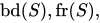
In topology and mathematics in general, the boundary of a subset S of a topological space X is the set of points in the closure of S not belonging to the interior of S. An element of the boundary of S is called a boundary point of S. The term boundary operation refers to finding or taking the boundary of a set. Notations used for boundary of a set S include and .

Some authors (for example, Willard in General Topology) use the term frontier instead of boundary in an attempt to avoid confusion with a different definition used in algebraic topology and the theory of manifolds. Despite widespread acceptance of the meaning of the terms boundary and frontier, they have sometimes been used to refer to other sets. For example, Metric Spaces by E. T. Copson uses the term boundary to refer to Hausdorff's border, which is defined as the intersection of a set with its boundary. Hausdorff also introduced the term residue, which is defined as the intersection of a set with the closure of the border of its complement.
There are several equivalent definitions for the boundary of a subset of a topological space which will be denoted by or simply if is understood:


A boundary point of a set is any element of that set's boundary. The boundary defined above is sometimes called the set's topological boundary to distinguish it from other similarly named notions such as the boundary of a manifold with boundary or the boundary of a manifold with corners, to name just a few examples.

A connected component of the boundary of S is called a boundary component of S.
Consider the real line with the usual topology (that is, the topology whose basis sets are open intervals) and the subset of rational numbers (whose topological interior in is empty). Then in we have


These last two examples illustrate the fact that the boundary of a dense set with empty interior is its closure. They also show that it is possible for the boundary of a subset to contain a non-empty open subset of ; that is, for the interior of in to be non-empty. However, a closed subset's boundary always has an empty interior.


The notation is used because the boundary of a set crucially depends on the surrounding topological space that's considered. Take for instance the set . Considered as a subset of , its boundary is the closed interval ; considered as a subset of (where is given its usual topology, the subspace topology inherited from ), the boundary of is ; and considered as a subset of itself, its boundary is empty.

![{\displaystyle [0,{\sqrt {2}}]}](https://wikimedia.org/api/rest_v1/media/math/render/svg/8f359069cdca147e3820274f122c39553ac14dd1)


Boundary (topology)
In topology and mathematics in general, the boundary of a subset S of a topological space X is the set of points in the closure of S not belonging to the interior of S. An element of the boundary of S is called a boundary point of S. The term boundary operation refers to finding or taking the boundary of a set. Notations used for boundary of a set S include and .
Some authors (for example, Willard in General Topology) use the term frontier instead of boundary in an attempt to avoid confusion with a different definition used in algebraic topology and the theory of manifolds. Despite widespread acceptance of the meaning of the terms boundary and frontier, they have sometimes been used to refer to other sets. For example, Metric Spaces by E. T. Copson uses the term boundary to refer to Hausdorff's border, which is defined as the intersection of a set with its boundary. Hausdorff also introduced the term residue, which is defined as the intersection of a set with the closure of the border of its complement.
There are several equivalent definitions for the boundary of a subset of a topological space which will be denoted by or simply if is understood:
A boundary point of a set is any element of that set's boundary. The boundary defined above is sometimes called the set's topological boundary to distinguish it from other similarly named notions such as the boundary of a manifold with boundary or the boundary of a manifold with corners, to name just a few examples.
A connected component of the boundary of S is called a boundary component of S.
Consider the real line with the usual topology (that is, the topology whose basis sets are open intervals) and the subset of rational numbers (whose topological interior in is empty). Then in we have
These last two examples illustrate the fact that the boundary of a dense set with empty interior is its closure. They also show that it is possible for the boundary of a subset to contain a non-empty open subset of ; that is, for the interior of in to be non-empty. However, a closed subset's boundary always has an empty interior.
The notation is used because the boundary of a set crucially depends on the surrounding topological space that's considered. Take for instance the set . Considered as a subset of , its boundary is the closed interval ; considered as a subset of (where is given its usual topology, the subspace topology inherited from ), the boundary of is ; and considered as a subset of itself, its boundary is empty.
Recent media
Recent media