
Recent from talks
Brandenburg Concertos
Knowledge base stats:
Talk channels stats:
Members stats:
Brandenburg Concertos
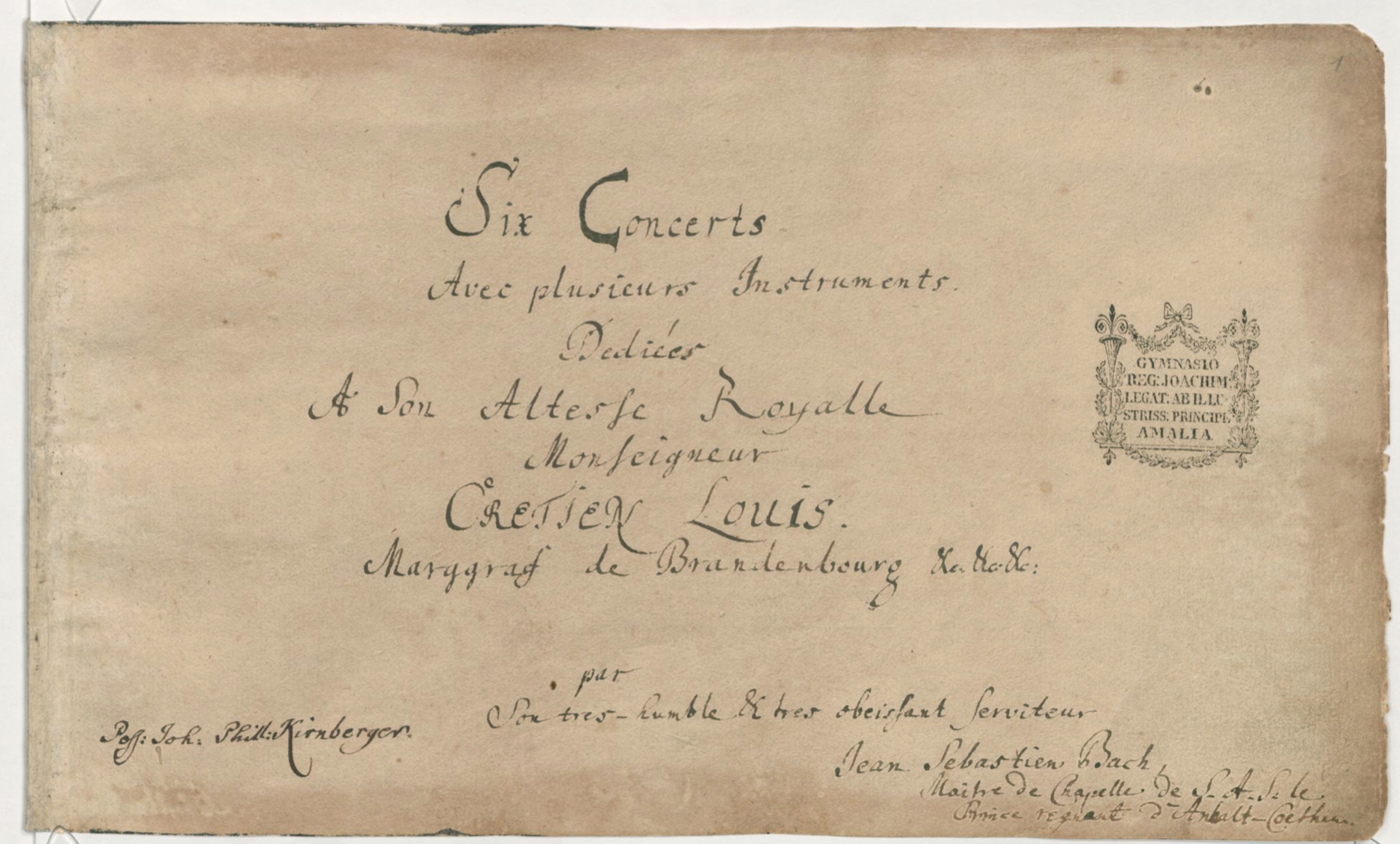
The Brandenburg Concertos (BWV 1046–1051) by Johann Sebastian Bach are a collection of six instrumental works presented by Bach to Christian Ludwig, Margrave of Brandenburg-Schwedt, in 1721 (though probably composed earlier). The original French title is Six Concerts avec plusieurs instruments, meaning "Six Concertos for several instruments". Some of the pieces feature several solo instruments in combination. They are widely regarded as some of the greatest orchestral compositions of the Baroque era.
It is uncertain when most of the material for the Brandenburg Concertos was written. It is clear that the first movement of Concerto No. 1 (BWV 1046) was based on an introduction to Bach's 1713 cantata Was mir behagt, and the second and last may have been as well. It also seems likely that Concerto No. 5 was the last to be written; it features a prominent harpsichord part, which is presumed to be for a new instrument ordered for Prince Leopold from the instrument-maker Michael Mietke and paid for by Bach in Berlin in 1719. Speculation regarding the composition dates of the other concertos varies, taking into account the styles of the pieces as well as the instrumentation Bach would have had available during his years prior to the date of the compiled manuscript.
In 1721, Bach compiled the six concertos, writing them almost entirely in his own hand instead of leaving the work to a copyist. He presented the collection to Christian Ludwig, Margrave of Brandenburg-Schwedt, under the title Six Concerts avec plusieurs instruments (Six Concertos for several instruments) with a dedication dated 24 March. Translated from the original French, the first sentence of Bach's dedication reads:
As I had the good fortune a few years ago to be heard by Your Royal Highness, at Your Highness's commands, and as I noticed then that Your Highness took some pleasure in the little talents which Heaven has given me for Music, and as in taking Leave of Your Royal Highness, Your Highness deigned to honour me with the command to send Your Highness some pieces of my Composition: I have in accordance with Your Highness's most gracious orders taken the liberty of rendering my most humble duty to Your Royal Highness with the present Concertos, which I have adapted to several instruments; begging Your Highness most humbly not to judge their imperfection with the rigour of that discriminating and sensitive taste, which everyone knows Him to have for musical works, but rather to take into benign Consideration the profound respect and the most humble obedience which I thus attempt to show Him.
It is likely that the performance this excerpt mentions happened during the trip Bach took to Berlin in 1719, to pay for the new Mietke harpsichord.
Bach's titular reference to scoring the concertos for "several instruments" has drawn commentary. Christoph Wolff treats it as an understatement, observing that Bach used the "widest imaginable spectrum of orchestral instruments. The modest title does not begin to suggest the degree of innovation exhibited in the daring combinations ... Every one of the six concertos set a precedent in its scoring, and every one was to remain without parallel." Boyd (1993) interprets it as an indication that the concertos are written in a Venetian style, "with its greater opportunities for soloistic display ... 'Concerti a quattro', 'Concerti a cinque' etc.", and also perhaps that Bach was indicating the number of different instruments, or that the sound was intended to evoke a larger orchestra even with only one player to a part. Heinrich Besseler has noted that the overall forces required (leaving aside the first concerto, which was rewritten for a special occasion) tallies exactly with the 17 players Bach had at his disposal in Köthen, although Wolff contradicts this: "contrary to conventional wisdom, the collection does not reflect specific structure of ensembles available either to the margrave of Brandenburg or to the prince of Anhalt-Cöthen."
It is often asserted that Christian Ludwig lacked the musicians in his Berlin ensemble to perform the concertos, and that the score was left unused in the Margrave's library until his death in 1734, but Boyd argues that the evidence does not necessarily support these assertions, and that "it seems unlikely that Bach would have sent him six concertos totally unsuitable for his musicians to play." Nevertheless, the concertos were not included by name in the library inventory after Christian Ludwig's death, and it is uncertain who they went to. The next owner we have a record of was Bach's own pupil Johann Kirnberger, who left the collection to Princess Anna Amalia on his death, who subsequently bequeathed it to the Joachimsthal Gymnasium from which it was transferred to the Royal Library of Berlin (now the Berlin State Library) in 1914. The manuscript was nearly lost during World War II, while being transported for safekeeping to Prussia by train in the care of a librarian – the train came under aerial bombardment, and the librarian escaped from the train to a nearby forest, with the scores hidden under his coat. As of 2023[update] the manuscript remains in the Berlin State Library.
After Bach's death only the fifth concerto received any widespread attention, probably due to the fashion for keyboard concertos; the rest were seemingly forgotten. The pieces were rediscovered by Siegfried Dehn, who found them in Princess Amalia's library in 1849 and had them published for the first time the following year, the centenary of Bach's death. However, this publication appears not to have spurred large numbers of performances, and those that did occur tended to adapt the instrumentation to the forces available to modern orchestras. The concertos' current place in the canon is instead owed to the advent of recording technology; the first recording of the complete set was made in 1936, directed by Adolf Busch, and the revival of interest in historically informed performance made the pieces popular for further recordings on period instruments. They have also been performed as chamber music, with one instrument per part, especially by groups using "baroque instruments" and historically informed techniques and practice. There is also an arrangement for four-hand piano duet by composer Max Reger.
Hub AI
Brandenburg Concertos AI simulator
(@Brandenburg Concertos_simulator)
Brandenburg Concertos
The Brandenburg Concertos (BWV 1046–1051) by Johann Sebastian Bach are a collection of six instrumental works presented by Bach to Christian Ludwig, Margrave of Brandenburg-Schwedt, in 1721 (though probably composed earlier). The original French title is Six Concerts avec plusieurs instruments, meaning "Six Concertos for several instruments". Some of the pieces feature several solo instruments in combination. They are widely regarded as some of the greatest orchestral compositions of the Baroque era.
It is uncertain when most of the material for the Brandenburg Concertos was written. It is clear that the first movement of Concerto No. 1 (BWV 1046) was based on an introduction to Bach's 1713 cantata Was mir behagt, and the second and last may have been as well. It also seems likely that Concerto No. 5 was the last to be written; it features a prominent harpsichord part, which is presumed to be for a new instrument ordered for Prince Leopold from the instrument-maker Michael Mietke and paid for by Bach in Berlin in 1719. Speculation regarding the composition dates of the other concertos varies, taking into account the styles of the pieces as well as the instrumentation Bach would have had available during his years prior to the date of the compiled manuscript.
In 1721, Bach compiled the six concertos, writing them almost entirely in his own hand instead of leaving the work to a copyist. He presented the collection to Christian Ludwig, Margrave of Brandenburg-Schwedt, under the title Six Concerts avec plusieurs instruments (Six Concertos for several instruments) with a dedication dated 24 March. Translated from the original French, the first sentence of Bach's dedication reads:
As I had the good fortune a few years ago to be heard by Your Royal Highness, at Your Highness's commands, and as I noticed then that Your Highness took some pleasure in the little talents which Heaven has given me for Music, and as in taking Leave of Your Royal Highness, Your Highness deigned to honour me with the command to send Your Highness some pieces of my Composition: I have in accordance with Your Highness's most gracious orders taken the liberty of rendering my most humble duty to Your Royal Highness with the present Concertos, which I have adapted to several instruments; begging Your Highness most humbly not to judge their imperfection with the rigour of that discriminating and sensitive taste, which everyone knows Him to have for musical works, but rather to take into benign Consideration the profound respect and the most humble obedience which I thus attempt to show Him.
It is likely that the performance this excerpt mentions happened during the trip Bach took to Berlin in 1719, to pay for the new Mietke harpsichord.
Bach's titular reference to scoring the concertos for "several instruments" has drawn commentary. Christoph Wolff treats it as an understatement, observing that Bach used the "widest imaginable spectrum of orchestral instruments. The modest title does not begin to suggest the degree of innovation exhibited in the daring combinations ... Every one of the six concertos set a precedent in its scoring, and every one was to remain without parallel." Boyd (1993) interprets it as an indication that the concertos are written in a Venetian style, "with its greater opportunities for soloistic display ... 'Concerti a quattro', 'Concerti a cinque' etc.", and also perhaps that Bach was indicating the number of different instruments, or that the sound was intended to evoke a larger orchestra even with only one player to a part. Heinrich Besseler has noted that the overall forces required (leaving aside the first concerto, which was rewritten for a special occasion) tallies exactly with the 17 players Bach had at his disposal in Köthen, although Wolff contradicts this: "contrary to conventional wisdom, the collection does not reflect specific structure of ensembles available either to the margrave of Brandenburg or to the prince of Anhalt-Cöthen."
It is often asserted that Christian Ludwig lacked the musicians in his Berlin ensemble to perform the concertos, and that the score was left unused in the Margrave's library until his death in 1734, but Boyd argues that the evidence does not necessarily support these assertions, and that "it seems unlikely that Bach would have sent him six concertos totally unsuitable for his musicians to play." Nevertheless, the concertos were not included by name in the library inventory after Christian Ludwig's death, and it is uncertain who they went to. The next owner we have a record of was Bach's own pupil Johann Kirnberger, who left the collection to Princess Anna Amalia on his death, who subsequently bequeathed it to the Joachimsthal Gymnasium from which it was transferred to the Royal Library of Berlin (now the Berlin State Library) in 1914. The manuscript was nearly lost during World War II, while being transported for safekeeping to Prussia by train in the care of a librarian – the train came under aerial bombardment, and the librarian escaped from the train to a nearby forest, with the scores hidden under his coat. As of 2023[update] the manuscript remains in the Berlin State Library.
After Bach's death only the fifth concerto received any widespread attention, probably due to the fashion for keyboard concertos; the rest were seemingly forgotten. The pieces were rediscovered by Siegfried Dehn, who found them in Princess Amalia's library in 1849 and had them published for the first time the following year, the centenary of Bach's death. However, this publication appears not to have spurred large numbers of performances, and those that did occur tended to adapt the instrumentation to the forces available to modern orchestras. The concertos' current place in the canon is instead owed to the advent of recording technology; the first recording of the complete set was made in 1936, directed by Adolf Busch, and the revival of interest in historically informed performance made the pieces popular for further recordings on period instruments. They have also been performed as chamber music, with one instrument per part, especially by groups using "baroque instruments" and historically informed techniques and practice. There is also an arrangement for four-hand piano duet by composer Max Reger.
Recent media