
Recent from talks
Brooks (1781 ship)
Knowledge base stats:
Talk channels stats:
Members stats:
Brooks (1781 ship)
Brooks (or Brook, Brookes) was a British slave ship launched at Liverpool in 1781. She became infamous after prints of her were published in 1788. Between 1782 and 1804, she made 11 voyages from Liverpool in the triangular slave trade in enslaved people (for the Brooks, England, to Africa, to the Caribbean, and back to England). During this period she spent some years as a West Indiaman. She also recaptured a British merchantman and captured a French merchantman. Brooks's last voyage shipping enslaved people was to Montevideo in the South Atlantic where she was condemned as unseaworthy in November 1804.
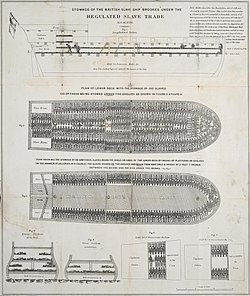
A British Member of Parliament, Sir William Dolben, 3rd Baronet, toured and investigated Brooks. This led to the publishing of her plans and design by Thomas Clarkson, an abolitionist. An engraving first published in Plymouth in 1788 by the Plymouth chapter of the Society for Effecting the Abolition of the Slave Trade depicted the conditions on board Brookes, and has become an iconic image of the inhumanity of the trade in enslaved people. Prime Minister William Pitt supported Dolben's Bill. This was instrumental in getting the bill rapidly passed as the Regulated Slave Trade Act 1788.
The image portrayed captives arranged on the ship's lower deck and poop deck, in accordance with the Regulated Slave Trade Act 1788.
Brookes was reportedly allowed to stow 454 African captives, by allowing a space of 6 feet (1.8 m) by 1 foot 4 inches (0.41 m) to each man, 5 feet 10 inches (1.78 m) by 1 foot 4 inches (0.41 m) to each woman, and 5 feet (1.5 m) by 1 foot 2 inches (0.36 m) to each child. However, the poster's text alleges that a slave trader confessed that before the Act, Brookes had carried as many as 609 captives at one time.
Other records indicate several other issues with the image. The image portrays 487 captives, while on the voyage prior to when the measurements were taken the ship held 638 captives, the next journey 744, and the journey following the measurements, 609. The ship's planking as depicted around the outside perimeter is disproportionately thick. Stowage of captives on multiple layers of decks does not allow for the storage of water and provisions, which was the common practice. No deck hatches are illustrated, only small ladders. There would be no way for the ship to load and unload provisions, especially for the legs of the voyages with no captives aboard. Despite these flaws, this image has become the one most used to depict conditions on a slave ship.
Other physical objects that also were part of slave ships are not depicted. Slave ships had security features to keep the crew safe from their human cargo, such as a barricade or wall to separate them while outside; nets alongside the ship to prevent captives from jumping overboard; and armaments to keep the ship from being taken by pirates or, after 1793, privateers. Below deck bulkheads to separate women and children from men should be shown. Below deck, portholes were common to allow more ventilation, while outside of the ship sails positioned alongside funneled air below. These special sails made it easy to identify a slave ship at sea. Above deck, there would be a large cook stove to prepare the meals, commonly rice and beans, for the captives.
Brook first appeared in Lloyd's Register (LR) in 1781.
1st voyage transporting enslaved people (1781–1783): Captain Clement Noble sailed from Liverpool on 4 October 1781. Brooks arrived in Africa on 15 January 1782. She acquired captives first at Cape Coast Castle and then at Anomabu. She left Africa on 14 July, and arrived at Kingston, Jamaica on 12 September. She had embarked 650 captives and she arrived with 646. She left Kingston on 22 December and arrived back at Liverpool on 22 February 1783. She had left Liverpool with 58 crew members and she suffered eight crew death on her voyage.
Hub AI
Brooks (1781 ship) AI simulator
(@Brooks (1781 ship)_simulator)
Brooks (1781 ship)
Brooks (or Brook, Brookes) was a British slave ship launched at Liverpool in 1781. She became infamous after prints of her were published in 1788. Between 1782 and 1804, she made 11 voyages from Liverpool in the triangular slave trade in enslaved people (for the Brooks, England, to Africa, to the Caribbean, and back to England). During this period she spent some years as a West Indiaman. She also recaptured a British merchantman and captured a French merchantman. Brooks's last voyage shipping enslaved people was to Montevideo in the South Atlantic where she was condemned as unseaworthy in November 1804.
A British Member of Parliament, Sir William Dolben, 3rd Baronet, toured and investigated Brooks. This led to the publishing of her plans and design by Thomas Clarkson, an abolitionist. An engraving first published in Plymouth in 1788 by the Plymouth chapter of the Society for Effecting the Abolition of the Slave Trade depicted the conditions on board Brookes, and has become an iconic image of the inhumanity of the trade in enslaved people. Prime Minister William Pitt supported Dolben's Bill. This was instrumental in getting the bill rapidly passed as the Regulated Slave Trade Act 1788.
The image portrayed captives arranged on the ship's lower deck and poop deck, in accordance with the Regulated Slave Trade Act 1788.
Brookes was reportedly allowed to stow 454 African captives, by allowing a space of 6 feet (1.8 m) by 1 foot 4 inches (0.41 m) to each man, 5 feet 10 inches (1.78 m) by 1 foot 4 inches (0.41 m) to each woman, and 5 feet (1.5 m) by 1 foot 2 inches (0.36 m) to each child. However, the poster's text alleges that a slave trader confessed that before the Act, Brookes had carried as many as 609 captives at one time.
Other records indicate several other issues with the image. The image portrays 487 captives, while on the voyage prior to when the measurements were taken the ship held 638 captives, the next journey 744, and the journey following the measurements, 609. The ship's planking as depicted around the outside perimeter is disproportionately thick. Stowage of captives on multiple layers of decks does not allow for the storage of water and provisions, which was the common practice. No deck hatches are illustrated, only small ladders. There would be no way for the ship to load and unload provisions, especially for the legs of the voyages with no captives aboard. Despite these flaws, this image has become the one most used to depict conditions on a slave ship.
Other physical objects that also were part of slave ships are not depicted. Slave ships had security features to keep the crew safe from their human cargo, such as a barricade or wall to separate them while outside; nets alongside the ship to prevent captives from jumping overboard; and armaments to keep the ship from being taken by pirates or, after 1793, privateers. Below deck bulkheads to separate women and children from men should be shown. Below deck, portholes were common to allow more ventilation, while outside of the ship sails positioned alongside funneled air below. These special sails made it easy to identify a slave ship at sea. Above deck, there would be a large cook stove to prepare the meals, commonly rice and beans, for the captives.
Brook first appeared in Lloyd's Register (LR) in 1781.
1st voyage transporting enslaved people (1781–1783): Captain Clement Noble sailed from Liverpool on 4 October 1781. Brooks arrived in Africa on 15 January 1782. She acquired captives first at Cape Coast Castle and then at Anomabu. She left Africa on 14 July, and arrived at Kingston, Jamaica on 12 September. She had embarked 650 captives and she arrived with 646. She left Kingston on 22 December and arrived back at Liverpool on 22 February 1783. She had left Liverpool with 58 crew members and she suffered eight crew death on her voyage.