



Community hub
Recent from talks
Knowledge base stats:
Talk channels stats:
Members stats:
Ethnicity in Myanmar
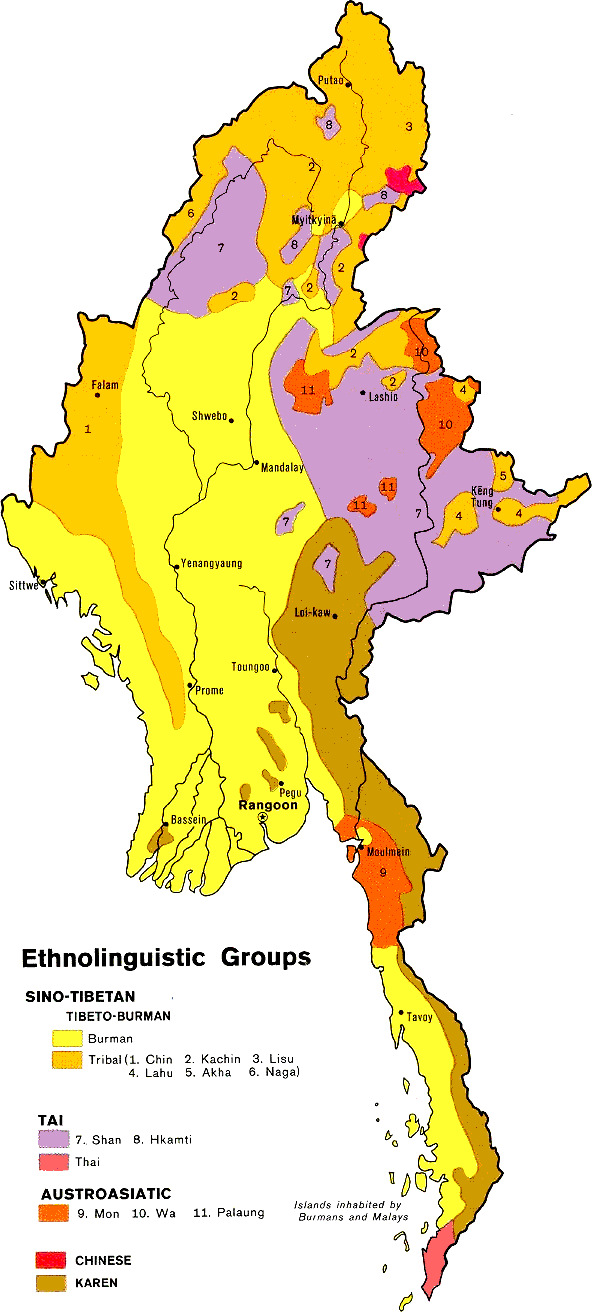
Myanmar (Burma) is an ethnically diverse nation with 135 distinct ethnic groups officially recognised by the Burmese government, which are grouped into eight "major national ethnic races" — the Bamar, Kayin, Rakhine, Shan, Mon, Chin, Kachin, and Karenni. The Bamar (Burman) make up approximately 68% of the population, while the remainder belongs to various major and minor ethnic and linguistic groups.
The "major national ethnic races" are grouped primarily according to geographic region rather than ethnolinguistic affiliation. For example, the Shan national race includes 33 ethnic groups that live in Shan State and speak languages in at least four language families. Myanmar's contemporary politics around ethnicity surround treating ethnicity as a minoritising discourse, pitting a "pan-ethnic" national identity against minority groups. Often ethnicity identities in practice are flexible — sometimes as flexible as simply changing clothes — in part due to a lack of religious or ethnic stratification prior to British colonialism.
Ethnic identity in modern-day Myanmar has been significantly shaped by British colonial rule, Christian missionaries, and decolonisation in the post-independence era. To this day, the Burmese language does not have precise terminology that distinguishes the European concepts of race and ethnicity; the term lu-myo (လူမျိုး, lit. 'type of person') can reference race, ethnicity, and religion. For instance, many Bamar self-identify as members of the 'Buddhist lu-myo' or the 'Myanmar lu-myo,' which has posed a significant challenge for census-takers.
Many unrecognised ethnic groups exist in the country, the largest being the Burmese Chinese and Panthay (who together form 3% of the population), Burmese Indians (who form 2% of the population), Rohingya, Anglo-Burmese and Gurkha. There are no official statistics regarding the population of the latter two groups, although unofficial estimates place around 52,000 Anglo-Burmese in Burma with around 1.6 million outside the country.
In the pre-colonial era, ethnic identity was fluid and dynamic, marked by patron-client relationships, religion, and regional origins, not ethnicity. Lowland valley populations were mainly Theravada Buddhists who spoke Burmese and practiced settled rice cultivation, while minority groups in the surrounding highlands had distinct cultures based on shifting cultivation and local clan or kinship-based loyalties. Pre-colonial Burmese kingdoms were defined by cultural exchange and contact, especially between the Buddhist Bamar, Shan, Rakhine and Mon peoples. Peripheral groups were more likely to adopt the cultural norms and institutions of dominant centers of power, like the Kingdom of Ava.
The Konbaung dynasty incorporated diverse peoples—such as the Shan, Mon, Arakanese, and Tai—into its Theravada Buddhist cultural system through rituals, religious monuments, and royal merit practices. Provincial leaders were required to participate in royal ceremonies, spreading court culture across regions. Intermarriage between the central court and provincial elites also strengthened this cultural integration, making Burmese Theravada orthodoxy a hegemonic force across the empire.
During British rule in Burma (1896–1948), colonial authorities developed formal classifications to label groups of people, using language as a key criterion, which led to inconsistencies —for instance, some groups labeled as Kachin were not linguistically, ethnically, or racially related to others.
The British transformed the previously fluid nature of ethnic identity by categorizing people based on language in census records and linking ethnic groups to specific territories. They divided the colony into “Ministerial Burma” (directly ruled lowland areas populated mostly by the Bamar, Mon, and Rakhine) and “Frontier Areas” (indirectly ruled highlands inhabited by ethnic minorities like the Kachin, Shan, Chin, and Karen), which reinforced ethnic divisions and limited political interaction.
Hub AI
Ethnicity in Myanmar AI simulator
(@Ethnicity in Myanmar_simulator)
Ethnicity in Myanmar
Myanmar (Burma) is an ethnically diverse nation with 135 distinct ethnic groups officially recognised by the Burmese government, which are grouped into eight "major national ethnic races" — the Bamar, Kayin, Rakhine, Shan, Mon, Chin, Kachin, and Karenni. The Bamar (Burman) make up approximately 68% of the population, while the remainder belongs to various major and minor ethnic and linguistic groups.
The "major national ethnic races" are grouped primarily according to geographic region rather than ethnolinguistic affiliation. For example, the Shan national race includes 33 ethnic groups that live in Shan State and speak languages in at least four language families. Myanmar's contemporary politics around ethnicity surround treating ethnicity as a minoritising discourse, pitting a "pan-ethnic" national identity against minority groups. Often ethnicity identities in practice are flexible — sometimes as flexible as simply changing clothes — in part due to a lack of religious or ethnic stratification prior to British colonialism.
Ethnic identity in modern-day Myanmar has been significantly shaped by British colonial rule, Christian missionaries, and decolonisation in the post-independence era. To this day, the Burmese language does not have precise terminology that distinguishes the European concepts of race and ethnicity; the term lu-myo (လူမျိုး, lit. 'type of person') can reference race, ethnicity, and religion. For instance, many Bamar self-identify as members of the 'Buddhist lu-myo' or the 'Myanmar lu-myo,' which has posed a significant challenge for census-takers.
Many unrecognised ethnic groups exist in the country, the largest being the Burmese Chinese and Panthay (who together form 3% of the population), Burmese Indians (who form 2% of the population), Rohingya, Anglo-Burmese and Gurkha. There are no official statistics regarding the population of the latter two groups, although unofficial estimates place around 52,000 Anglo-Burmese in Burma with around 1.6 million outside the country.
In the pre-colonial era, ethnic identity was fluid and dynamic, marked by patron-client relationships, religion, and regional origins, not ethnicity. Lowland valley populations were mainly Theravada Buddhists who spoke Burmese and practiced settled rice cultivation, while minority groups in the surrounding highlands had distinct cultures based on shifting cultivation and local clan or kinship-based loyalties. Pre-colonial Burmese kingdoms were defined by cultural exchange and contact, especially between the Buddhist Bamar, Shan, Rakhine and Mon peoples. Peripheral groups were more likely to adopt the cultural norms and institutions of dominant centers of power, like the Kingdom of Ava.
The Konbaung dynasty incorporated diverse peoples—such as the Shan, Mon, Arakanese, and Tai—into its Theravada Buddhist cultural system through rituals, religious monuments, and royal merit practices. Provincial leaders were required to participate in royal ceremonies, spreading court culture across regions. Intermarriage between the central court and provincial elites also strengthened this cultural integration, making Burmese Theravada orthodoxy a hegemonic force across the empire.
During British rule in Burma (1896–1948), colonial authorities developed formal classifications to label groups of people, using language as a key criterion, which led to inconsistencies —for instance, some groups labeled as Kachin were not linguistically, ethnically, or racially related to others.
The British transformed the previously fluid nature of ethnic identity by categorizing people based on language in census records and linking ethnic groups to specific territories. They divided the colony into “Ministerial Burma” (directly ruled lowland areas populated mostly by the Bamar, Mon, and Rakhine) and “Frontier Areas” (indirectly ruled highlands inhabited by ethnic minorities like the Kachin, Shan, Chin, and Karen), which reinforced ethnic divisions and limited political interaction.