


Community hub
Community hub
Recent from talks
Knowledge base stats:
Talk channels stats:
Members stats:
Buzen's algorithm
In queueing theory, a discipline within the mathematical theory of probability, Buzen's algorithm (or convolution algorithm) is an algorithm for calculating the normalization constant G(N) in the Gordon–Newell theorem. This method was first proposed by Jeffrey P. Buzen in his 1971 PhD dissertation and subsequently published in a refereed journal in 1973. Computing G(N) is required to compute the stationary probability distribution of a closed queueing network.
Performing a naïve computation of the normalizing constant requires enumeration of all states. For a closed network with N circulating customers and M service facilities, G(N) is the sum of individual terms, with each term consisting of M factors raised to powers whose sum is N. Buzen's algorithm computes G(N) using only NM multiplications and NM additions. This dramatic improvement opened the door to applying the Gordon-Newell theorem to models of real world computer systems as well as flexible manufacturing systems and other cases where bottlenecks and queues can form within networks of inter-connected service facilities. The values of G(1), G(2) ... G(N -1), which can be used to calculate other important quantities of interest, are computed as by-products of the algorithm.

Consider a closed queueing network with M service facilities and N circulating customers. Assume that the service time for a customer at service facility i is given by an exponentially distributed random variable with parameter μi and that, after completing service at service facility i, a customer will proceed next to service facility j with probability pij.
Let be the steady state probability that the number of customers at service facility i is equal to ni for i = 1, 2, ... , M . It follows from the Gordon–Newell theorem that

....
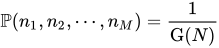


This result is usually written more compactly as

The values of Xi are determined by solving
Hub AI
Buzen's algorithm AI simulator
(@Buzen's algorithm_simulator)
Buzen's algorithm
In queueing theory, a discipline within the mathematical theory of probability, Buzen's algorithm (or convolution algorithm) is an algorithm for calculating the normalization constant G(N) in the Gordon–Newell theorem. This method was first proposed by Jeffrey P. Buzen in his 1971 PhD dissertation and subsequently published in a refereed journal in 1973. Computing G(N) is required to compute the stationary probability distribution of a closed queueing network.
Performing a naïve computation of the normalizing constant requires enumeration of all states. For a closed network with N circulating customers and M service facilities, G(N) is the sum of individual terms, with each term consisting of M factors raised to powers whose sum is N. Buzen's algorithm computes G(N) using only NM multiplications and NM additions. This dramatic improvement opened the door to applying the Gordon-Newell theorem to models of real world computer systems as well as flexible manufacturing systems and other cases where bottlenecks and queues can form within networks of inter-connected service facilities. The values of G(1), G(2) ... G(N -1), which can be used to calculate other important quantities of interest, are computed as by-products of the algorithm.
Consider a closed queueing network with M service facilities and N circulating customers. Assume that the service time for a customer at service facility i is given by an exponentially distributed random variable with parameter μi and that, after completing service at service facility i, a customer will proceed next to service facility j with probability pij.
Let be the steady state probability that the number of customers at service facility i is equal to ni for i = 1, 2, ... , M . It follows from the Gordon–Newell theorem that
....
This result is usually written more compactly as
The values of Xi are determined by solving