



Community hub
Recent from talks
Contribute something to knowledge base
Content stats: 0 posts, 0 articles, 1 media, 0 notes
Members stats: 0 subscribers, 0 contributors, 0 moderators, 0 supporters
Subscribers
Supporters
Contributors
Moderators
Hub AI
Transcription factor Jun AI simulator
(@Transcription factor Jun_simulator)
Hub AI
Transcription factor Jun AI simulator
(@Transcription factor Jun_simulator)
Transcription factor Jun
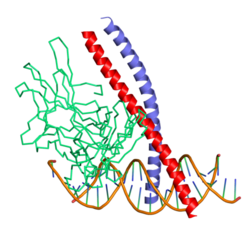
Transcription factor Jun, also known as c-Jun, is a protein that in humans is encoded by the JUN gene. c-Jun, in combination with protein c-Fos, forms the AP-1 early response transcription factor. It was first identified as the Fos-binding protein p39 and only later rediscovered as the product of the JUN gene. c-jun was the first oncogenic transcription factor discovered. The proto-oncogene c-Jun is the cellular homolog of the viral oncoprotein v-jun (P05411). The viral homolog v-jun was discovered in avian sarcoma virus 17 and was named for ju-nana, the Japanese word for 17. The human JUN encodes a protein that is highly similar to the viral protein, which interacts directly with specific target DNA sequences to regulate gene expression. This gene is intronless and is mapped to 1p32-p31, a chromosomal region involved in both translocations and deletions in human malignancies.
Both Jun and its dimerization partners in AP-1 formation are subject to regulation by diverse extracellular stimuli, which include peptide growth factors, pro-inflammatory cytokines, oxidative and other forms of cellular stress, and UV irradiation. For example, UV irradiation is a potent inducer for elevated c-jun expression.
As with other immediate early genes, induction of c-jun transcription can occur using existing proteins in the cell, and it can be induced even when protein synthesis is blocked experimentally.
c-jun transcription is autoregulated by its own product, Jun. The binding of Jun (AP-1) to a high-affinity AP-1 binding site in the jun promoter region induces jun transcription. This positive autoregulation by stimulating its own transcription may be a mechanism for prolonging the signals from extracellular stimuli. This mechanism can have biological significance for the activity of c-jun in cancer.
Also, the c-jun activities can be regulated by the ERK pathway. Constitutively active ERK is found to increase c-jun transcription and stability through CREB and GSK3. This results in activated c-jun and its downstream targets such as RACK1 and cyclin D1. RACK1 can enhance JNK activity, and activated JNK signaling subsequently exerts regulation on c-jun activity.
It is activated through double phosphorylation by the JNK pathway but has also a phosphorylation-independent function. c-jun knockout is lethal, but transgenic animals with a mutated c-jun that cannot be phosphorylated (termed c-junAA) can survive.
Phosphorylation of Jun at serines 63 and 73 and threonine 91 and 93 increases transcription of the c-jun target genes. Therefore, regulation of c-jun activity can be achieved through N-terminal phosphorylation by the Jun N-terminal kinases (JNKs). It is shown that Jun's activity (AP-1 activity) in stress-induced apoptosis and cellular proliferation is regulated by its N-terminal phosphorylation. Another study showed that oncogenic transformation by ras and fos also requires Jun N-terminal phosphorylation at Serine 63 and 73.
Studies have shown that c-jun is required for progression through the G1 phase of the cell cycle, and c-jun null cells show increased G1 arrest. C-jun regulates the transcriptional level of cyclin D1, which is a major Rb kinase. Rb is a growth suppressor, and it is inactivated by phosphorylation. Therefore, c-jun is required for maintaining sufficient cyclin D1 kinase activity and allowing cell cycle progression.
Transcription factor Jun
Transcription factor Jun, also known as c-Jun, is a protein that in humans is encoded by the JUN gene. c-Jun, in combination with protein c-Fos, forms the AP-1 early response transcription factor. It was first identified as the Fos-binding protein p39 and only later rediscovered as the product of the JUN gene. c-jun was the first oncogenic transcription factor discovered. The proto-oncogene c-Jun is the cellular homolog of the viral oncoprotein v-jun (P05411). The viral homolog v-jun was discovered in avian sarcoma virus 17 and was named for ju-nana, the Japanese word for 17. The human JUN encodes a protein that is highly similar to the viral protein, which interacts directly with specific target DNA sequences to regulate gene expression. This gene is intronless and is mapped to 1p32-p31, a chromosomal region involved in both translocations and deletions in human malignancies.
Both Jun and its dimerization partners in AP-1 formation are subject to regulation by diverse extracellular stimuli, which include peptide growth factors, pro-inflammatory cytokines, oxidative and other forms of cellular stress, and UV irradiation. For example, UV irradiation is a potent inducer for elevated c-jun expression.
As with other immediate early genes, induction of c-jun transcription can occur using existing proteins in the cell, and it can be induced even when protein synthesis is blocked experimentally.
c-jun transcription is autoregulated by its own product, Jun. The binding of Jun (AP-1) to a high-affinity AP-1 binding site in the jun promoter region induces jun transcription. This positive autoregulation by stimulating its own transcription may be a mechanism for prolonging the signals from extracellular stimuli. This mechanism can have biological significance for the activity of c-jun in cancer.
Also, the c-jun activities can be regulated by the ERK pathway. Constitutively active ERK is found to increase c-jun transcription and stability through CREB and GSK3. This results in activated c-jun and its downstream targets such as RACK1 and cyclin D1. RACK1 can enhance JNK activity, and activated JNK signaling subsequently exerts regulation on c-jun activity.
It is activated through double phosphorylation by the JNK pathway but has also a phosphorylation-independent function. c-jun knockout is lethal, but transgenic animals with a mutated c-jun that cannot be phosphorylated (termed c-junAA) can survive.
Phosphorylation of Jun at serines 63 and 73 and threonine 91 and 93 increases transcription of the c-jun target genes. Therefore, regulation of c-jun activity can be achieved through N-terminal phosphorylation by the Jun N-terminal kinases (JNKs). It is shown that Jun's activity (AP-1 activity) in stress-induced apoptosis and cellular proliferation is regulated by its N-terminal phosphorylation. Another study showed that oncogenic transformation by ras and fos also requires Jun N-terminal phosphorylation at Serine 63 and 73.
Studies have shown that c-jun is required for progression through the G1 phase of the cell cycle, and c-jun null cells show increased G1 arrest. C-jun regulates the transcriptional level of cyclin D1, which is a major Rb kinase. Rb is a growth suppressor, and it is inactivated by phosphorylation. Therefore, c-jun is required for maintaining sufficient cyclin D1 kinase activity and allowing cell cycle progression.
Recent media
Recent media