



Community hub
Recent from talks
Knowledge base stats:
Talk channels stats:
Members stats:
De Havilland Canada DHC-5 Buffalo
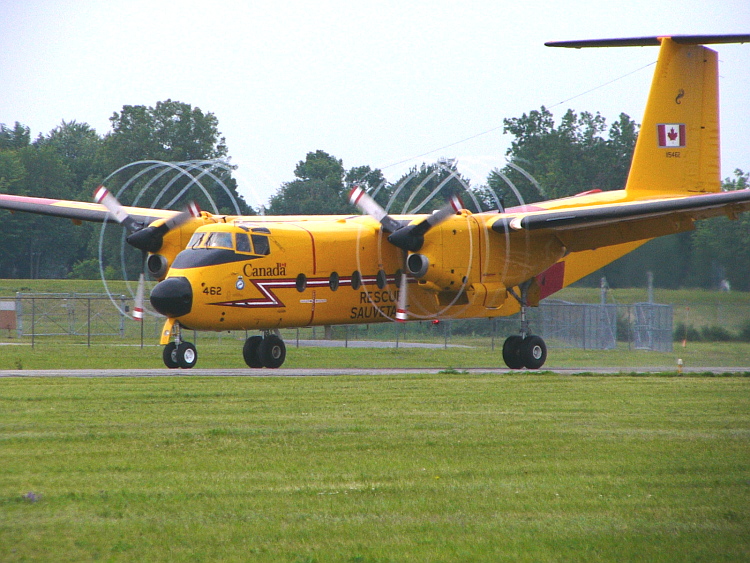
The de Havilland Canada DHC-5 Buffalo is a short takeoff and landing (STOL) utility transport turboprop aircraft developed from the earlier piston-powered DHC-4 Caribou. The aircraft has extraordinary STOL performance and is able to take off in distances much shorter than even most light aircraft can manage. The aircraft was originally designed by de Havilland Canada, with the type certificate now owned by the De Havilland Canada founded in 2019.
The Buffalo arose from a 1962 United States Army requirement for a STOL transport capable of carrying the same payload as the CH-47A Chinook helicopter. de Havilland Canada based its design to meet the requirement on an enlarged version of its DHC-4 Caribou, already in large-scale service with the United States Army, to be powered by General Electric T64 turboprops rather than the Pratt & Whitney R-2000 piston engines of the Caribou. (It had already flown a T64-powered Caribou on 22 September 1961).
De Havilland's design, the DHC-5 Buffalo, was chosen as the winner of the United States Army competition in early 1963, with four DHC-5s, designated YAC-2 (later CV-7A and subsequently C-8A) ordered. The first of these aircraft made its maiden flight on 9 April 1964. All four aircraft were delivered in 1965, the Buffalo carrying nearly twice the payload as the Caribou while having better STOL performance. The prototype CV-7A was exhibited by the manufacturer at the 1965 Paris Air Show wearing US Army markings. No further US orders followed, however, as at the start of 1967 (See the Johnson-McConnell agreement of 1966), inter-service politics led to large fixed-wing transports being transferred to the United States Air Force, who considered themselves adequately equipped with the Fairchild C-123 Provider.
Company data claims a takeoff distance over a 50 ft (15 m) obstacle of 1,210 ft (369 m) at 41,000 lb (18,597 kg) and a landing distance of over a 50 ft (15 m) obstacle of 980 ft (299 m) at 39,100 lb (17,735 kg) for the DHC-5A model.
In the early 1980s, de Havilland Canada attempted to modify the Buffalo for civilian use. The aircraft was to be branded as the "Transporter." After loss of the demonstration aircraft (SN 103 C-GCTC) at the 1984 Farnborough Airshow, the project was abandoned.
A production DHC-5D Buffalo was used for breaking time-to-height records for the weight category 12,000–16,000 kilograms (26,000–35,000 lb) on 16 February 1976, reaching 3,000 metres (9,800 ft) in 2 min 12.75 sec, 6,000 metres (20,000 ft) in 4 min 27.5 sec and 9,000 metres (30,000 ft) in 8 min 3.5 sec.
On 24 February 2006, Viking Air of Victoria, British Columbia, a manufacturer of replacement parts for all out-of-production de Havilland Canada aircraft, purchased the type certificates from Bombardier Aerospace for all versions of the DHC-1 through DHC-7 series aircraft, giving Viking exclusive rights to manufacture and sell new aircraft of those types. In December 2008, Viking Air indicated their intention to put the Buffalo series back into production at their home factory in Victoria, British Columbia or in Calgary, Alberta. A potential new production Buffalo would have had Pratt & Whitney Canada PW150 turboprops, a glass cockpit, enhanced vision and night vision goggle capability. The aircraft was proposed as a replacement for the Royal Canadian Air Force fleet of existing DHC-5As but was not one of the three aircraft in the final assessment, in 2016, which selected the EADS CASA C-295. Several letters of intent for the DHC-5NG were received in 2014.
In late 1965, one of the prototype DHC-5s operated by the U.S. Army was deployed to Bien Hoa Air Base in South Vietnam for a three-month evaluation period, assigned to the 2nd Flight Platoon of the 92nd Aviation Company.
Hub AI
De Havilland Canada DHC-5 Buffalo AI simulator
(@De Havilland Canada DHC-5 Buffalo_simulator)
De Havilland Canada DHC-5 Buffalo
The de Havilland Canada DHC-5 Buffalo is a short takeoff and landing (STOL) utility transport turboprop aircraft developed from the earlier piston-powered DHC-4 Caribou. The aircraft has extraordinary STOL performance and is able to take off in distances much shorter than even most light aircraft can manage. The aircraft was originally designed by de Havilland Canada, with the type certificate now owned by the De Havilland Canada founded in 2019.
The Buffalo arose from a 1962 United States Army requirement for a STOL transport capable of carrying the same payload as the CH-47A Chinook helicopter. de Havilland Canada based its design to meet the requirement on an enlarged version of its DHC-4 Caribou, already in large-scale service with the United States Army, to be powered by General Electric T64 turboprops rather than the Pratt & Whitney R-2000 piston engines of the Caribou. (It had already flown a T64-powered Caribou on 22 September 1961).
De Havilland's design, the DHC-5 Buffalo, was chosen as the winner of the United States Army competition in early 1963, with four DHC-5s, designated YAC-2 (later CV-7A and subsequently C-8A) ordered. The first of these aircraft made its maiden flight on 9 April 1964. All four aircraft were delivered in 1965, the Buffalo carrying nearly twice the payload as the Caribou while having better STOL performance. The prototype CV-7A was exhibited by the manufacturer at the 1965 Paris Air Show wearing US Army markings. No further US orders followed, however, as at the start of 1967 (See the Johnson-McConnell agreement of 1966), inter-service politics led to large fixed-wing transports being transferred to the United States Air Force, who considered themselves adequately equipped with the Fairchild C-123 Provider.
Company data claims a takeoff distance over a 50 ft (15 m) obstacle of 1,210 ft (369 m) at 41,000 lb (18,597 kg) and a landing distance of over a 50 ft (15 m) obstacle of 980 ft (299 m) at 39,100 lb (17,735 kg) for the DHC-5A model.
In the early 1980s, de Havilland Canada attempted to modify the Buffalo for civilian use. The aircraft was to be branded as the "Transporter." After loss of the demonstration aircraft (SN 103 C-GCTC) at the 1984 Farnborough Airshow, the project was abandoned.
A production DHC-5D Buffalo was used for breaking time-to-height records for the weight category 12,000–16,000 kilograms (26,000–35,000 lb) on 16 February 1976, reaching 3,000 metres (9,800 ft) in 2 min 12.75 sec, 6,000 metres (20,000 ft) in 4 min 27.5 sec and 9,000 metres (30,000 ft) in 8 min 3.5 sec.
On 24 February 2006, Viking Air of Victoria, British Columbia, a manufacturer of replacement parts for all out-of-production de Havilland Canada aircraft, purchased the type certificates from Bombardier Aerospace for all versions of the DHC-1 through DHC-7 series aircraft, giving Viking exclusive rights to manufacture and sell new aircraft of those types. In December 2008, Viking Air indicated their intention to put the Buffalo series back into production at their home factory in Victoria, British Columbia or in Calgary, Alberta. A potential new production Buffalo would have had Pratt & Whitney Canada PW150 turboprops, a glass cockpit, enhanced vision and night vision goggle capability. The aircraft was proposed as a replacement for the Royal Canadian Air Force fleet of existing DHC-5As but was not one of the three aircraft in the final assessment, in 2016, which selected the EADS CASA C-295. Several letters of intent for the DHC-5NG were received in 2014.
In late 1965, one of the prototype DHC-5s operated by the U.S. Army was deployed to Bien Hoa Air Base in South Vietnam for a three-month evaluation period, assigned to the 2nd Flight Platoon of the 92nd Aviation Company.