



Community hub
Recent from talks
Knowledge base stats:
Talk channels stats:
Members stats:
Boeing Vertol CH-46 Sea Knight
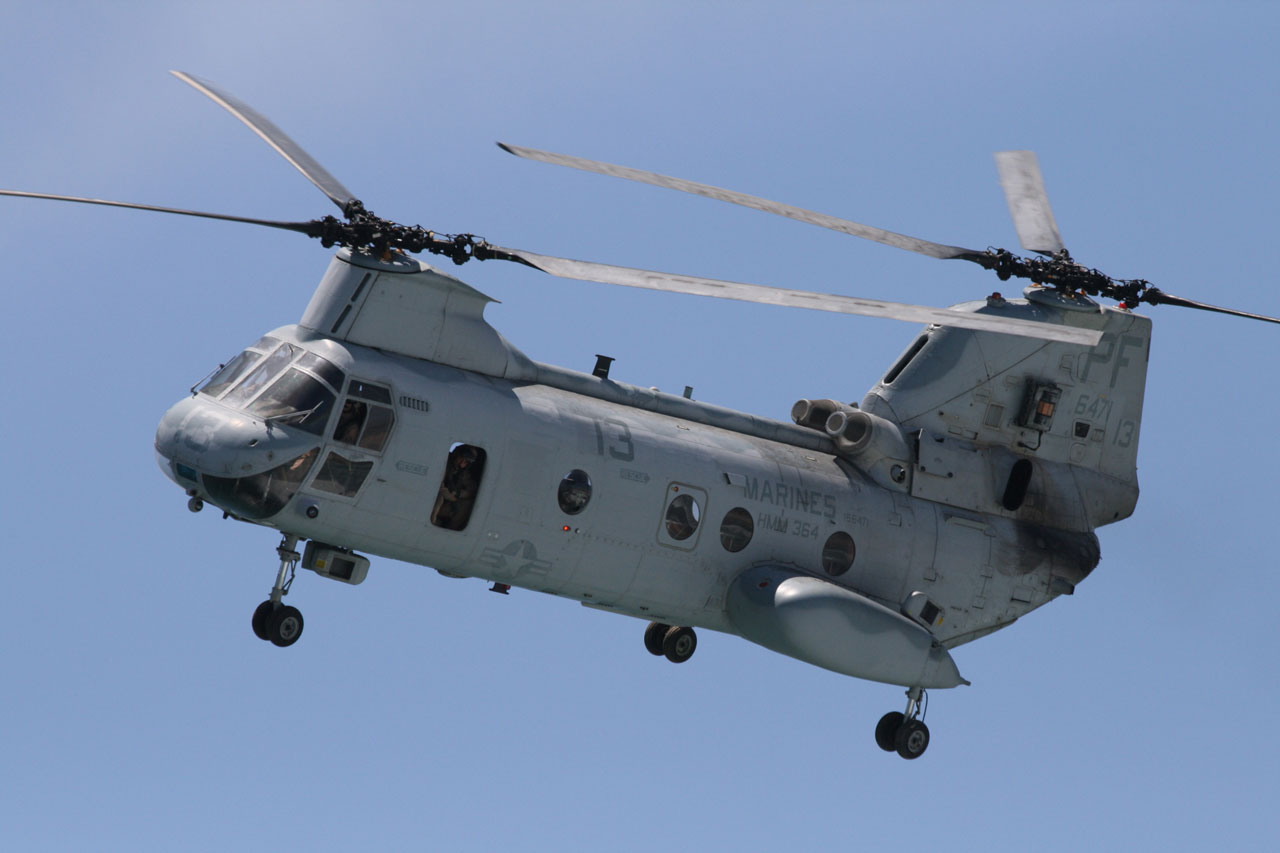
The Boeing Vertol CH-46 Sea Knight is an American medium-lift tandem-rotor transport helicopter powered by twin turboshaft engines. It was designed by Vertol and manufactured by Boeing Vertol following Vertol's acquisition by Boeing.
Development of the Sea Knight, which was originally designated by the firm as the Vertol Model 107, commenced during 1956. It was envisioned as a successor to the first generation of rotorcraft, such as the H-21 "Flying Banana", that had been powered by piston engines; in its place, the V-107 made use of the emergent turboshaft engine. On 22 April 1958, the V-107 prototype performed its maiden flight. During June 1958, the US Army awarded a contract for the construction of ten production-standard aircraft, designated as the YHC-1A, based on the V-107; this initial order was later cut down to three YHC-1As. During 1961, the US Marine Corps (USMC), which had been studying its requirements for a medium-lift, twin-turbine cargo/troop assault helicopter, selected Boeing Vertol's Model 107M as the basis from which to manufacture a suitable rotorcraft to meet their needs. Known colloquially as the "Phrog" and formally as the "Sea Knight", it was operated across all US Marine Corps' operational environments between its introduction during the Vietnam War and its frontline retirement during 2014.
The Sea Knight was operated by the USMC to provide all-weather, day-or-night assault transport of combat troops, supplies and equipment until it was replaced by the MV-22 Osprey during the 2010s. The USMC also used the helicopter for combat support, search and rescue (SAR), casualty evacuation and Tactical Recovery of Aircraft and Personnel (TRAP). The Sea Knight also functioned as the US Navy's standard medium-lift utility helicopter prior to the type being phased out of service in favor of the MH-60S Knighthawk during the early 2000s. Several overseas operators acquired the rotorcraft as well. Canada operated the Sea Knight, designated as CH-113; the type was used predominantly in the SAR role until 2004. Other export customers for the type included Japan, Sweden, and Saudi Arabia. The commercial version of the rotorcraft is the BV 107-II, commonly referred to simply as the "Vertol". The Sea Knight is an amphibious helicopter, able to land directly on calm water and float, but only for a few hours.
During the 1940s and 1950s, American rotorcraft manufacturer Piasecki Helicopter emerged as a pioneering developer of tandem-rotor helicopters; perhaps the most famous of these being the piston-powered H-21 "Flying Banana", an early utility and transport helicopter. During 1955, Piasecki was officially renamed as Vertol Corporation (standing for vertical take-off and landing); it was around this time that work commenced on the development of a new generation of tandem rotor helicopter. During 1956, the new design received the internal company designation of Vertol Model 107, or simply V-107; this rotorcraft differed from its predecessors by harnessing the newly developed turboshaft engine instead of piston-based counterparts. During that year, construction of a prototype, powered by a pair of Lycoming T53 turboshaft engines, each one being capable of producing 877 shp (640 kW), commenced.
On 22 April 1958, the V-107 prototype performed its maiden flight. In order to garner publicity for the newly developed rotorcraft, it was decided to use the prototype to conduct a series of publicised flight demonstrations during a tour across the United States and several overseas nations. During June 1958, it was announced that the U.S. Army had awarded a contract to Vertol for the construction of ten production-standard aircraft based on the V-107, which were designated YHC-1A. However, this order was later decreased to three helicopters; according to aviation author Jay P. Spenser, the cutback had been enacted in order that the U.S. Army would be able to divert funds for the development of the rival V-114 helicopter, which was also a turbine-powered tandem rotor design but substantially larger than the V-107. All of the U.S. Army's three YHC-1As were powered by pairs of GE-T-58 engines. During August 1959, the first YHC-1A-model rotorcraft conducted its first flight; independently, it was shortly followed by the maiden flight of an improved model intended for the commercial and export markets, designated 107-II.
During 1960, the U.S. Marine Corps evolved a requirement for a medium-lift, twin-turbine troop/cargo assault helicopter to replace the various piston-engined types that were then in widespread use with the service. That same year, American aviation company Boeing acquired Vertol, after which the group was consequently renamed Boeing Vertol. Following a competition between several competing designs, during early 1961, it was announced that Boeing Vertol had been selected to manufacture its model 107M for the U.S. Marine Corps, where it was designated HRB-1. During 1962, the U.S. Air Force placed its own order for 12 XCH-46B Sea Knight helicopters, which used the XH-49A designation; however, the service later decided to cancel the order due to delays in its delivery; instead, the U.S. Air Force opted to procure the rival Sikorsky S-61R in its place.[citation needed]
Following the Sea Knight's first flight in August 1962, the military designation was changed to CH-46A. During November 1964, the introduction of the Marines' CH-46A and the Navy's UH-46As commenced. The UH-46A variant was a modified version of the rotorcraft to perform the vertical replenishment mission. The CH-46A was equipped with a pair of T58-GE8-8B turboshaft engines, each being rated at 1,250 shp (930 kW); these allowed the Sea Knight to carry up to 17 passengers or a maximum of 4,000 pounds (1,815 kg) of cargo.
During 1966, production of the improved CH-46D commenced with deliveries following shortly thereafter. This model featured various improvements, including modified rotor blades and the adoption of more powerful T58-GE-10 turboshaft engines, rated at 1,400 shp (1,040 kW) each. The increased power of these new engines allowed the CH-46D to carry an increased payload, such as up to 25 troops or a maximum of 7,000 pounds (3,180 kg) of cargo. During late 1967, the improved model was introduced to the Vietnam theater, where it supplemented the U.S. Marine Corps' existing CH-46A fleet, which had proven to be relatively unreliable and problematic in service. Along with the USMC's CH-46Ds, the U.S. Navy also acquired a small number of UH-46Ds for ship resupply purposes. In addition, approximately 33 CH-46As were progressively re-manufactured to the CH-46D standard.
Hub AI
Boeing Vertol CH-46 Sea Knight AI simulator
(@Boeing Vertol CH-46 Sea Knight_simulator)
Boeing Vertol CH-46 Sea Knight
The Boeing Vertol CH-46 Sea Knight is an American medium-lift tandem-rotor transport helicopter powered by twin turboshaft engines. It was designed by Vertol and manufactured by Boeing Vertol following Vertol's acquisition by Boeing.
Development of the Sea Knight, which was originally designated by the firm as the Vertol Model 107, commenced during 1956. It was envisioned as a successor to the first generation of rotorcraft, such as the H-21 "Flying Banana", that had been powered by piston engines; in its place, the V-107 made use of the emergent turboshaft engine. On 22 April 1958, the V-107 prototype performed its maiden flight. During June 1958, the US Army awarded a contract for the construction of ten production-standard aircraft, designated as the YHC-1A, based on the V-107; this initial order was later cut down to three YHC-1As. During 1961, the US Marine Corps (USMC), which had been studying its requirements for a medium-lift, twin-turbine cargo/troop assault helicopter, selected Boeing Vertol's Model 107M as the basis from which to manufacture a suitable rotorcraft to meet their needs. Known colloquially as the "Phrog" and formally as the "Sea Knight", it was operated across all US Marine Corps' operational environments between its introduction during the Vietnam War and its frontline retirement during 2014.
The Sea Knight was operated by the USMC to provide all-weather, day-or-night assault transport of combat troops, supplies and equipment until it was replaced by the MV-22 Osprey during the 2010s. The USMC also used the helicopter for combat support, search and rescue (SAR), casualty evacuation and Tactical Recovery of Aircraft and Personnel (TRAP). The Sea Knight also functioned as the US Navy's standard medium-lift utility helicopter prior to the type being phased out of service in favor of the MH-60S Knighthawk during the early 2000s. Several overseas operators acquired the rotorcraft as well. Canada operated the Sea Knight, designated as CH-113; the type was used predominantly in the SAR role until 2004. Other export customers for the type included Japan, Sweden, and Saudi Arabia. The commercial version of the rotorcraft is the BV 107-II, commonly referred to simply as the "Vertol". The Sea Knight is an amphibious helicopter, able to land directly on calm water and float, but only for a few hours.
During the 1940s and 1950s, American rotorcraft manufacturer Piasecki Helicopter emerged as a pioneering developer of tandem-rotor helicopters; perhaps the most famous of these being the piston-powered H-21 "Flying Banana", an early utility and transport helicopter. During 1955, Piasecki was officially renamed as Vertol Corporation (standing for vertical take-off and landing); it was around this time that work commenced on the development of a new generation of tandem rotor helicopter. During 1956, the new design received the internal company designation of Vertol Model 107, or simply V-107; this rotorcraft differed from its predecessors by harnessing the newly developed turboshaft engine instead of piston-based counterparts. During that year, construction of a prototype, powered by a pair of Lycoming T53 turboshaft engines, each one being capable of producing 877 shp (640 kW), commenced.
On 22 April 1958, the V-107 prototype performed its maiden flight. In order to garner publicity for the newly developed rotorcraft, it was decided to use the prototype to conduct a series of publicised flight demonstrations during a tour across the United States and several overseas nations. During June 1958, it was announced that the U.S. Army had awarded a contract to Vertol for the construction of ten production-standard aircraft based on the V-107, which were designated YHC-1A. However, this order was later decreased to three helicopters; according to aviation author Jay P. Spenser, the cutback had been enacted in order that the U.S. Army would be able to divert funds for the development of the rival V-114 helicopter, which was also a turbine-powered tandem rotor design but substantially larger than the V-107. All of the U.S. Army's three YHC-1As were powered by pairs of GE-T-58 engines. During August 1959, the first YHC-1A-model rotorcraft conducted its first flight; independently, it was shortly followed by the maiden flight of an improved model intended for the commercial and export markets, designated 107-II.
During 1960, the U.S. Marine Corps evolved a requirement for a medium-lift, twin-turbine troop/cargo assault helicopter to replace the various piston-engined types that were then in widespread use with the service. That same year, American aviation company Boeing acquired Vertol, after which the group was consequently renamed Boeing Vertol. Following a competition between several competing designs, during early 1961, it was announced that Boeing Vertol had been selected to manufacture its model 107M for the U.S. Marine Corps, where it was designated HRB-1. During 1962, the U.S. Air Force placed its own order for 12 XCH-46B Sea Knight helicopters, which used the XH-49A designation; however, the service later decided to cancel the order due to delays in its delivery; instead, the U.S. Air Force opted to procure the rival Sikorsky S-61R in its place.[citation needed]
Following the Sea Knight's first flight in August 1962, the military designation was changed to CH-46A. During November 1964, the introduction of the Marines' CH-46A and the Navy's UH-46As commenced. The UH-46A variant was a modified version of the rotorcraft to perform the vertical replenishment mission. The CH-46A was equipped with a pair of T58-GE8-8B turboshaft engines, each being rated at 1,250 shp (930 kW); these allowed the Sea Knight to carry up to 17 passengers or a maximum of 4,000 pounds (1,815 kg) of cargo.
During 1966, production of the improved CH-46D commenced with deliveries following shortly thereafter. This model featured various improvements, including modified rotor blades and the adoption of more powerful T58-GE-10 turboshaft engines, rated at 1,400 shp (1,040 kW) each. The increased power of these new engines allowed the CH-46D to carry an increased payload, such as up to 25 troops or a maximum of 7,000 pounds (3,180 kg) of cargo. During late 1967, the improved model was introduced to the Vietnam theater, where it supplemented the U.S. Marine Corps' existing CH-46A fleet, which had proven to be relatively unreliable and problematic in service. Along with the USMC's CH-46Ds, the U.S. Navy also acquired a small number of UH-46Ds for ship resupply purposes. In addition, approximately 33 CH-46As were progressively re-manufactured to the CH-46D standard.