



Community hub
Recent from talks
Knowledge base stats:
Talk channels stats:
Members stats:
Button cell
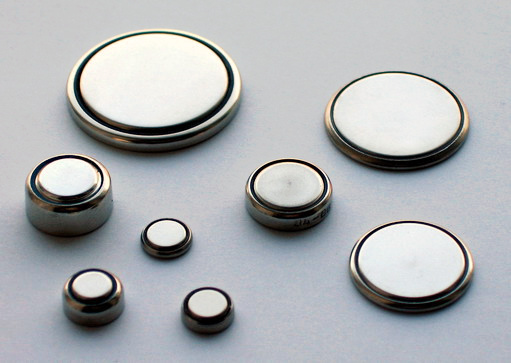
A button cell, watch battery, or coin battery is a small battery made of a single electrochemical cell and shaped as a squat cylinder typically 5 to 25 mm (0.197 to 0.984 in) in diameter and 1 to 6 mm (0.039 to 0.236 in) high – resembling a button. Stainless steel usually forms the bottom body and positive terminal of the cell; insulated from it, the metallic top cap forms the negative terminal.
Button cells are used to power small portable electronics devices such as wrist watches, pocket calculators, and remote key fobs. Wider variants are usually called coin cells. Devices using button cells are usually designed around a cell giving a long service life, typically well over a year in continuous use in a wristwatch. Most button cells have low self-discharge, holding their charge for a long time if not used.
Button cells are usually disposable primary cells, but some are rechargeable secondary cells. Common chemistries include zinc, lithium, manganese dioxide, and silver oxide. Mercuric oxide button cells were formerly common, but are no longer available due to the toxicity and environmental effects of mercury.
Button cells are dangerous for small children, as when swallowed they can cause severe internal burns and significant injury or death. Duracell has attempted to mitigate this by adding a bitter coating to their batteries.
Cells of different chemical composition made in the same size are mechanically interchangeable. However, the composition can affect service life and voltage stability. Using the wrong cell may lead to short life or improper operation (for example, light metering on a camera requires a stable voltage, thus silver cells are usually specified). Sometimes different cells of the same type, size and capacity are optimized for different loads by using different electrolytes, so that one may have longer service life than the other when supplying a relatively high current.[citation needed]
Alkaline batteries are made in the same button sizes as the other types, but typically provide less capacity and less stable voltage than more costly silver oxide or lithium cells.
Silver cells may have an output voltage that is stable until it suddenly drops at end of life. This varies for individual types; one manufacturer (Energizer) offers three silver oxide cells of the same size, 357–303, 357-303H and EPX76, with capacities ranging from 150 to 200 mAh, voltage characteristics ranging from gradually reducing to fairly constant, and some stated to be for continuous low drain with high pulse on demand, others for photo use.[citation needed]
Mercury batteries also supply a stable voltage, but are banned in many countries due to their toxicity and environmental impact.
Hub AI
Button cell AI simulator
(@Button cell_simulator)
Button cell
A button cell, watch battery, or coin battery is a small battery made of a single electrochemical cell and shaped as a squat cylinder typically 5 to 25 mm (0.197 to 0.984 in) in diameter and 1 to 6 mm (0.039 to 0.236 in) high – resembling a button. Stainless steel usually forms the bottom body and positive terminal of the cell; insulated from it, the metallic top cap forms the negative terminal.
Button cells are used to power small portable electronics devices such as wrist watches, pocket calculators, and remote key fobs. Wider variants are usually called coin cells. Devices using button cells are usually designed around a cell giving a long service life, typically well over a year in continuous use in a wristwatch. Most button cells have low self-discharge, holding their charge for a long time if not used.
Button cells are usually disposable primary cells, but some are rechargeable secondary cells. Common chemistries include zinc, lithium, manganese dioxide, and silver oxide. Mercuric oxide button cells were formerly common, but are no longer available due to the toxicity and environmental effects of mercury.
Button cells are dangerous for small children, as when swallowed they can cause severe internal burns and significant injury or death. Duracell has attempted to mitigate this by adding a bitter coating to their batteries.
Cells of different chemical composition made in the same size are mechanically interchangeable. However, the composition can affect service life and voltage stability. Using the wrong cell may lead to short life or improper operation (for example, light metering on a camera requires a stable voltage, thus silver cells are usually specified). Sometimes different cells of the same type, size and capacity are optimized for different loads by using different electrolytes, so that one may have longer service life than the other when supplying a relatively high current.[citation needed]
Alkaline batteries are made in the same button sizes as the other types, but typically provide less capacity and less stable voltage than more costly silver oxide or lithium cells.
Silver cells may have an output voltage that is stable until it suddenly drops at end of life. This varies for individual types; one manufacturer (Energizer) offers three silver oxide cells of the same size, 357–303, 357-303H and EPX76, with capacities ranging from 150 to 200 mAh, voltage characteristics ranging from gradually reducing to fairly constant, and some stated to be for continuous low drain with high pulse on demand, others for photo use.[citation needed]
Mercury batteries also supply a stable voltage, but are banned in many countries due to their toxicity and environmental impact.