
Recent from talks
Cahora Bassa
Knowledge base stats:
Talk channels stats:
Members stats:
Cahora Bassa
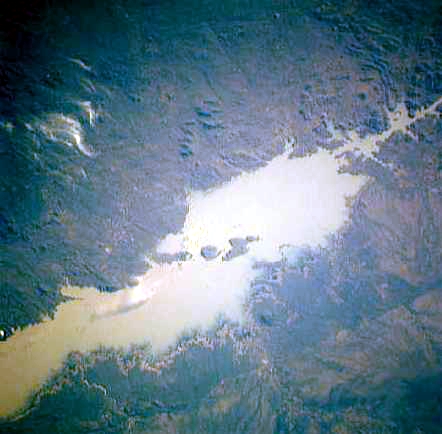
The Cahora Bassa lake—in the Portuguese colonial era (until 1974) known as Cabora Bassa, from Nyungwe Kahoura-Bassa, meaning "finish the job"—is Africa's fourth-largest artificial lake, situated in the Tete Province in Mozambique. In Africa, only Lake Volta in Ghana, Lake Kariba on the Zambezi upstream of Cahora Bassa, and Egypt's Lake Nasser are bigger in terms of surface water.
The Cahora Bassa System started in the late 1960s as a project of the Portuguese in the Overseas Province of Mozambique. Southern African governments were also involved in an agreement stating that Portugal would build and operate a hydroelectric generating station at Cabora Bassa (as it was then called in Portuguese) together with the high-voltage direct current (HVDC) transmission system required to bring electricity to the border of South Africa. South Africa, on the other hand, undertook to build and operate the Apollo converter station and part of the transmission system required to bring the electricity from the South African-Mozambican border to the Apollo converter station near Pretoria. South Africa was then obliged to buy electricity that Portugal was obliged to supply.
During the struggle for independence, construction materials for the dam were repeatedly attacked in a strategic move by Frelimo guerrillas, as its completion would cause the lake to widen so much it would take very long to cross to the other side with their canoes. The dam began to fill in December 1974, after the Carnation Revolution in mainland Portugal and the independence agreement being signed. Mozambique officially became independent from Portugal on 25 June 1975.
Until November 2007, the dam was operated by Hidroeléctrica de Cahora Bassa (HCB) and jointly owned by Mozambique, with an 18% equity stake, and Portugal, which held the remaining 82% equity. On 27 November 2007, Mozambique assumed control of the dam from Portugal, when Portugal sold to Mozambique most of its 82 percent stake. Finance Minister Fernando Teixeira dos Santos said Portugal would collect US$950 million (€750 million) from the sale of its part of southern Africa's largest hydropower project. Portugal kept a 15 percent stake, though it planned to sell off another 10 percent at a later stage to an investor that would be proposed by the Mozambican government. Portugal's Prime Minister, José Sócrates, signed the agreement with the Mozambican government, during an official visit to Maputo. The agreement ended decades of dispute between Portugal and its former colony over the company, called Hidroeléctrica de Cahora Bassa. The central disagreement was over the handling of the company's estimated US$2.2 billion (€1.7 billion) debts to Portugal. Mozambican authorities argued they had not guaranteed the debt and therefore should not be liable for the payments.
Mozambique became independent from Portugal on 25 June 1975. Since closure, the Zambezi, which is the fourth largest floodplain river in Africa, has received a far more regulated flow rate, but disastrous natural floods still occur. The 1978 flood caused 45 deaths, 100,000 people to be displaced and $62 million worth of damage.
According to engineering consultants, "This was the first flood since completion of Cahora Bassa, and destroyed the widely held belief that the dam would finally bring flooding under full control". For further details of ecological problems caused by the dam, see the article on the Zambezi River.
During the Mozambican Civil War (1977–1992) the transmission lines were sabotaged to the extent that 1,895 towers needed to be replaced and 2,311 refurbished over a distance of 893 km on the Mozambican side of the line.
In the 1990s, after the end of the civil war, Hidroeléctrica de Cahora Bassa (HCB) appointed South Africa's Trans-Africa Projects (TAP) to perform the construction management, quality assurance and design support service for the rehabilitation of the project. TAP assisted HCB in awarding the construction contract to a joint venture company comprising Consorzio Italia 2000 and Enel, and a scheduled period of 24 months was set for the project. The lines in South Africa were damaged to a minor extent and only normal maintenance was required by Eskom to get these lines back in operation.
Hub AI
Cahora Bassa AI simulator
(@Cahora Bassa_simulator)
Cahora Bassa
The Cahora Bassa lake—in the Portuguese colonial era (until 1974) known as Cabora Bassa, from Nyungwe Kahoura-Bassa, meaning "finish the job"—is Africa's fourth-largest artificial lake, situated in the Tete Province in Mozambique. In Africa, only Lake Volta in Ghana, Lake Kariba on the Zambezi upstream of Cahora Bassa, and Egypt's Lake Nasser are bigger in terms of surface water.
The Cahora Bassa System started in the late 1960s as a project of the Portuguese in the Overseas Province of Mozambique. Southern African governments were also involved in an agreement stating that Portugal would build and operate a hydroelectric generating station at Cabora Bassa (as it was then called in Portuguese) together with the high-voltage direct current (HVDC) transmission system required to bring electricity to the border of South Africa. South Africa, on the other hand, undertook to build and operate the Apollo converter station and part of the transmission system required to bring the electricity from the South African-Mozambican border to the Apollo converter station near Pretoria. South Africa was then obliged to buy electricity that Portugal was obliged to supply.
During the struggle for independence, construction materials for the dam were repeatedly attacked in a strategic move by Frelimo guerrillas, as its completion would cause the lake to widen so much it would take very long to cross to the other side with their canoes. The dam began to fill in December 1974, after the Carnation Revolution in mainland Portugal and the independence agreement being signed. Mozambique officially became independent from Portugal on 25 June 1975.
Until November 2007, the dam was operated by Hidroeléctrica de Cahora Bassa (HCB) and jointly owned by Mozambique, with an 18% equity stake, and Portugal, which held the remaining 82% equity. On 27 November 2007, Mozambique assumed control of the dam from Portugal, when Portugal sold to Mozambique most of its 82 percent stake. Finance Minister Fernando Teixeira dos Santos said Portugal would collect US$950 million (€750 million) from the sale of its part of southern Africa's largest hydropower project. Portugal kept a 15 percent stake, though it planned to sell off another 10 percent at a later stage to an investor that would be proposed by the Mozambican government. Portugal's Prime Minister, José Sócrates, signed the agreement with the Mozambican government, during an official visit to Maputo. The agreement ended decades of dispute between Portugal and its former colony over the company, called Hidroeléctrica de Cahora Bassa. The central disagreement was over the handling of the company's estimated US$2.2 billion (€1.7 billion) debts to Portugal. Mozambican authorities argued they had not guaranteed the debt and therefore should not be liable for the payments.
Mozambique became independent from Portugal on 25 June 1975. Since closure, the Zambezi, which is the fourth largest floodplain river in Africa, has received a far more regulated flow rate, but disastrous natural floods still occur. The 1978 flood caused 45 deaths, 100,000 people to be displaced and $62 million worth of damage.
According to engineering consultants, "This was the first flood since completion of Cahora Bassa, and destroyed the widely held belief that the dam would finally bring flooding under full control". For further details of ecological problems caused by the dam, see the article on the Zambezi River.
During the Mozambican Civil War (1977–1992) the transmission lines were sabotaged to the extent that 1,895 towers needed to be replaced and 2,311 refurbished over a distance of 893 km on the Mozambican side of the line.
In the 1990s, after the end of the civil war, Hidroeléctrica de Cahora Bassa (HCB) appointed South Africa's Trans-Africa Projects (TAP) to perform the construction management, quality assurance and design support service for the rehabilitation of the project. TAP assisted HCB in awarding the construction contract to a joint venture company comprising Consorzio Italia 2000 and Enel, and a scheduled period of 24 months was set for the project. The lines in South Africa were damaged to a minor extent and only normal maintenance was required by Eskom to get these lines back in operation.
Recent media