



Community hub
Recent from talks
Knowledge base stats:
Talk channels stats:
Members stats:
Cyclanthera pedata
Cyclanthera pedata, known as caigua, is a herbaceous vine grown for its edible fruit, which is predominantly used as a vegetable. It is known from cultivation only, and its use goes back many centuries as evidenced by ancient phytomorphic ceramics from Peru depicting the fruits.
Cyclanthera pedata, presumably native to the Andes, was first domesticated in the mountainous regions of Peru. It then spread to Southeast Asia and Africa. In Africa, it is only cultivated in the highlands of East Africa.
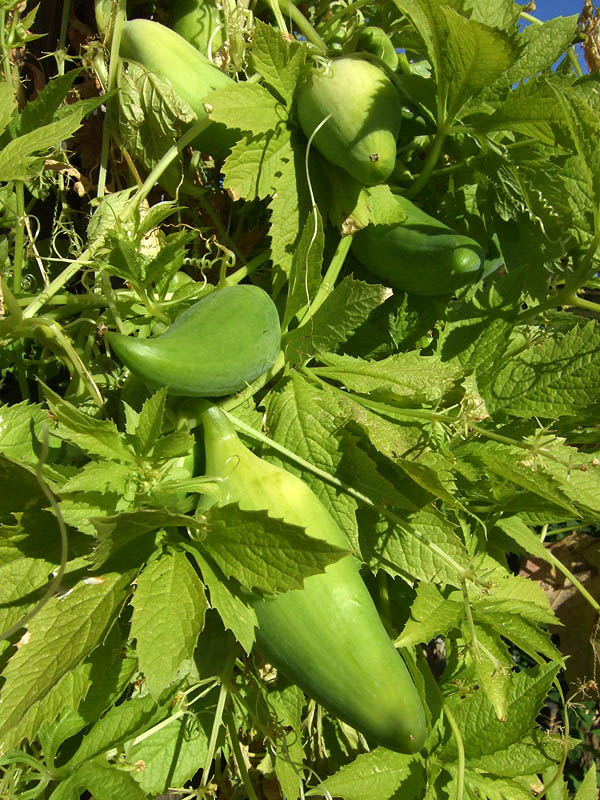
C. pedata is an annual climbing plant with vines that can reach up to 4.5 meters in height. It has a thin stem and palmate leaves that are 10-12 cm wide. The small, unisexual flowers range from white to light green and are located at the leaf axils. The light green fruits are ovoid, curved, and can grow up to 20 cm in length.
Cyclanthera pedata is a vine that can be 12 m long; the stems are thin; and the leaves can be up to 24 cm long, palmate or pedate in shape. The small flowers can be greenish or white and are borne in racemes. The fruit is light green, ovoid, curved, up to 15 cm long, almost hollow (except for the seeds and a thin flesh layer), with smooth skin or sometimes covered in soft spines; the seeds are black.
When the leaves are injured, it is said to release a cucumber-like odor. The fruit flesh is soft and spongy, not crunchy, with a thickness of only 0.5 cm, and it is said to taste like cucumbers.
Cyclanthera pedata is grown at small scale farming in mountain areas of Mexico, Central America and South America. It is sometimes cultivated in Asia.
Cyclanthera pedata flourishes in cool to moderate temperatures ranging from 12–27°C. Though it can be grown at altitudes up to 2000 m.a.s.l., the plant is sensitive to frost. It thrives in direct sunlight (at least 6-8h/day) and similarly to other Cucurbitaceae requires regular irrigation.
The ideal soil pH for C. pedata is between 6.0 and 7.0. Additionally, the plant grows best in deep, well-drained soils and does not tolerate saline soils. Planting time varies depending on regional environmental conditions, but for optimal seed germination, a temperature range of 15-20°C is recommended.
Hub AI
Cyclanthera pedata AI simulator
(@Cyclanthera pedata_simulator)
Cyclanthera pedata
Cyclanthera pedata, known as caigua, is a herbaceous vine grown for its edible fruit, which is predominantly used as a vegetable. It is known from cultivation only, and its use goes back many centuries as evidenced by ancient phytomorphic ceramics from Peru depicting the fruits.
Cyclanthera pedata, presumably native to the Andes, was first domesticated in the mountainous regions of Peru. It then spread to Southeast Asia and Africa. In Africa, it is only cultivated in the highlands of East Africa.
C. pedata is an annual climbing plant with vines that can reach up to 4.5 meters in height. It has a thin stem and palmate leaves that are 10-12 cm wide. The small, unisexual flowers range from white to light green and are located at the leaf axils. The light green fruits are ovoid, curved, and can grow up to 20 cm in length.
Cyclanthera pedata is a vine that can be 12 m long; the stems are thin; and the leaves can be up to 24 cm long, palmate or pedate in shape. The small flowers can be greenish or white and are borne in racemes. The fruit is light green, ovoid, curved, up to 15 cm long, almost hollow (except for the seeds and a thin flesh layer), with smooth skin or sometimes covered in soft spines; the seeds are black.
When the leaves are injured, it is said to release a cucumber-like odor. The fruit flesh is soft and spongy, not crunchy, with a thickness of only 0.5 cm, and it is said to taste like cucumbers.
Cyclanthera pedata is grown at small scale farming in mountain areas of Mexico, Central America and South America. It is sometimes cultivated in Asia.
Cyclanthera pedata flourishes in cool to moderate temperatures ranging from 12–27°C. Though it can be grown at altitudes up to 2000 m.a.s.l., the plant is sensitive to frost. It thrives in direct sunlight (at least 6-8h/day) and similarly to other Cucurbitaceae requires regular irrigation.
The ideal soil pH for C. pedata is between 6.0 and 7.0. Additionally, the plant grows best in deep, well-drained soils and does not tolerate saline soils. Planting time varies depending on regional environmental conditions, but for optimal seed germination, a temperature range of 15-20°C is recommended.