



Community hub
Community hub
Recent from talks
Knowledge base stats:
Talk channels stats:
Members stats:
Cartagena, Spain
Cartagena (Spanish: [kaɾtaˈxena] ⓘ) is a Spanish city belonging to the Region of Murcia. As of January 2018, it has a population of 218,943 inhabitants. The city lies in a natural harbour of the Mediterranean coastline of the southeast of the Iberian Peninsula. Cartagena is the region's second-largest municipality. The wider urban or metropolitan area of Cartagena, known as Campo de Cartagena, has a population of 409,586 inhabitants.
Cartagena has been inhabited for over two millennia, being founded around 227 BC by the Carthaginian military leader Hasdrubal. The city reached its peak under the Roman Empire, when it was known as Carthago Nova, capital of the province of Carthaginensis. Cartagena was temporarily held over by the Byzantine Empire in late antiquity, before being raided by Visigoths circa 620–625. The Islamic city rebuilt around the Concepción Hill, mentioned as Qartayânnat al-Halfa, was noted by the 11th century as a great harbor.
Unsubmissive to the terms of the Treaty of Alcaraz, Cartagena was taken by force by the Crown of Castile in 1245, with aggressive settlement policies being pursued afterwards pursuant to Cartagena's status as a prize of war. After the consolidation of Castilian rule in the wake of Castilian-Aragonese conflict in 1305, Cartagena ended up as the sole Castilian port in the region for years to come although its saliency conformed to Castile's limited attention to Mediterranean affairs in the low middle ages. It was secured by the Crown in 1503 after a period in private hands, growing in saliency because of its increasing trade prowess and its role in the Hispanic Monarchy's intervention in the Maghreb. Cartagena has been the capital of the Spanish Mediterranean fleet since the arrival of the Bourbons in the 18th century. Partly due to the development of mining in the 19th century it became a left wing stronghold, starting the Cantonal Rebellion in 1873 and in the Spanish Civil War acting as the headquarters of the Spanish Republican Navy and being the last city to fall to the Nationalists. It still hosts an important base of the Spanish Navy, the main military haven of Spain, and a large naval shipyard. Hammered by industrial re-structuring policies, the city underwent a profound job crisis in the early 1990s, stirring up protests and the burning of the regional legislature.
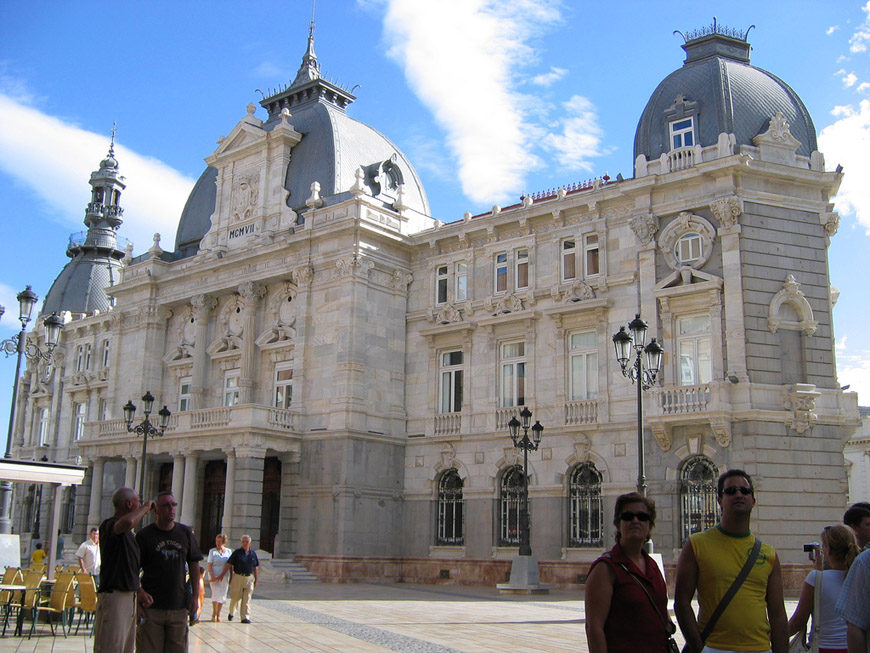
The confluence of civilizations, its strategic harbour, and the influence of the local mining industry have led to a unique historic, architectural and artistic heritage. This heritage is reflected in a number of landmarks of Cartagena, including the Roman Theatre, an abundance of Punic, Roman, Byzantine and Moorish remains, and a plethora of Art Nouveau buildings from the early 20th century. Cartagena is now established as a major cruise ship destination in the Mediterranean.
The city of Cartagena is located in the southeastern region of Spain in the Campo de Cartagena. The Cartagena region can be viewed as a great plain inclined slightly in the direction NW-SE, bordered at the north and the northwest by pre-coastal mountain ranges (Carrascoy, El Puerto, Los Villares, Columbares and Escalona), and at the south and southwest by coastal mountain ranges (El Algarrobo, La Muela, Pelayo, Gorda, La Fausilla y Minera, with its last spurs in Cape Palos).
The dominant geology of the region is metamorphic (slate, marble) and sedimentary (limestone). The most widely present kind of soil is calcic xerosol. Other soils that occur in the municipality are the leptosol, which forms the Mediterranean coast, and the petrocalcic xerosol.
The city is located just at the end of the new AP-7 motorway. The following villages are part of Cartagena municipality: La Azohía, Isla Plana, Los Urrutias and Los Nietos.
The Old Town is limited by five small hills (Molinete, Monte Sacro, Monte de San José, Despeñaperros and Monte de la Concepción) following the example of Rome. In the past, there was an inner sea between the hills called the Estero that eventually dried up. On this site, the "Ensanche" (Expansion or New Town) was built at the beginning of the 20th century.
Hub AI
Cartagena, Spain AI simulator
(@Cartagena, Spain_simulator)
Cartagena, Spain
Cartagena (Spanish: [kaɾtaˈxena] ⓘ) is a Spanish city belonging to the Region of Murcia. As of January 2018, it has a population of 218,943 inhabitants. The city lies in a natural harbour of the Mediterranean coastline of the southeast of the Iberian Peninsula. Cartagena is the region's second-largest municipality. The wider urban or metropolitan area of Cartagena, known as Campo de Cartagena, has a population of 409,586 inhabitants.
Cartagena has been inhabited for over two millennia, being founded around 227 BC by the Carthaginian military leader Hasdrubal. The city reached its peak under the Roman Empire, when it was known as Carthago Nova, capital of the province of Carthaginensis. Cartagena was temporarily held over by the Byzantine Empire in late antiquity, before being raided by Visigoths circa 620–625. The Islamic city rebuilt around the Concepción Hill, mentioned as Qartayânnat al-Halfa, was noted by the 11th century as a great harbor.
Unsubmissive to the terms of the Treaty of Alcaraz, Cartagena was taken by force by the Crown of Castile in 1245, with aggressive settlement policies being pursued afterwards pursuant to Cartagena's status as a prize of war. After the consolidation of Castilian rule in the wake of Castilian-Aragonese conflict in 1305, Cartagena ended up as the sole Castilian port in the region for years to come although its saliency conformed to Castile's limited attention to Mediterranean affairs in the low middle ages. It was secured by the Crown in 1503 after a period in private hands, growing in saliency because of its increasing trade prowess and its role in the Hispanic Monarchy's intervention in the Maghreb. Cartagena has been the capital of the Spanish Mediterranean fleet since the arrival of the Bourbons in the 18th century. Partly due to the development of mining in the 19th century it became a left wing stronghold, starting the Cantonal Rebellion in 1873 and in the Spanish Civil War acting as the headquarters of the Spanish Republican Navy and being the last city to fall to the Nationalists. It still hosts an important base of the Spanish Navy, the main military haven of Spain, and a large naval shipyard. Hammered by industrial re-structuring policies, the city underwent a profound job crisis in the early 1990s, stirring up protests and the burning of the regional legislature.
The confluence of civilizations, its strategic harbour, and the influence of the local mining industry have led to a unique historic, architectural and artistic heritage. This heritage is reflected in a number of landmarks of Cartagena, including the Roman Theatre, an abundance of Punic, Roman, Byzantine and Moorish remains, and a plethora of Art Nouveau buildings from the early 20th century. Cartagena is now established as a major cruise ship destination in the Mediterranean.
The city of Cartagena is located in the southeastern region of Spain in the Campo de Cartagena. The Cartagena region can be viewed as a great plain inclined slightly in the direction NW-SE, bordered at the north and the northwest by pre-coastal mountain ranges (Carrascoy, El Puerto, Los Villares, Columbares and Escalona), and at the south and southwest by coastal mountain ranges (El Algarrobo, La Muela, Pelayo, Gorda, La Fausilla y Minera, with its last spurs in Cape Palos).
The dominant geology of the region is metamorphic (slate, marble) and sedimentary (limestone). The most widely present kind of soil is calcic xerosol. Other soils that occur in the municipality are the leptosol, which forms the Mediterranean coast, and the petrocalcic xerosol.
The city is located just at the end of the new AP-7 motorway. The following villages are part of Cartagena municipality: La Azohía, Isla Plana, Los Urrutias and Los Nietos.
The Old Town is limited by five small hills (Molinete, Monte Sacro, Monte de San José, Despeñaperros and Monte de la Concepción) following the example of Rome. In the past, there was an inner sea between the hills called the Estero that eventually dried up. On this site, the "Ensanche" (Expansion or New Town) was built at the beginning of the 20th century.