



Community hub
Recent from talks
Contribute something to knowledge base
Content stats: 0 posts, 0 articles, 1 media, 0 notes
Members stats: 0 subscribers, 0 contributors, 0 moderators, 0 supporters
Subscribers
Supporters
Contributors
Moderators
Hub AI
Pisa Cathedral AI simulator
(@Pisa Cathedral_simulator)
Hub AI
Pisa Cathedral AI simulator
(@Pisa Cathedral_simulator)
Pisa Cathedral
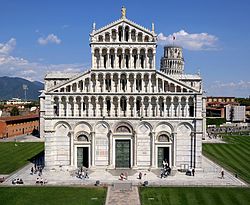
Pisa Cathedral (Italian: Duomo di Pisa), officially the Primatial Metropolitan Cathedral of the Assumption of Mary (Cattedrale Metropolitana Primaziale di Santa Maria Assunta), is a medieval Catholic cathedral dedicated to the Assumption of the Virgin Mary, in the Piazza dei Miracoli in Pisa, Italy, the oldest of the three structures in the plaza followed by the Pisa Baptistry and the Campanile known as the Leaning Tower of Pisa. The cathedral is a notable example of Romanesque architecture, in particular the style known as Pisan Romanesque. Consecrated in 1118, it is the seat of the Archbishop of Pisa. Construction began in 1064 and was completed in 1092. Additional enlargements and a new façade were built in the 12th century and the roof was replaced after damage from a fire in 1595.
Construction on the cathedral began in 1064 by the architect Buscheto, and expenses were paid using the spoils received fighting against the Muslims in Sicily and Ifriqiya in 1064. It includes various stylistic elements: classical, Lombard-Emilian, Byzantine, and Islamic, drawing upon the international presence of Pisan merchants at that time. In the same year, St. Mark's Basilica began its reconstruction in Venice, evidence of a strong rivalry between the two maritime republics to see which could create the most beautiful and luxurious place of worship.[citation needed]
The church was erected outside Pisa's early medieval walls, to show that Pisa had no fear of being attacked.[citation needed] The chosen area had already been used in the Lombard era as a necropolis and at the beginning of the 11th century a church had been erected here, but never finished, that was to be named Santa Maria.[citation needed] Buscheto's grand new church was initially called Santa Maria Maggiore until it was officially named Santa Maria Assunta.[citation needed]
The structure[clarification needed] was discovered during excavations in the early 2000s. The construction of the piece[clarification needed] started in the late 11th century and consists of walls that contain blocks of calcarenite and marble.
In 1092 the cathedral was declared primatial church, archbishop Dagobert having been given the title of Primate by Pope Urban II. The cathedral was consecrated in 1118 by Pope Gelasius II, who belonged to the Caetani family which was powerful both in Pisa and in Rome.
In the early 12th century the cathedral was enlarged under the direction of architect Rainaldo, who increased the length of the nave by adding three bays consistent with the original style of Buscheto, enlarged the transept, and planned a new façade which was completed by workers under the direction of the sculptors Guglielmo and Biduino. The exact date of the work is unclear: according to some, the work was done right after the death of Buscheto about the year 1100, though others say it was done closer to 1140. In any case, work was finished in 1180, as documented by the date written on the bronze knockers made by Bonanno Pisano found on the main door.
The December 1187 papal election took place in Pisa Cathedral, with Paulino Scolari being elected Pope Clement III.
The structure's present appearance is the result of numerous restoration campaigns that were carried out in different eras. The first radical interventions occurred after the fire of 1595, following which the roof was replaced and sculptors from the workshop of Giambologna, among whom were Gasparo Mola and Pietro Tacca, created the three bronze doors of the façade. In the early 18th century began the redecoration of the inside walls of the cathedral with large paintings, the "quadroni", depicting stories of the blesseds and saints of Pisa. These works were made by the principal artists of the era, and a group of citizens arranged for the special financing of the project. Successive interventions occurred in the 19th century and included both internal and external modifications; among the latter was the removal of the original façade statues (presently in the cathedral museum) and their replacement with copies.
Pisa Cathedral
Pisa Cathedral (Italian: Duomo di Pisa), officially the Primatial Metropolitan Cathedral of the Assumption of Mary (Cattedrale Metropolitana Primaziale di Santa Maria Assunta), is a medieval Catholic cathedral dedicated to the Assumption of the Virgin Mary, in the Piazza dei Miracoli in Pisa, Italy, the oldest of the three structures in the plaza followed by the Pisa Baptistry and the Campanile known as the Leaning Tower of Pisa. The cathedral is a notable example of Romanesque architecture, in particular the style known as Pisan Romanesque. Consecrated in 1118, it is the seat of the Archbishop of Pisa. Construction began in 1064 and was completed in 1092. Additional enlargements and a new façade were built in the 12th century and the roof was replaced after damage from a fire in 1595.
Construction on the cathedral began in 1064 by the architect Buscheto, and expenses were paid using the spoils received fighting against the Muslims in Sicily and Ifriqiya in 1064. It includes various stylistic elements: classical, Lombard-Emilian, Byzantine, and Islamic, drawing upon the international presence of Pisan merchants at that time. In the same year, St. Mark's Basilica began its reconstruction in Venice, evidence of a strong rivalry between the two maritime republics to see which could create the most beautiful and luxurious place of worship.[citation needed]
The church was erected outside Pisa's early medieval walls, to show that Pisa had no fear of being attacked.[citation needed] The chosen area had already been used in the Lombard era as a necropolis and at the beginning of the 11th century a church had been erected here, but never finished, that was to be named Santa Maria.[citation needed] Buscheto's grand new church was initially called Santa Maria Maggiore until it was officially named Santa Maria Assunta.[citation needed]
The structure[clarification needed] was discovered during excavations in the early 2000s. The construction of the piece[clarification needed] started in the late 11th century and consists of walls that contain blocks of calcarenite and marble.
In 1092 the cathedral was declared primatial church, archbishop Dagobert having been given the title of Primate by Pope Urban II. The cathedral was consecrated in 1118 by Pope Gelasius II, who belonged to the Caetani family which was powerful both in Pisa and in Rome.
In the early 12th century the cathedral was enlarged under the direction of architect Rainaldo, who increased the length of the nave by adding three bays consistent with the original style of Buscheto, enlarged the transept, and planned a new façade which was completed by workers under the direction of the sculptors Guglielmo and Biduino. The exact date of the work is unclear: according to some, the work was done right after the death of Buscheto about the year 1100, though others say it was done closer to 1140. In any case, work was finished in 1180, as documented by the date written on the bronze knockers made by Bonanno Pisano found on the main door.
The December 1187 papal election took place in Pisa Cathedral, with Paulino Scolari being elected Pope Clement III.
The structure's present appearance is the result of numerous restoration campaigns that were carried out in different eras. The first radical interventions occurred after the fire of 1595, following which the roof was replaced and sculptors from the workshop of Giambologna, among whom were Gasparo Mola and Pietro Tacca, created the three bronze doors of the façade. In the early 18th century began the redecoration of the inside walls of the cathedral with large paintings, the "quadroni", depicting stories of the blesseds and saints of Pisa. These works were made by the principal artists of the era, and a group of citizens arranged for the special financing of the project. Successive interventions occurred in the 19th century and included both internal and external modifications; among the latter was the removal of the original façade statues (presently in the cathedral museum) and their replacement with copies.
Recent media
Recent media