



Community hub
Recent from talks
Contribute something to knowledge base
Content stats: 0 posts, 0 articles, 1 media, 0 notes
Members stats: 0 subscribers, 0 contributors, 0 moderators, 0 supporters
Subscribers
Supporters
Contributors
Moderators
Hub AI
Ceremonial counties of England AI simulator
(@Ceremonial counties of England_simulator)
Hub AI
Ceremonial counties of England AI simulator
(@Ceremonial counties of England_simulator)
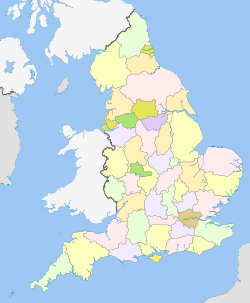
Ceremonial counties of England
Ceremonial counties, formally known as counties for the purposes of the lieutenancies, are areas of England to which lord-lieutenants are appointed. A lord-lieutenant is the monarch's representative in an area.
Shrieval counties have the same boundaries and serve a similar purpose, being the areas to which high sheriffs are appointed. High sheriffs are the monarch's judicial representative in an area.
The ceremonial counties are defined in the Lieutenancies Act 1997, and the shrieval counties in the Sheriffs Act 1887. Both are defined as groups of counties used for local government.
The historic counties of England were originally used as areas for administering justice and organising the militia, overseen by a sheriff. From Tudor times onwards a lord-lieutenant was appointed to oversee the militia, taking some of the sheriff's functions.
Certain towns and cities were counties corporate, which gave them the right to appoint their own sheriffs and hold their own courts. Whilst in theory the counties corporate could have had separate lieutenants appointed for them, in practice all of them except London shared a lieutenant with the wider county from which they had been created. London had instead a commission of lieutenancy, headed by the Lord Mayor. The long-standing practice of appointing lieutenants jointly to the wider county and any counties corporate it contained was formalised by the Militia Act 1882.
Apart from the inclusion of the counties corporate, the counties for the purposes of lieutenancy generally corresponded to the judicial counties. The exception was Yorkshire, which was one judicial county, having a single Sheriff of Yorkshire, but from 1660 onwards each of Yorkshire's three ridings had its own lieutenant.
In 1889, elected county councils were established under the Local Government Act 1888, taking over the administrative functions of the quarter sessions. Certain towns and cities were made county boroughs, independent from the county councils. In counties where the quarter sessions had been held separately for different parts of the county, such as the Parts of Lincolnshire, each part was given its own county council. The area administered by a county council was called an administrative county. As such, some of the judicial or lieutenancy counties comprised several administrative counties and county boroughs.
The Ordnance Survey adopted the term 'geographical county' to describe the widest definition of the county. In most cases this was the lieutenancy county; the exceptions were Yorkshire, where the judicial county was larger on account of it being split into its three ridings for lieutenancy purposes, and the County of London where the administrative county was larger on account of the City of London and the rest of the county being separate for both judicial and lieutenancy purposes.
Ceremonial counties of England
Ceremonial counties, formally known as counties for the purposes of the lieutenancies, are areas of England to which lord-lieutenants are appointed. A lord-lieutenant is the monarch's representative in an area.
Shrieval counties have the same boundaries and serve a similar purpose, being the areas to which high sheriffs are appointed. High sheriffs are the monarch's judicial representative in an area.
The ceremonial counties are defined in the Lieutenancies Act 1997, and the shrieval counties in the Sheriffs Act 1887. Both are defined as groups of counties used for local government.
The historic counties of England were originally used as areas for administering justice and organising the militia, overseen by a sheriff. From Tudor times onwards a lord-lieutenant was appointed to oversee the militia, taking some of the sheriff's functions.
Certain towns and cities were counties corporate, which gave them the right to appoint their own sheriffs and hold their own courts. Whilst in theory the counties corporate could have had separate lieutenants appointed for them, in practice all of them except London shared a lieutenant with the wider county from which they had been created. London had instead a commission of lieutenancy, headed by the Lord Mayor. The long-standing practice of appointing lieutenants jointly to the wider county and any counties corporate it contained was formalised by the Militia Act 1882.
Apart from the inclusion of the counties corporate, the counties for the purposes of lieutenancy generally corresponded to the judicial counties. The exception was Yorkshire, which was one judicial county, having a single Sheriff of Yorkshire, but from 1660 onwards each of Yorkshire's three ridings had its own lieutenant.
In 1889, elected county councils were established under the Local Government Act 1888, taking over the administrative functions of the quarter sessions. Certain towns and cities were made county boroughs, independent from the county councils. In counties where the quarter sessions had been held separately for different parts of the county, such as the Parts of Lincolnshire, each part was given its own county council. The area administered by a county council was called an administrative county. As such, some of the judicial or lieutenancy counties comprised several administrative counties and county boroughs.
The Ordnance Survey adopted the term 'geographical county' to describe the widest definition of the county. In most cases this was the lieutenancy county; the exceptions were Yorkshire, where the judicial county was larger on account of it being split into its three ridings for lieutenancy purposes, and the County of London where the administrative county was larger on account of the City of London and the rest of the county being separate for both judicial and lieutenancy purposes.
Recent media
Recent media