Hubbry Logo
Chach of ArorChach of ArorMain
Open search
Chach of Aror
Community hub
Chach of Aror
logo
8 pages, 0 posts
0 subscribers
Be the first to start a discussion here.
Chach of Aror
Chach of Aror
from Wikipedia

Chach (Sindhi: چچ; r. 631–671) was a Hindu Brahmin king of Sindh from 631 to 671. He was in service of the court of Rai Sahasi II and became a close confidate of the king and the queen.[1] When Rai Sahasi died, he married the widowed queen and thus became ruler of Sindh.[1] His ascend was challenged by Rai Sahasi's brother from Chittor, who claimed to be rightful successor of the kingdom. He marched to Sind but was killed by Chanch by stratagem. Thus Chanch became ruler of Sindh and laying foundation of a short-lived Brahmin dynasty of Sindh.[1][2] Chach expanded the kingdom of Sindh and defeated those who objected to his ascend like Agham Lohana.[2] His his successful efforts to subjugate surrounding monarchies and ethnic groups into an empire covering the entire Indus valley and beyond were recorded in the Chach Nama. Upon his death, Chach was succeeded by his brother Chandar; Chandar is stated to have ruled for eight years, whereupon Dahir, Chach's eldest son, inherited the throne.[1][3][2]

Key Information

Preceded by Chach of Alor
632-671 AD
Succeeded by
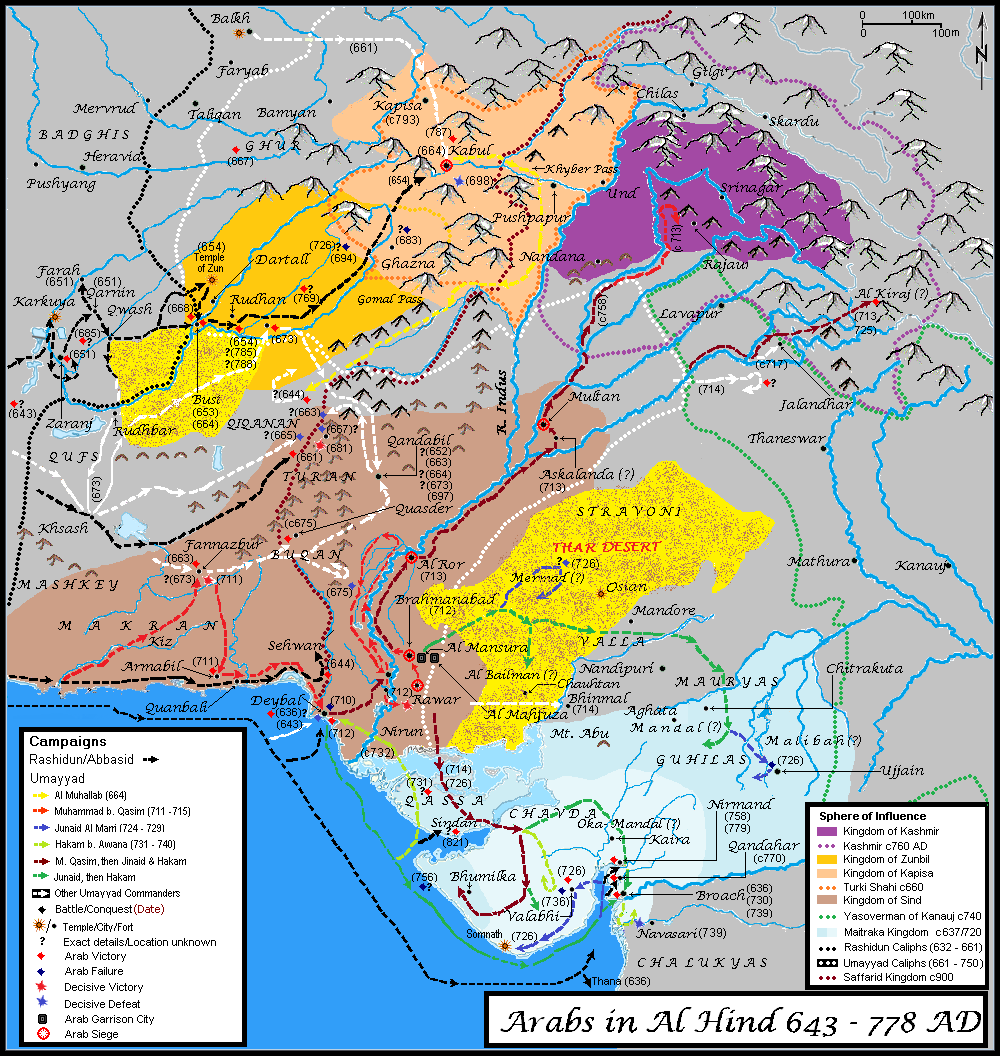
King Chah was affected by Muslim conquests in the Indian subcontinent.
  Desert areas (Registan Desert and Thar Desert)
  Kingdom of Sindh (c. 632– 711 CE)
then, Caliphal province of Sind (712-854 CE)
  Maitraka Kingdom (c.475–c.776 CE)

References

[edit]
Revisions and contributorsEdit on WikipediaRead on Wikipedia
from Grokipedia
Chach (Sindhi: چچ; r. c. 631–671 CE) was a ruler of who ascended from the position of chamberlain to establish the short-lived Brahmin dynasty, supplanting the preceding Buddhist through intrigue following the death of Rai Sahasi II without a male heir. According to the primary historical account in the Chachnama—a 13th-century Persian translation of an earlier Arabic chronicle compiled after the Arab conquest—Chach, originally a low-caste Brahmin advisor from , gained the confidence of the widowed queen (reportedly named Suhandi or similar) and sidelined the late king's minor sons to consolidate power, renaming the capital region Brahminabad to reflect his origins. During his approximately 40-year reign, Chach expanded Sindh's domain northward toward and consolidated control over fractious local monarchies and tribal groups, implementing administrative measures that emphasized centralized authority and resource management, such as tree-planting campaigns for environmental stability. His rule marked a shift toward dominance amid pre-existing Hindu-Buddhist tensions, with accounts describing suppression of Buddhist strongholds and the promotion of Vedic practices, though the Chachnama's post-conquest origins introduce potential interpretive biases favoring the eventual narrative. Chach's death led to succession by his son Dahir, whose reign culminated in the Umayyad conquest of Sindh in 712 CE, ending indigenous rule in the region.

Early Life and Background

Origins and Rise in the Rai Court

Chach, a Brahmin of non-royal lineage, was born circa 610 CE into a family of humble circumstances near Aror in Sindh. The Chach Nama, the principal historical text detailing his era, names him as the son of Silaj (or Selaij), emphasizing his origins within the Brahmin caste but outside the aristocratic elite of the region. This low-status background underscored the unconventional nature of his ascent in a society stratified by varna and dynastic privilege. Entering the service of Rai Sahasi II, the last king of the Buddhist (r. c. 489–632 CE), Chach initially held subordinate roles that showcased his administrative talents. Appointed chamberlain and secretary, he managed court correspondence, finances, and daily governance, gaining the king's confidence through meticulous efficiency in a centered at . The Rai court, dominated by Buddhist nobility amid Sindh's diverse religious fabric, provided Chach—a Hindu —with an entry point via merit rather than birthright, as evidenced by his rapid elevation from obscurity. Chach's ambition manifested early through strategic loyalty and opportunism, particularly as Rai Sahasi's health waned and the dynasty exhibited signs of internal frailty, including succession uncertainties. His role expanded to advisory capacities, where he influenced policy and resource allocation, positioning himself as indispensable amid the court's weakening cohesion. This phase highlighted Chach's acumen in navigating a Buddhist-majority administration as an outsider, leveraging intellect over martial or hereditary claims to amass influence by the early 630s CE.

Ascension to the Throne

Intrigue and Usurpation

Chach, a chamberlain serving under Rai Sahasi II of the , exploited his position of influence to orchestrate a of power following the king's death around 631 CE. According to the Chachnama, Rai Sahasi II succumbed to illness without producing heirs, leaving the throne vulnerable amid administrative instability. Chach, who had cultivated a close relationship with the widowed queen (known as Suhanadi or Suhandi), married her shortly after the king's demise, leveraging this union as a pretext to assume regency and control over the kingdom's affairs. This marital alliance enabled Chach to marginalize potential rivals within the Rai court, including kinsmen and princes who might claim succession through collateral lines. The Chachnama recounts how Chach confined these Rai princes to prevent uprisings, effectively neutralizing immediate threats to his authority through isolation rather than outright execution. Such maneuvers reflected calculated political intrigue, transforming Chach from advisor to sovereign while maintaining a veneer of continuity with the prior regime. The usurpation signified a pivotal dynastic shift in Sindh, supplanting the Rai dynasty—associated with Buddhist patronage and rule—with a Brahmin-led lineage emphasizing Hindu orthodoxy. Chach's Brahmin origins and consolidation of power under this marriage established the Brahmin dynasty (c. 632–712 CE), redirecting governance away from the Rai's syncretic Buddhist affiliations toward Brahminical dominance, as evidenced in contemporary chronicles. This transition, while rooted in internal court dynamics, laid the foundation for Chach's subsequent rule without immediate reliance on external conquests.

Consolidation Against Rivals

Following his ascension, Chach confronted immediate challenges from regional governors who rejected his rule, most notably Agham , the governor of Brahmanabad who mobilized forces against the new regime. Chach advanced on Brahmanabad, engaging Agham in battle where the latter was defeated and slain, thereby neutralizing a primary internal threat to his . To prevent further unrest, Chach stationed himself in Brahmanabad for about one year, overseeing the submission of local leaders and integrating the territory into his domain, which reinforced control over eastern Sindh and deterred other potential rebels. This phase allowed him to redirect resources toward fortifying as the primary capital, sidelining remaining sympathizers through strategic appointments of dependable administrators drawn from his networks. Such measures effectively dismantled networks of opposition, enabling Chach to centralize command and avert counter-coups by reallocating key positions to allies who owed their status to his rather than the prior dynasty. By mid-century, these consolidations had stabilized the core of the kingdom, paving the way for subsequent expansions without immediate fear of internal fracture.

Military Campaigns and Expansion

Conquests in Sindh and Beyond

Chach initiated military campaigns shortly after his ascension around 631 CE to consolidate power in and extend its boundaries, subjugating resistant local s and forts that had fragmented under the preceding . According to the , his forces targeted groups such as the Meds, a nomadic of likely descent inhabiting the lower Indus regions, whom he defeated through sieges and forced submissions, integrating them into his administration via tribute and garrisons. These operations, spanning the 630s and 640s CE, secured key forts in areas like Sewistan (possibly corresponding to Siwis), enabling control over riverine trade and agricultural heartlands. The , a 13th-century Persian account based on lost sources, provides these details but warrants caution due to its composition long after the events, potentially embellishing successes to align with later Abbasid historiographical norms. Further expansions northward reached by the mid-7th century, where Chach's armies overcame local rulers, appointing a thakur (military governor) to oversee the frontier and extract revenues from fertile plains. This victory, detailed in the , marked the northern limit of his empire, facilitating oversight of trade routes linking to the upper Indus. To the southwest, Chach incorporated around 631 CE, defeating coastal chieftains and establishing forts to safeguard maritime access and overland paths to Persia, though subsequent incursions in the 640s tested these gains. Chach's strategy emphasized alliances with amenable monarchies, such as those in neighboring Kabol (possibly linked to Kaba), combined with fortification of strategic passes, which collectively transformed from a regional into an Indus-spanning domain by the 660s CE. These efforts prioritized causal control over commerce and mobility, as evidenced by repairs to infrastructure like the Brahmanabad fortress, yielding economic leverage without overextension. Empirical records from the underscore tactical acumen in leveraging and sieges, though the text's retrospective nature may inflate the scale of unchallenged dominance.

Subjugation of Neighboring Groups

Chach launched military expeditions against the Meds, a nomadic tribe dominant in the lower Indus valley, utilizing allied Jat chieftains in his army to subdue them. Historical accounts record that he killed approximately three thousand Meds during these clashes and erected a , termed Sakrul Med, to assert control over their strongholds. To further weaken their position, Chach diverted seawater via a into their primary , rendering it saline and unusable, which compelled their submission. In parallel, Chach imposed coercive terms on the and Lohanas following their defeat, mandating they bear only wooden swords lacking iron tips as a symbol of , prohibiting ownership of or fine garments, and extracting regular in oil, (ghee), firewood, and fodder grass for Brahmanabad's royal establishments. These stipulations, enforced through chiefs' oversight, effectively dismantled their and channeled their labor toward state needs, with the Meds previously exerting dominance over the Jats now reversed under Chach's hierarchy. Such integrations expanded Chach's military capacity beyond Sindh's urban cores, as subjugated tribal elements were redeployed against resistant neighbors, while tribute systems sustained administrative functions without full assimilation. The , the primary chronicle of these events compiled from earlier Arabic records, details these mechanisms as essential to containing nomadic disruptions, though its later Persian rendering reflects interpretive layers from Muslim chroniclers.

Rule and Administration

Governance Structure

Chach implemented a centralized administrative system reliant on an aristocratic-ministerial model, where governance depended on the counsel of officials who held key roles in revenue collection and provincial oversight. These officials, continued from prior practices, were dispersed across the realm to manage local affairs, ensuring loyalty to the throne in through Brahmin intermediaries versed in fiscal and bureaucratic duties. The kingdom was organized into provinces under governors or viceroys, a structure inherited and adapted from the preceding Rai rulers, who divided Sindh into four primary units extending from the Arabian Sea coast to inland territories like Lohana and Multan. Chach's viceroys maintained hierarchical control, with central directives from Aror enforcing uniformity in taxation and order, though specific provincial demarcations varied with conquests. Fiscal administration emphasized land revenue as the primary income source, assessed and collected by functionaries to sustain the state's agrarian base in arid , with policies aimed at stabilizing collections amid expansion. Trade along the Indus was supported through these revenues, facilitating commerce without detailed records of tariffs or monopolies unique to Chach's era.

Economic and Infrastructure Policies

Chach's economic policies centered on revenue generation through land taxes and trade tolls, which supported administrative stability following his consolidation of power. In Brahmanabad, after its , he established a system of income collection explicitly aimed at facilitating commerce and ensuring the safety of merchants and travelers along key routes. This measure reflected a pragmatic approach to leveraging conquered territories for fiscal resources, distinct from purely military impositions, and aligned with broader administrative reforms documented in contemporary accounts of his rule. Agricultural productivity, the backbone of Sindh's economy, relied on the maintenance of river-based networks along the Indus, which Chach's governance preserved amid regional expansions. The references ongoing agrarian concessions and cultivation practices under his dynasty, indicating policies that incentivized farming to sustain surplus production essential for urban centers like . Archaeological assessments of confirm that prosperity during this era stemmed from effective enabling agricultural output, underscoring the continuity of hydraulic infrastructure critical for flood mitigation and crop yields in the flood-prone Indus valley. Trade promotion extended to securing riverine pathways, where tolls on goods transiting conquered areas generated revenue while deterring banditry, thereby fostering economic exchanges with neighboring regions. These initiatives contributed to Aror's growth as a commercial hub, with textual and material evidence pointing to heightened urban activity and resource management under Chach's oversight.

Religious Policies

Relations with Hinduism and Buddhism

Chach, a Brahmin by origin, ascended to power by usurping the Rai dynasty, which had patronized Buddhist institutions in Sindh during the early 7th century. His rule initiated a perceptible shift toward Hindu Brahminism, as evidenced in the Chachnama, the primary Persian chronicle compiled from earlier Arabic accounts around the 13th century CE, which depicts him consulting and elevating Brahmins to consolidate authority. This patronage included administrative roles for Brahmin advisors, reflecting a strategic alignment with Hindu priestly networks to legitimize his non-royal usurpation, in contrast to the Rai rulers' reported support for Buddhist viharas and samanas (monks). Specific policies under Chach favored Hindu temple construction and rituals, with the Chachnama recording that he assembled chiefs, headmen, and Brahmins to announce permissions for rebuilding or erecting temples, implying prior constraints possibly linked to the transitional instability following the Rai overthrow. This endorsement extended to ritual endowments, where Brahmins received lands and revenues for maintaining Hindu worship sites, fostering dynastic stability through religious legitimacy rooted in Vedic traditions. While the text frequently references Buddhist temples and clergy in Sindh's landscape—using terms like "samanī" for monks—Chach's administration shows no documented active suppression, though the reorientation of patronage likely diminished Buddhist institutional influence by redirecting resources. Historians note that the Chachnama's portrayal intertwines and Buddhist figures, with the term "barahman" occasionally applied ambiguously, suggesting syncretic elements in Sindhi society rather than outright conflict under Chach. This nuance challenges later interpretations of sharp Hindu-Buddhist antagonism, attributing any tensions to Chach's power consolidation rather than ideological purge; Buddhist communities persisted, but Hindu elevation served causal ends of loyalty from priestly elites amid regional threats. The chronicle's later compilation by Muslim authors introduces potential interpretive layers favoring narratives of pre-Islamic disunity, yet its details align with archaeological evidence of coexisting viharas and temples in 7th-century .

Treatment of Local Ethnic Groups

Chach imposed stringent restrictions on the Meds and , designating them as degraded groups subject to specific sartorial and behavioral codes to enforce . These included prohibitions on carrying swords except in emergencies, mandates to wear woolen undergarments and coarse cotton scarves in black or red while barring silk or velvet, requirements to ride unsaddled horses or walk bareheaded and , and obligations to keep dogs for identification. Such measures compelled these tribes to provide in the form of labor, including supplying , serving as guides and spies for the ruler of Brahmanabad, and contributing military support against external threats, with hostages taken to ensure compliance. individuals faced punishments such as enforced security duties or administrative appointments, reflecting a policy of coercion to extract loyalty and resources amid their perceived adversarial nature. The Lohanas encountered parallel degradations, restricted to rough black blankets and coarse scarves, with bare heads and feet, and fines levied for violations involving finer materials; they were also liable for family executions in cases of theft and tasked with provisioning the court, guarding the king, and aiding travelers. Described in contemporary accounts as wild and prone to robbery, the Lohanas supplied tribute through these services, yet pragmatic alliances emerged, such as the marriage of Chach's son Dahar to a Lohana widow, which integrated select leaders into the ruling structure. Jats similarly bore heavy taxes and faced military campaigns to quell uprisings, though temporary pacts granted local autonomy in exchange for tribute and suppression of guerrilla resistance, indicating a blend of confrontation and co-optation. These policies yielded partial assimilation, as evidenced by intermarriages and administrative roles for compliant elements, but persistent resentments fostered long-term instability; the tribes' subjugation under Chach eroded their autonomy without eradicating ethnic distinctions, contributing to fragmented loyalties that later facilitated alliances with Arab invaders during the conquest of Sindh around 711 CE. The Chach Nama, compiled in the 13th century from earlier Arabic sources, portrays these interactions through a lens favoring centralized Brahmanical authority, potentially exaggerating tribal recalcitrance to justify coercive measures, though archaeological and later Persian accounts corroborate the tribes' enduring presence and martial roles in the region. Overall, Chach's approach preserved Sindh's ethnic mosaic under imperial oversight but sowed seeds of division that influenced the subcontinent's demographic shifts prior to Islamic expansion.

Death, Succession, and Legacy

Final Years and Heirs

Chach reigned until circa 671 CE, after which he was succeeded by his brother Chandar, whom he had appointed as deputy during his lifetime to ensure administrative continuity. Chandar's succession averted immediate dynastic strife, as the established governance structures facilitated a smooth transition without recorded civil war or major internal challenges. Chandar, described in some accounts as a Buddhist ascetic, ruled for approximately eight years (671–679 CE), focusing on defense against external pressures such as incursions from the Rana of Kannauj while preserving the realm's stability. Upon Chandar's death, the throne passed to Chach's eldest son, Dahir, marking the direct inheritance within the paternal line and setting the stage for the dynasty's continuation amid growing Arab incursions in peripheral regions like Makran. This succession underscored the Chach dynasty's emphasis on familial loyalty and prepared Dahir to confront escalating threats from Umayyad forces by 679 CE.

Historical Assessment and Sources

The Chach-nama, a 13th-century Persian compilation attributed to 'Ali Kufi and based on lost 8th-century Arabic accounts from the era of ibn al-Qasim's 712 CE campaign, serves as the principal source for Chach's reign and the pre-Islamic . This text details Chach's consolidation of power and administrative measures, drawing from oral traditions and documents preserved in Alor, though its retrospective composition post-conquest introduces potential Arab-centric biases favoring narratives of local disunity to legitimize Umayyad expansion. Historians note that while the Chach-nama rehabilitates Chach as a capable unifier—contrasting earlier dismissals of it as romance—its reliability is contested due to intertextual inconsistencies and the absence of contemporaneous non-Islamic corroboration, rendering it a secondary synthesis rather than eyewitness record. Assessments of Chach's impact balance his unification of fragmented Buddhist and Brahmanical polities in Sindh—spanning from the Indus delta to Multan by circa 670 CE—against charges of usurpation from the prior Rai dynasty through intrigue and marriage to a regent's widow. Proponents highlight his empire-building as evidence of indigenous resilience, forging a centralized Hindu-Brahmin state that repelled earlier Arab raids and extended influence into Punjab and Rajasthan, thereby stabilizing a region prone to tribal incursions and internal rivalries among groups like the Jats and Meds. Critics, drawing from the Chach-nama's own portrayal of coercive tactics, argue his authoritarian centralization alienated feudatories, sowing discord that weakened successors like Dahir amid persistent fragmentation. Right-leaning historiographies emphasize that such internal Hindu disunity enabled Chach's rise but also underscored the causal role of decisive leadership in temporarily thwarting external Islamic pressures, absent which Sindh's polities might have collapsed earlier. Chach's legacy endures as the architect of a Brahmin dynasty (circa 632–712 CE) that postponed full Muslim subjugation of for over a generation, maintaining sovereignty until Dahir's defeat at the Battle of in 712 CE, after which Umayyad forces under overran the core territories. This interlude, per the Chach-nama and subsequent analyses, reflects effective hydraulic and military administration that fortified riverine defenses, though modern cautions against overreliance on the text's teleological framing of pre-Islamic rule as prelude to , urging cross-verification with numismatic and inscriptional where sparse. Pakistani narratives often integrate Chach into a continuum of Sindhi statecraft, while Indian perspectives stress the dynasty's role in preserving dharmic governance amid peripheral threats, highlighting biases in colonial-era interpretations that amplified Arab sources to underscore "inevitable" Islamic advance. Overall, empirical reconstruction privileges Chach's unification as a causal bulwark against fragmentation, substantiated by the dynasty's documented endurance until geopolitical shifts enabled the 711–713 CE incursion.

References

Add your contribution
Related Hubs
User Avatar
No comments yet.