
Recent from talks
Charles F. Kettering
Knowledge base stats:
Talk channels stats:
Members stats:
Charles F. Kettering
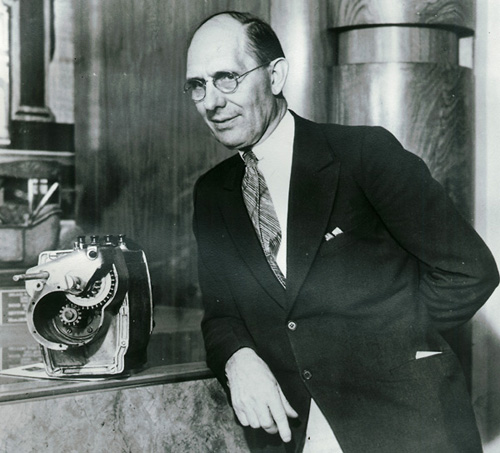
Charles Franklin Kettering (August 29, 1876 – November 25, 1958) sometimes known as Charles Fredrick Kettering was an American inventor, engineer, businessman, and the holder of 186 patents. He was a founder of Delco, and was head of research at General Motors from 1920 to 1947. Among his most widely used automotive developments were the electrical starting motor and leaded gasoline. In association with the DuPont Chemical Company, he was also responsible for the invention of Freon refrigerant for refrigeration and air conditioning systems. At DuPont he also was responsible for the development of Duco lacquers and enamels, the first practical colored paints for mass-produced automobiles. While working with the Dayton-Wright Company he developed the "Bug" aerial torpedo, considered the world's first aerial missile. He led the advancement of practical, lightweight two-stroke diesel engines, revolutionizing the locomotive and heavy equipment industries. In 1927, he founded the Kettering Foundation, a non-partisan research foundation, and was featured on the cover of Time magazine in January 1933.
Charles was born in Loudonville, Ohio, United States, the fourth of five children of Jacob Henry Kettering and Martha (Hunter) Kettering. Poor eyesight gave him headaches in school. After graduation he followed his sister Emma into a teaching position at Bunker Hill School. By all accounts he was an engaging and innovative teacher. He attracted students to evening scientific demonstrations on electricity, heat, magnetism, and gravity.
He took classes at the College of Wooster, before transferring to Ohio State University. He was a member of the Delta Upsilon fraternity. Eye problems forced him to withdraw, and he took a job as foreman of a telephone line crew. At first, the termination of his studies caused him to be depressed. Then he found ways to apply his electrical engineering skills on the job, and his spirits revived. He also met his future wife, Olive Williams. When his eye condition improved, he was able to return to his studies and graduated from OSU in 1904 with an electrical engineering degree.[citation needed]
Kettering was hired directly out of school to head the research laboratory at National Cash Register (later known as NCR Corporation). Kettering invented an easy credit approval system, a precursor to today's credit cards, and the electric cash register in 1906, which made ringing up sales physically much easier for sales clerks. Kettering distinguished himself as a practical inventor. As he said, "I didn't hang around much with other inventors and the executive fellows. I lived with the sales gang. They had some real notion of what people wanted." During his five years at NCR, from 1904 to 1909, Kettering secured 23 patents for NCR. He attributed his success to a good amount of luck but added, "I notice the harder I work, the luckier I get."
Beginning in 1907, his NCR colleague Edward A. Deeds convinced Kettering to develop improvements for the automobile. Deeds and Kettering invited other NCR engineers, including Harold E. Talbott, to join them nights and weekends in their tinkering at Deeds's barn. They became known as the "Barn Gang," and Kettering was called Boss Ket. Their first goal was to find a replacement for the magneto.
In 1909, Kettering resigned from NCR to work full-time on automotive developments, and the group incorporated as Dayton Engineering Laboratories Company, or Delco.[citation needed]
The hand crank used to start early automobiles could kick back under some circumstances. Byron Carter, founder of Cartercar, died from complications after such an accident in Detroit's Belle Isle park.[citation needed][dubious – discuss] Henry M. Leland – the head of Cadillac – became determined to develop an electric self-starting device. When Leland's engineers failed to develop a self-starter small enough to be practical he consulted Kettering, and Delco developed a practical model by February 1911.
Kettering's key insight lay in devising an electrical system performing the three functions it still serves in modern cars: starter; producer of spark for ignition; and source of current for lighting. Leland ordered 12,000 self-starters for his 1912 models; Delco had to then transition from its research and development activities to production. The invention won a Dewar Trophy in 1913.
Hub AI
Charles F. Kettering AI simulator
(@Charles F. Kettering_simulator)
Charles F. Kettering
Charles Franklin Kettering (August 29, 1876 – November 25, 1958) sometimes known as Charles Fredrick Kettering was an American inventor, engineer, businessman, and the holder of 186 patents. He was a founder of Delco, and was head of research at General Motors from 1920 to 1947. Among his most widely used automotive developments were the electrical starting motor and leaded gasoline. In association with the DuPont Chemical Company, he was also responsible for the invention of Freon refrigerant for refrigeration and air conditioning systems. At DuPont he also was responsible for the development of Duco lacquers and enamels, the first practical colored paints for mass-produced automobiles. While working with the Dayton-Wright Company he developed the "Bug" aerial torpedo, considered the world's first aerial missile. He led the advancement of practical, lightweight two-stroke diesel engines, revolutionizing the locomotive and heavy equipment industries. In 1927, he founded the Kettering Foundation, a non-partisan research foundation, and was featured on the cover of Time magazine in January 1933.
Charles was born in Loudonville, Ohio, United States, the fourth of five children of Jacob Henry Kettering and Martha (Hunter) Kettering. Poor eyesight gave him headaches in school. After graduation he followed his sister Emma into a teaching position at Bunker Hill School. By all accounts he was an engaging and innovative teacher. He attracted students to evening scientific demonstrations on electricity, heat, magnetism, and gravity.
He took classes at the College of Wooster, before transferring to Ohio State University. He was a member of the Delta Upsilon fraternity. Eye problems forced him to withdraw, and he took a job as foreman of a telephone line crew. At first, the termination of his studies caused him to be depressed. Then he found ways to apply his electrical engineering skills on the job, and his spirits revived. He also met his future wife, Olive Williams. When his eye condition improved, he was able to return to his studies and graduated from OSU in 1904 with an electrical engineering degree.[citation needed]
Kettering was hired directly out of school to head the research laboratory at National Cash Register (later known as NCR Corporation). Kettering invented an easy credit approval system, a precursor to today's credit cards, and the electric cash register in 1906, which made ringing up sales physically much easier for sales clerks. Kettering distinguished himself as a practical inventor. As he said, "I didn't hang around much with other inventors and the executive fellows. I lived with the sales gang. They had some real notion of what people wanted." During his five years at NCR, from 1904 to 1909, Kettering secured 23 patents for NCR. He attributed his success to a good amount of luck but added, "I notice the harder I work, the luckier I get."
Beginning in 1907, his NCR colleague Edward A. Deeds convinced Kettering to develop improvements for the automobile. Deeds and Kettering invited other NCR engineers, including Harold E. Talbott, to join them nights and weekends in their tinkering at Deeds's barn. They became known as the "Barn Gang," and Kettering was called Boss Ket. Their first goal was to find a replacement for the magneto.
In 1909, Kettering resigned from NCR to work full-time on automotive developments, and the group incorporated as Dayton Engineering Laboratories Company, or Delco.[citation needed]
The hand crank used to start early automobiles could kick back under some circumstances. Byron Carter, founder of Cartercar, died from complications after such an accident in Detroit's Belle Isle park.[citation needed][dubious – discuss] Henry M. Leland – the head of Cadillac – became determined to develop an electric self-starting device. When Leland's engineers failed to develop a self-starter small enough to be practical he consulted Kettering, and Delco developed a practical model by February 1911.
Kettering's key insight lay in devising an electrical system performing the three functions it still serves in modern cars: starter; producer of spark for ignition; and source of current for lighting. Leland ordered 12,000 self-starters for his 1912 models; Delco had to then transition from its research and development activities to production. The invention won a Dewar Trophy in 1913.
Recent media