
Recent from talks
Racing flags
Knowledge base stats:
Talk channels stats:
Members stats:
Racing flags
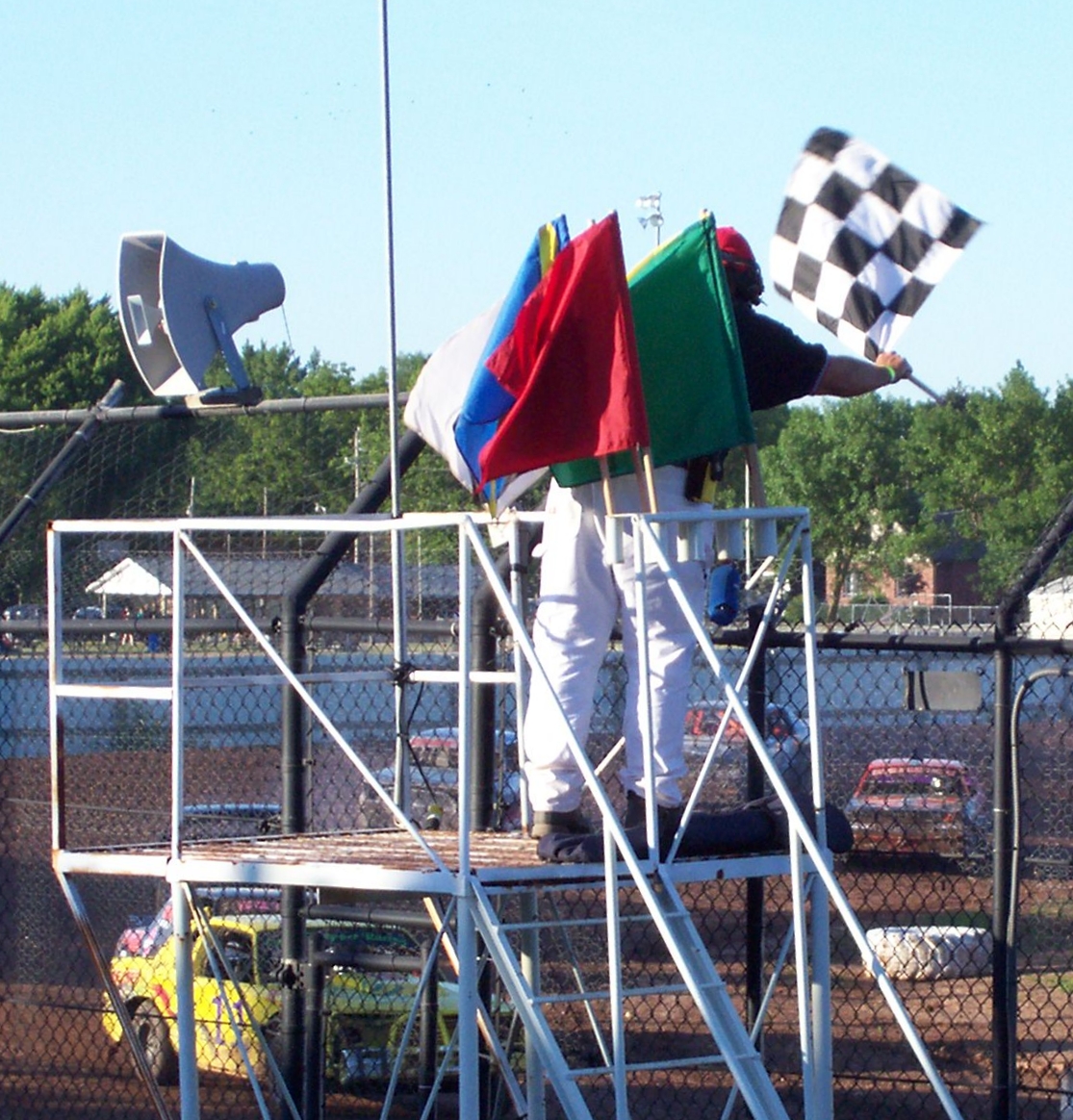
Racing flags are traditionally used in auto racing and similar motorsports to indicate track conditions and to communicate important messages to drivers. Typically, the starter, sometimes the grand marshal of a race, waves the flags atop a flag stand near the start-finish line. Track marshals are also stationed at observation posts along the race track in order to communicate both local and course-wide conditions to drivers. Alternatively, some race tracks employ lights to supplement the primary flag at the start-finish line.
While there is no universal system of racing flags across all of motorsports, most series have standardized them, with some flags carrying over between series. For example, the chequered flag is commonly used across all of motorsport to signify the end of a session (practice, qualifying, or race), while the penalty flags differ from series to series. FIA-sanctioned championship flags are the most commonly used internationally as they cover championships such as Formula 1, the FIA World Endurance Championship and WTCC, and are adopted (and sometimes adapted) by many more motorsport governing bodies across the world such as, for example, the MSA.
Status flags are used to inform all drivers of the general status of the course during a race. In addition, the green, yellow, and red flags described below may be augmented or replaced by lights at various points around the circuit.
The solid green flag is usually displayed by the starter to indicate the start of a race. During a race, it is displayed at the end of a caution period or a temporary delay to indicate that the race is restarting. The waving of a green flag is almost universally supplemented with the illumination of green lights (resembling traffic lights) at various intervals around the course, particularly on ovals.
If the race is not under caution or delayed, it is said to be "under green-flag conditions". However, the flag itself is typically not continuously waved by the starter. No flag displayed at the starter's stand implies safe, green-flag conditions. At all times, however, the green lights remain lit.
The solid yellow flag, or caution flag, universally requires drivers to slow down due to a hazard on the track, typically a crash, a stopped car, debris or light rain. However, the procedures for displaying the yellow flag vary for different racing styles and sanctioning bodies.
In Formula One racing, a yellow flag displayed at the starter's stand or a marshal station indicates that there is a hazard "downstream" of the station. The manner of display depends on the location of the hazard:
When shown at a station, drivers are forbidden from overtaking until either the hazard or the next flag station displaying a green flag (signifying the end of a cautionary section) is passed. This flag is shown at the discretion of the marshals manning the station.
Hub AI
Racing flags AI simulator
(@Racing flags_simulator)
Racing flags
Racing flags are traditionally used in auto racing and similar motorsports to indicate track conditions and to communicate important messages to drivers. Typically, the starter, sometimes the grand marshal of a race, waves the flags atop a flag stand near the start-finish line. Track marshals are also stationed at observation posts along the race track in order to communicate both local and course-wide conditions to drivers. Alternatively, some race tracks employ lights to supplement the primary flag at the start-finish line.
While there is no universal system of racing flags across all of motorsports, most series have standardized them, with some flags carrying over between series. For example, the chequered flag is commonly used across all of motorsport to signify the end of a session (practice, qualifying, or race), while the penalty flags differ from series to series. FIA-sanctioned championship flags are the most commonly used internationally as they cover championships such as Formula 1, the FIA World Endurance Championship and WTCC, and are adopted (and sometimes adapted) by many more motorsport governing bodies across the world such as, for example, the MSA.
Status flags are used to inform all drivers of the general status of the course during a race. In addition, the green, yellow, and red flags described below may be augmented or replaced by lights at various points around the circuit.
The solid green flag is usually displayed by the starter to indicate the start of a race. During a race, it is displayed at the end of a caution period or a temporary delay to indicate that the race is restarting. The waving of a green flag is almost universally supplemented with the illumination of green lights (resembling traffic lights) at various intervals around the course, particularly on ovals.
If the race is not under caution or delayed, it is said to be "under green-flag conditions". However, the flag itself is typically not continuously waved by the starter. No flag displayed at the starter's stand implies safe, green-flag conditions. At all times, however, the green lights remain lit.
The solid yellow flag, or caution flag, universally requires drivers to slow down due to a hazard on the track, typically a crash, a stopped car, debris or light rain. However, the procedures for displaying the yellow flag vary for different racing styles and sanctioning bodies.
In Formula One racing, a yellow flag displayed at the starter's stand or a marshal station indicates that there is a hazard "downstream" of the station. The manner of display depends on the location of the hazard:
When shown at a station, drivers are forbidden from overtaking until either the hazard or the next flag station displaying a green flag (signifying the end of a cautionary section) is passed. This flag is shown at the discretion of the marshals manning the station.
Recent media