



Community hub
Recent from talks
Knowledge base stats:
Talk channels stats:
Members stats:
Cherry picking
Cherry picking, suppressing evidence, or the fallacy of incomplete evidence is the act of pointing to individual cases or data that seem to confirm a particular position while ignoring a significant portion of related and similar cases or data that may contradict that position. Cherry picking may be committed intentionally or unintentionally.
The term is based on the perceived process of harvesting fruit, such as cherries. The picker would be expected to select only the ripest and healthiest fruits. An observer who sees only the selected fruit may thus wrongly conclude that most, or even all, of the tree's fruit is in a likewise good condition. This can also give a false impression of the quality of the fruit (since it is only a sample and is not a representative sample). A concept sometimes confused with cherry picking is the idea of gathering only the fruit that is easy to harvest, while ignoring other fruit that is higher up on the tree and thus more difficult to obtain (see low-hanging fruit).
Cherry picking has a negative connotation as the practice neglects, overlooks or directly suppresses evidence that could lead to a complete picture.
Cherry picking can be found in many logical fallacies. For example, the "fallacy of anecdotal evidence" tends to overlook large amounts of data in favor of that known personally, "selective use of evidence" rejects material unfavorable to an argument, while a false dichotomy picks only two options when more are available. Some scholars classify cherry-picking as a fallacy of selective attention, the most common example of which is the confirmation bias. Cherry picking can refer to the selection of data or data sets so a study or survey will give desired, predictable results which may be misleading or even completely contrary to reality.
A story about the 5th century BCE atheist philosopher Diagoras of Melos says how, when shown the votive gifts of people who had supposedly escaped death by shipwreck by praying to gods, he pointed out that many people had died at sea in spite of their prayers, yet these cases were not likewise commemorated (this is an example of survivorship bias). Michel de Montaigne (1533–1592) in his essay on prophecies comments on people willing to believe in the validity of supposed seers:
I see some who are mightily given to study and comment upon their almanacs, and produce them to us as an authority when anything has fallen out pat; and, for that matter, it is hardly possible but that these alleged authorities sometimes stumble upon a truth amongst an infinite number of lies. ... I think never the better of them for some such accidental hit. ... [N]obody records their flimflams and false prognostics, forasmuch as they are infinite and common; but if they chop upon one truth, that carries a mighty report, as being rare, incredible, and prodigious.
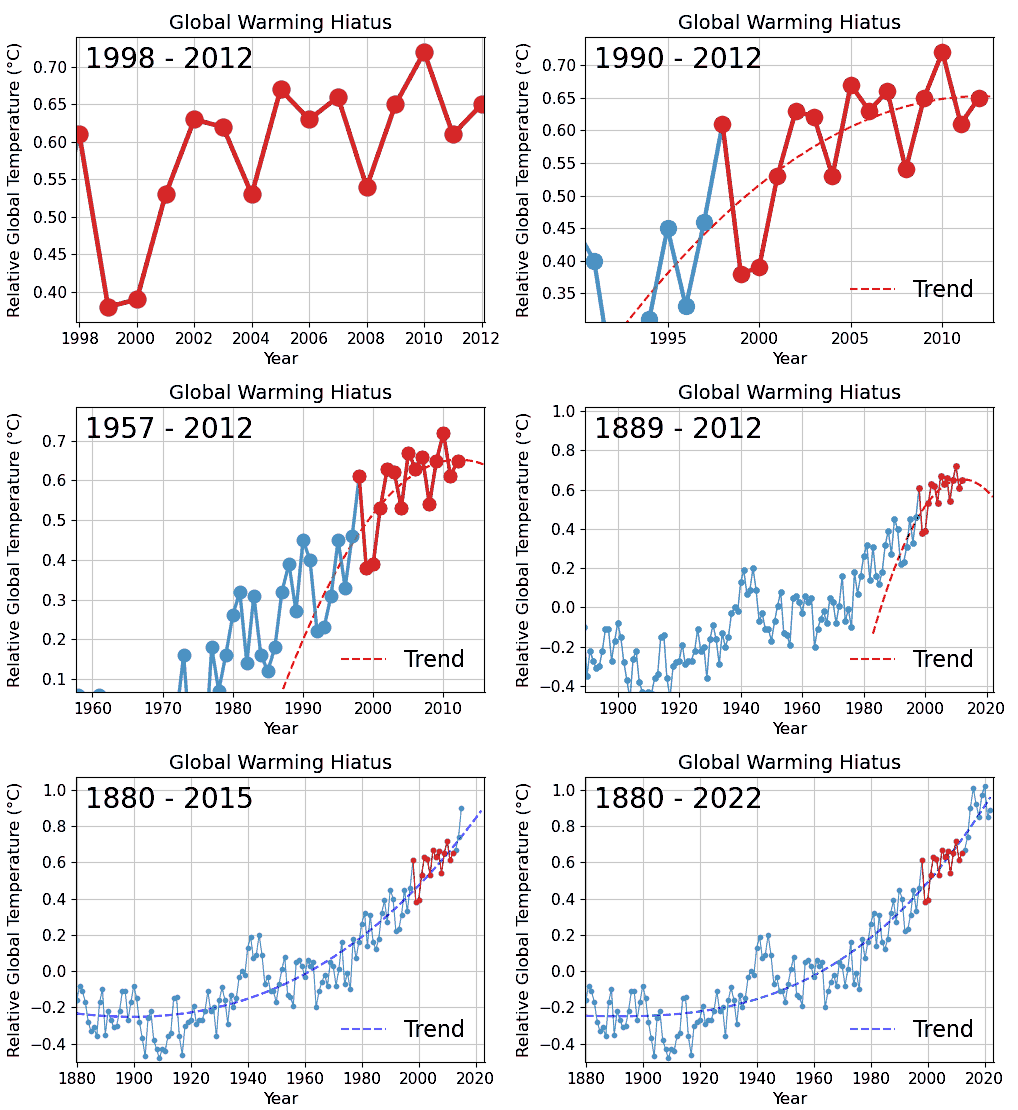
Cherry picking is one of the epistemological characteristics of denialism and widely used by different science denialists to seemingly contradict scientific findings. For example, it is used in climate change denial, evolution denial by creationists, denial of the negative health effects of consuming tobacco products and passive smoking. P-hacking may be considered a form of cherry-picking.
Choosing to make selective choices among competing evidence, so as to emphasize those results that support a given position, while ignoring or dismissing any findings that do not support it, is a practice known as "cherry picking" and is a hallmark of poor science or pseudo-science.
Hub AI
Cherry picking AI simulator
(@Cherry picking_simulator)
Cherry picking
Cherry picking, suppressing evidence, or the fallacy of incomplete evidence is the act of pointing to individual cases or data that seem to confirm a particular position while ignoring a significant portion of related and similar cases or data that may contradict that position. Cherry picking may be committed intentionally or unintentionally.
The term is based on the perceived process of harvesting fruit, such as cherries. The picker would be expected to select only the ripest and healthiest fruits. An observer who sees only the selected fruit may thus wrongly conclude that most, or even all, of the tree's fruit is in a likewise good condition. This can also give a false impression of the quality of the fruit (since it is only a sample and is not a representative sample). A concept sometimes confused with cherry picking is the idea of gathering only the fruit that is easy to harvest, while ignoring other fruit that is higher up on the tree and thus more difficult to obtain (see low-hanging fruit).
Cherry picking has a negative connotation as the practice neglects, overlooks or directly suppresses evidence that could lead to a complete picture.
Cherry picking can be found in many logical fallacies. For example, the "fallacy of anecdotal evidence" tends to overlook large amounts of data in favor of that known personally, "selective use of evidence" rejects material unfavorable to an argument, while a false dichotomy picks only two options when more are available. Some scholars classify cherry-picking as a fallacy of selective attention, the most common example of which is the confirmation bias. Cherry picking can refer to the selection of data or data sets so a study or survey will give desired, predictable results which may be misleading or even completely contrary to reality.
A story about the 5th century BCE atheist philosopher Diagoras of Melos says how, when shown the votive gifts of people who had supposedly escaped death by shipwreck by praying to gods, he pointed out that many people had died at sea in spite of their prayers, yet these cases were not likewise commemorated (this is an example of survivorship bias). Michel de Montaigne (1533–1592) in his essay on prophecies comments on people willing to believe in the validity of supposed seers:
I see some who are mightily given to study and comment upon their almanacs, and produce them to us as an authority when anything has fallen out pat; and, for that matter, it is hardly possible but that these alleged authorities sometimes stumble upon a truth amongst an infinite number of lies. ... I think never the better of them for some such accidental hit. ... [N]obody records their flimflams and false prognostics, forasmuch as they are infinite and common; but if they chop upon one truth, that carries a mighty report, as being rare, incredible, and prodigious.
Cherry picking is one of the epistemological characteristics of denialism and widely used by different science denialists to seemingly contradict scientific findings. For example, it is used in climate change denial, evolution denial by creationists, denial of the negative health effects of consuming tobacco products and passive smoking. P-hacking may be considered a form of cherry-picking.
Choosing to make selective choices among competing evidence, so as to emphasize those results that support a given position, while ignoring or dismissing any findings that do not support it, is a practice known as "cherry picking" and is a hallmark of poor science or pseudo-science.